Branding, Bravery and Breaking Through with Melissa Vela-Williamson - Episode 308
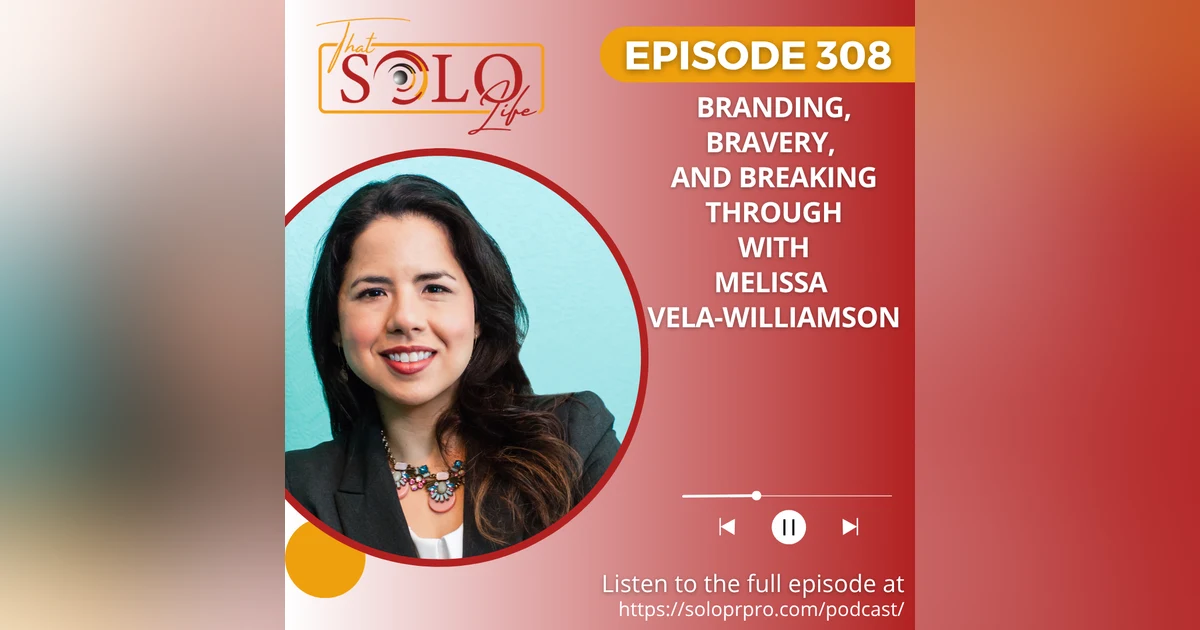


That Solo Life, Episode 308: Branding, Bravery and Breaking Through with Melissa Vela-Williamson Episode Summary:
Tune in to this powerful episode of That Solo Life featuring Melissa Vela-Williamson, APR, Fellow PRSA, CDP, an accomplished PR strategist, author, and advocate for inclusivity in communication. Hosts Karen Swim, APR, and Michelle Kane sit down for an intimate chat with Melissa, discussing her inspiring career and successful personal brand. Melissa shares why it is so important to be a little louder and how that benefits your career and lights the way for the next generation. Melissa does not hold back in sharing her challenges on the road to success and how she solves for fear and the expectations of others. Grab a group and listen to this episode together!
Guests:
- Melissa Vela-Williamson, APR, Fellow PRSA, CDP, Founder of MVW Communications, Author, and Speaker
Key Topics Covered:
- [00:02:30] Melissa’s PR career path and her inspiration for writing two books.
- [00:07:10] The importance of self-promotion and building a personal brand as a solo PR pro.
- [00:13:45] Overcoming imposter syndrome to gain confidence and attract the right clients.
- [00:20:40] Using storytelling and cultural intelligence (CQ) to connect on a deeper level.
- [00:29:15] Applying PR strategies to amplify diversity and inclusivity in the industry.
- [00:38:00] Melissa’s advice for staying consistent and authentic in your solo practice.
About Melissa Vela-Williamson, APR, Fellow PRSA, CDP:
Melissa Vela-Williamson is an accredited, internationally recognized public relations strategist, national industry columnist, podcast host, and author. For over two decades, she has provided strategic public relations counsel, professional communication services, and shared leadership guidance with over 100 brands -- educating, equipping, and empowering diverse audiences ranging from children to CEOs. Melissa serves as a consultant, trainer, and account director at her boutique PR firm, MVW Communications. With unique experience in employee communications and DEI, Melissa leverages her PR expertise and acumen as a certified diversity professional to create social good. She represents only 750 PR professionals nationwide who have earned the elite PRSA College of Fellows credential. Her first book, “Smart Talk: Public Relations Essentials All Pros Should Know” was published Oct. 2022 and is an Amazon Bestseller. Her second industry book, “Latinas in Public Relations: Shaping Communications, Communities, and Culture” was published during Women's History Month 2025 and quickly became an Amazon Bestseller in three categories. She shares communication insights and advice through her podcast, “Smart Talk Series”, her Public Relations Society of America column, and through her blog at mvw360.com.
Resources Mentioned:
- Visit Melissa’s website, MVW360.com, for more on her books, services, and resources.
- Get Melissa’s books: Smart Talk: Public Relations Essentials All Pros Should Know and Latinas in Public Relations: Shaping Communications, Communities, and Culture.”
- Connect with Melissa on LinkedIn at Melissa Vela-Williamson.
Call to Action:
Don't miss an episode of That Solo Life! Subscribe on your favorite podcast platform to stay updated. If you enjoyed this episode, leave a review and share it with your solo PR network. For more resources and insights, join the Solo PR Pro community at our website. Your next level in solo PR starts here!
Transcribing live conversations can be tricky so please be forgiving of any typos or errors that you find. Love something here and want to share? Great, please read the notes at the end. Enjoy!
Michelle Kane (00:18):
Thank you for joining us for this episode of That Solo Life, the podcast for PR pros and marketers who work for themselves, people like me, Michelle Kane, with Voice Matters, and my wonderful co-host, Karen Swim of Solo PR Pro, and we are so excited. It's a guest day. Yay. Yay. We're so happy to be joined by Melissa Vela Williamson. She is the founder of MVW Communications and also an author of two books, Smart Talk and Latinas in Public Relations. Thanks for joining us today, Melissa. We're so excited to have you here.
Melissa Vela-Williamson, APR, Fellow PRSA, CDP (00:54):
Oh, I'm thrilled. Michelle and Karen, I heard the intro music going. I'm like, Ooh, the heart started pounding. So I'm excited to talk with you.
Karen Swim, APR (01:02):
We're so excited to have you here. And Smart Talk is so aptly named because you are so smart, and our listeners are in for a treat today as you take us a little bit behind the curtain to the secrets to your success.
Michelle Kane (01:20):
Yeah, definitely.
Melissa Vela-Williamson, APR, Fellow PRSA, CDP (01:21):
Wonderful. Well, thank you, and I'm excited to be here and talk with you and especially to give a little love and insights to our solo community, our solo PR Pro community. Being a member myself, since I really started my individual practitioner journey almost 10 years ago, we're like two weeks away. It's incredible. A whole decade flew by, but it's been so supportive, a place of encouragement, a place of really helpful resources like templates and advice and webinars, and of course the podcast that I listened to. I heard about Media Under the Influence just this morning, Karen and Michelle. So we appreciate what you do and I'm happy to share and talk a little bit about some of the necessary work we need to do as solos, which is around self-promotion, which we are going to talk about today.
Michelle Kane (02:10):
Yeah, yeah, actually, and you are an expert in personal branding, and you are certainly leading by example. We know this. This is almost like a no-brainer, but I don't think we think about this enough. Why do you think that self-promotion is so important for us as solos?
Melissa Vela-Williamson, APR, Fellow PRSA, CDP (02:29):
Yeah. Well, a variety of reasons. For a variety of reasons. Self-promotion is vital to what we do as solos. One, because no one cares about your business and frankly, you as much as you need to, right? So I've learned this both personally and professionally throughout my life, but particularly as a business owner, if I wasn't offering my services, if I wasn't telling my story and my expertise, my experience and point of view on public relations and strategic communications, no one else was a going to, or B, if they did try, it may not be in the narrative. It may not be the script I would advise them to use and also my energy and passion around it, it's not communicated the same way through anyone else. So I learned through really being essentialist is that I need to keep my business going. I need to keep prospects interested.
(03:24):
And particularly during COVID in 2020, when everything was shut down and it was quite apparent I could not go to the same industry events and luncheons, I couldn't organically be next to someone who could be my next project lead, my next client. I needed to find a way to be in places I literally couldn't be, which was really optimizing my online presence and sharing my story in non-icky ways that would resonate with people and really help, particularly in a time when the helpers stood out as good and valuable. So, a timeless art of public relations and a principle is that we are to be advisors, true tellers, and helpers. And so I wanted to use public relations for good, in particular in 2020, but that's also when I shot up in terms of my professional brand because I was really using a lot of content to help other people.
Karen Swim, APR (04:20):
I love that. And you really hit on something that I think people shy away from in public relations. We are the behind-the-scenes makers and doers, problem solvers, and we are uncomfortable being in the spotlight because we look at it the wrong way. But you have a different way of looking at that, and you talk about not being icky and not being salesy. So tell us how we can overcome that and your perspective on what it really means to promote yourself.
Melissa Vela-Williamson, APR, Fellow PRSA, CDP (04:53):
It's so funny. As PR professionals, we know so many of these strategies and tactics, right? Karen, we know we should be telling our story. We know we should be getting on podcast interviews like this one, we should be going out to events and making strategic networking alliances, and whatnot. It's just still really awkward and uncomfortable to do. And I think accepting the fact that, look, promotion of any kind when it's about your business or yourself does feel self-promotional. One accepting that will give you allowance for some grace for yourself is I feel the feeling, and I'm going to do it anyway because it's really important. I can't help others. I can't help the causes I believe in. I can't support the clients I want to back and support through tough times, particularly this decade has not been easy for anybody, really. I can't help others if they don't know about me, or if they don't trust me, or if they don't understand that I have something to offer.
(05:57):
So sometimes putting ourselves and thinking of ourselves in third person, we are the client. That's a helpful strategy because sales really is a very natural and organic part of public relations. A lot of our work is about building influence. We don't have direct lines and really, we don't control a lot of aspects of our work. We influence it because we are the resource, or we become resourceful in what we do, and providing that builds trust. So sales, being able to pitch an idea, pitch yourself, pitch an angle, pitch a media story, it's very natural to our work. We just kind of need to turn that on ourselves to benefit what we're trying to do professionally. Self-promotion is vitally important in particular for women and women of color. There's some research that shows that we really need to push ourselves a little bit more because maybe we're growing up in a collectivist culture like mine in the Hispanic and Latino cultures here in the US, where we are not told, Hey, to be a leader, you need to be a little bit louder.
(07:04):
In fact, some of the messages we get or to be quieter, when I was putting together the Latinas and public relations anthology that featured my story, plus 14 other Latina working leader level pros in the industry across the us and some of them were first in the country, first in the profession, first like me, to graduate from university and being the first is one very uncomfortable. And two, when you do, it feels a little self-promotional when you're telling people your achievements. But actually, the research shows that to be seen as leaders, you have to take your credit, give yourself credit, make sure people know what you have to offer, and what you have achieved. And so I find that earning the credentials gives me confidence, but I have to push myself to share. Yes, I'm an APR, I'm a fellow PRSA, I'm a columnist, I'm an author. All of that makes me want to hide, but I use the strategies I would give a client to say, it's really important you do that because it builds trust around your brand and that's going to help your team. I do that for myself, and I encourage us solos to do that for ourselves.
Michelle Kane (08:12):
Oh my goodness, that is so true. When you say all the things out loud, I know oftentimes I think all the things we all do, and I go, I do. Oh my God. But it's so incredible, and it is so true. Every word you say. So how has your personal branding shaped the work that you do with your clients, either along the way or how has that journey unfolded?
Melissa Vela-Williamson, APR, Fellow PRSA, CDP (08:39):
We can't really separate who we are as people from our professional brand. And I think as PR strategists, advisors, and counselors, sometimes we see the negative parts of that. Our bad behaviors off duty can infiltrate our personal and our professional brands during the day. We've seen some of that. We see it every day, right in the opposite way, in a proactive, optimistic way. When I feel more comfortable in my skin, I'm better at the work I do. So I do a lot of self-work so that I do feel comfortable with myself as Melissa Vela Williamson. I mean, even my last name's kind of a mouthful. So there's a lot of self-work I've done. If my personal backstory, people may not know I lost a hundred pounds in my freshman year of college because I had grown up as an overweight child, and that made me feel invisible and yet very visible in ways I did not want to feel.
(09:40):
And I had thank goodness, the insight as a college freshman to say, I don't think I can achieve what I want professionally in this shape. And that was my journey, that's my experience. But if there's something that holds anyone back from feeling confident, maybe they didn't have a PR major, so what I did not either. So I've learned everything on the ground, and now I'm making sure that I package that up, document it so I can better teach it. And let's be frank, as I get older, remember all my insights and scale that mentoring I wish I had as a young person, but I also worked really hard to get my credentials through a PR, so that I felt like I knew what I was talking about and I could validate that externally from another source. So again, some of these strategies you'll see they kind of infiltrate and intersect and that's okay.
(10:31):
I think as a whole person, we need to acknowledge that sometimes we do get in our own way and we have to push ourselves. I brought a little prop, Michelle and Karen. I don't know if you can see it, but it's for anyone else. It would look like my monogram, right? It's MVW, but it's literally like my logo. And as a starting solo, when I started the business, I named my boutique firm MVW communications because I wanted to be strategic in that, well, really I am the brand in a lot of ways, and I wanted to make sure that people knew that it was going to be my point of view and my brain and hands would touch all the work in some ways because I had built equity around my professional name, our reputations are everything, and so we really need to invest in them and protect them. But I also didn't want to seem, maybe I'm from the southern area of the US, but too big for my britches, and I wasn't coming out with a big company name because I wasn't going to have big company overhead, and I didn't want to. So I named my company MVW after myself, easy to remember. But also I ended up making this little monogram necklace on Etsy like super grassroots and easy so that I would push myself to talk about my business when I went into certain places and spaces love it because I would find, I'd say, oh yes, I'm a PR strategist that didn't necessarily let anyone know that I was available to help them as a solopreneur or as a business owner. Right. That's
Michelle Kane (12:03):
Fantastic.
Karen Swim, APR (12:05):
You said something so profound, and I just want to spend a moment. You talked about being comfortable in your skin, and I want to encourage solos that this is so critical. We talk a lot about imposter syndrome and all of those things, and imposter syndrome is something that you probably will deal with for a good part of your career, and you just have to speak to it and push through it. But being comfortable in who you are is so important to even attracting clients because if you can't be confident in who you are and the gifts that you bring to the world, the services that you offer, how do you expect your clients to trust you? I promise you that big brands do not put out products that they don't think that you will love and that you will buy, and you are a service.
(12:56):
You're offering something to the free market. And so you have to have that belief in yourself, and order for others to believe in you. And you saying that is, I believe, the reason why so many solos and micro agencies don't charge enough money for their services, because there's that little tiny bit of doubt that I'm not good enough. I'm not big enough, I am just a solo. I don't know enough, and it's not true. And if you can't deal with those underlying issues, it's going to hold you back in so many ways. And not only attracting clients, but doing the work with confidence because we have so much to offer to get a seat at the table, you have to believe that you deserve that seat at the table.
Melissa Vela-Williamson, APR, Fellow PRSA, CDP (13:45):
Absolutely, absolutely. And to your point, Karen, if you don't feel confident, then work to get there, right? A lot of times, I will tell people, I call it smart talk, which is having real conversations of substance that'll help people make some good changes, even myself, because sometimes when I verbally walk through something, I got there with you on that path. But for a lot of us, if you are the first to be a business owner or do this kind of work versus in your family or in your circle or your network, it's a lonely walk, and you can have moments of doubt. It is very natural as a human to do that much more. So again, if you come from an adverse background, but I think that part of it is earning different credentials, applying for awards, achieving them, earning them, and sharing about them, celebrating yourself and letting people celebrate you.
(14:40):
That will help. But I think we want to be more brave than feel like we are confident because confidence is not necessarily an end state. And I think the act of sharing your story helps people relate to you. We know as PR and communicators that stories are sticky, right? People don't really always believe numbers and data. We certainly have a hard time retaining it, but we remember a good story, and we connect with people through stories. So just sharing a little bit about ourselves, like me sharing that I lost a hundred pounds, you'll probably be like, oh my God, I need to ask you more about that. Let's talk about that one day. But I do that. It's vulnerable for me, but I do that because it shows, look, I've overcome something. I'm not perfect. What you see now has been curated and worked on, and it is a work in progress, and that's what I want to promote, right, is the human part, but also the achievements. Because if I'm nothing but a hot mess, human, vulnerable person online, then you're not going to trust me when you have something really hard to work through communication wise. So it is a strategic, I think, placement of story, time, place, space, person, but it's something that I think we just need to be more thoughtful about.
(15:56):
Yeah,
Karen Swim, APR (15:56):
It's opening up and getting people to know you without vomiting all of your entire life on social media. And I do think that that's a balance, and it's not a lie. It's the same advice that we would give clients. It doesn't mean I know that there was pushback years ago against the term transparency because, as a brand, you can't be transparent about absolutely everything that happens in your business; that wouldn't be smart.
Michelle Kane (16:25):
But
Karen Swim, APR (16:25):
There are ways that you can let people in so that they see who you are as a person, as a company, so that you can share the things that let them see, like, oh, there's real people behind this. But also, as you said, sharing the accomplishments and achievements. That's also opening up to them and being comfortable in talking about those things and sharing why you have the ability to help people to solve the specific problems that you solve.
Michelle Kane (16:58):
So true, so true. And a lot of it it is that fine line because we certainly don't owe everyone every little fact about us, but those things that can help others get to know us better and learn, just know that we're credible professionals, it's huge. And I would say, I'm going to guess that that may be partly what drove you to write your books. I mean, because it's such valuable content to have out there. I'll hawk the titles again, I have them Smart Talk and Latinas in Public Relations, fabulous, fabulous.
Melissa Vela-Williamson, APR, Fellow PRSA, CDP (17:38):
Yeah. I'll tell you the origin stories because again, I think they are relatable and they're not insurmountable, right? Writing a book, even now, I'm like, I can't believe I wrote a book. It blows my mind. But it was little by little, day by day, small little turtle steps, and then I was there. So, in particular, I would say my solo book, my first book, Smart Talk, Public Relations Essentials, All Pros Should Know was a calling that came to me in 2020, and it was not what I was expecting to receive. The quick story about that is I was in church after everything had been shut down, and my kids begged me to take them to church because they were a kindergartner and a fifth grader who went on spring break and never got to go back. It was devastating to them. It was devastating to me.
(18:29):
I had never used Zoom. We didn't have a video platform on this desktop, all of it. What a paradigm shift for everyone. But by that time, it was like April May, and it felt like I needed to take a strategic risk for the wellbeing of my children, their emotional wellbeing, to just, let's get out, let's mask up. Let's do this as safely as we can. But you do need to see other kids your age to feel a little more normal, a little more grounded. And then of course, if your kids ask you to go to church, you should probably go to church, went to church. But as a PR leader, as someone who was running this boutique firm who had team members, who had clients that were all of a sudden serving the most vulnerable populations on earth, I was serving Meals on Wheels in our community, and we had to pivot and turn everything upside down about how they operated, how we communicated, how volunteers could participate, like everything, right?
(19:25):
Crisis comms, like 4,500. Yeah, I went to church. I said, I'm going to sit in this lobby away from everyone, in the auditorium, so that I don't get sick. And I had a moment to pray, and I was literally asking for some energy mojo, optimism. Could you help me with the right words? God, I'm not sure how to say. All that needs to be said to really convince people to keep doing what's most vital in the work that we do in my clients' needs. And I heard different phrases come down. If you are a little bit of a creative writer or if you get a muse every now and then of great words or phrases to use, or maybe you hear music or whatnot, I hear words sometimes, and I started hearing words and I just opened up my notes app because maybe this could be part of a good press release or a social media message.
(20:20):
Every word really mattered so much during the height of COVID. So I started taking down the notes, and when I looked down and I scrolled up and down, what had I written? It was just little phrases that I'm like, this is a table of contents. This is a book. I was actually quite frustrated because I'm like, I don't really need another project right now. God, I have enough on my plate right now, I'm barely surviving now in all kinds of ways, but I felt called to document, to write down my directions, my insights, all the lessons I learned, the embarrassing way, the hard way, what to do with media and how to treat journalists and what not to do with media relations and what is strategic comms planning. And my goodness, if you're going to go after your PR goals versus objectives, how to understand all that, I just felt really, really called to just document it, write it down, pay it forward in case something happened to me during COVID, and at least if nothing else, my kids can learn about my journey and pick up and be a part of the profession in case that's calling for them in the future, because I do believe PR is for everyone.
(21:32):
I'd also have research in the Smart Talk book and definitely in the Latinas in PR book. What fueled me was I kept running into circumstances and research that showed that people of color, and particularly women of color and Latinas, while we may be a good percentage of populations or communities, we are not an equal representation in the public relations industry, in which I feel like in some ways is unnatural because we are so wired for community and caring and sharing, but there's something about confidence and there's something about wanting to be invited into an industry we're not already represented in that needed to happen. So I just said, well, why not me? Why not? Now? Nothing's guaranteed. Let's just go for it and let me just share, and if I can help one person, great. And I think that we tell our clients that a lot about public speaking, but it's the same thing with content creation.
(22:31):
That is the way we can help others without being salesy, but they can see our point of view. They can understand, is this person a good writer? Do they seem smart? Do they have something to offer? That seems like what I need right now. They can tell by what we produce, and that can help our brand. So as an outcome, yes, writing books has helped my business because it helps people believe that maybe I know a little bit about content creation, maybe I know a little bit about marketing and promotion, or at least I can do hard things. So either way, right? Communication wise for sure. I love that contributing and engaging is so helpful.
Karen Swim, APR (23:15):
I love everything that you're doing, and I love that my pastor does this halftime huddle every year when we get to, and it's just individual meetings, to go through the top five areas of your life and rating your stressors and really going through and helping you to plan for how to hit your goals and where you're headed. And I was really encouraged and got a little bit of a nudge to do some things, and I could hear your voice talking about be brave, but I love that you heard the calling and acted, and I think many solos, you don't have to keep doing the same thing in the same way, if you are hearing that call to do something that seems wild and different and maybe you don't even have experience, the one thing that I know about you solos in this audience is that you know how to learn how to figure it out.
(24:09):
That is PR people. Nothing should throw us. We are masters at this. So when it comes to your own life and your professional career, your brand, or just your passion, don't be afraid to do that thing that seems to be just nudging at you. It keeps talking to you. Don't ignore it. Go for it because Melissa has shown us that this can become a whole new avenue for you. I mean, you heard that calling and you didn't know where it was going. I'm sure that you could never have imagined that one turned into two, and I'm sure there's more coming, and that it would just open up so many doors for you that was unexpected. You just said, I got to write this down. I got to do what I'm hearing that I'm supposed to do. And that's, thank you for doing that, and thank you for sharing that with all of us.
Michelle Kane (25:04):
Definitely.
Karen Swim, APR (25:05):
It is definitely an inspiration.
Michelle Kane (25:08):
Yeah. Sorry, go ahead.
Melissa Vela-Williamson, APR, Fellow PRSA, CDP (25:11):
Well, I was going to say around the self-promotional piece, so in the Latinas and pr, what I was finding was particularly this segment, right? Latinas are the fastest-growing women segment in the us,
(25:24):
But again, the representation in public relations is about six, 7%, and then half that are at the leadership level. And there's no good reason for that, right? I feel like yes, there are systemic challenges and societal challenges, but sometimes it's the culture that we were brought up in that is holding us back. And as adults, we can make a conscious choice to reject parts of our identity that no longer benefit us, fit us. It's not what we need to do to take care of ourselves and take care of our family. And so the research actually showed around women in particular is, if you can think of doing it for her, young women are particularly inspired by our elders, like someone like me now, our stories and how we got there,
(26:11):
But then the elders are less likely to tell their stories. So don't let people pressure you into these little tight corners of, or be humble and blah, blah, blah. It's like I'm in public relations. My job is to build relationships with people. I can't do that if I'm not speaking to them and with 'em. So I think if you come to it with a place of contribution and care and gentle curiosity and you're just consistent with it, right? An offering is great. You don't see in a lot of my content me selling you. It's at least a 90/10 split of 90% of advice and encouragement and support and thought leadership. And then a little bit, I'll say, yeah, by the way, we do planning. And by the way, if you need this or that, right?
Michelle Kane (26:57):
Exactly.
Melissa Vela-Williamson, APR, Fellow PRSA, CDP (26:57):
Just so that people know what you offer, because sometimes they're too shy or uncomfortable with themselves to even
Michelle Kane (27:02):
Ask. So true. The word that's swirling around my head is trust. We have to trust ourselves. We have to trust our instincts. We have to trust our capabilities to just do what we are meant to do. And that goes both for solos and our clients.
Karen Swim, APR (27:23):
And we of course are going to have links to your books and everything in our show notes. But I just want to pause here and just ask our audience to listen to this episode. Share it widely. Grab your books, grab Latinas in PR You don't have to be a Latina, but I feel like this disconnect of having not enough representation and sit with those statistics for a moment, only six to 7%, this is a disconnect that persists across lots of industries, and it's not on the Latinas or the people of color or the women to solve it on their own. This is something that we should all fill. Why does the C-suite, why does leadership, why do industries not reflect the buying public? We're talking about people that represent your audience, that purchases subjects that are not represented. So how are we really serving our audiences?
(28:30):
And as public relations professionals, we have that dual goal of serving our publics, and our publics include our clients and their audiences. So I think that we have to fill that burden as a whole where we are making sure that we are entering spaces that invite these people, that we're creating not just a safe space, but a space where we can mentor and educate and inspire people to be a part of this profession regardless of their gender or their color. And that we're intentionally because it does take intentionality, seeking out diverse groups, people that are different from us, and bringing this message that is our jobs, all of us collectively. And so I want you to be inspired by what Melissa is saying and doing, and help us to connect those dots and to be a leader in that area as well.
Melissa Vela-Williamson, APR, Fellow PRSA, CDP (29:27):
Hundred percent.
(29:27):
Thank you, Karen. And I just want to, again, give honor to the fact that it takes time for change, and the reality, I like to give a lot of grace around how I approach DE. I am a certified diversity professional. I like to integrate DEI principles with public relation principles because they're both people first strategies, and they're both for the long haul, long game, long win. And the reality is, it's kind of a twofold situation. One is if you are the representation, right? I may be the representation in certain rooms or places. What I have found is that I just need to be braver and bolder and raise my own hand and not wait to be invited. No one asked me to write books. No one asked me to start a podcast. No one invited me to the PRSA column that I write and have written for two years, two plus years now. I pitched myself I raised my own hand because I realized I'm not seeing the representation and diversity of thought and backgrounds that I'd like to,
(30:30):
And I'm going to offer a solution, not just point out a problem. So I think we can use our problem-solving skills and creative bents as pros to help close some of these gaps. And then two, when you're in that space, then you need to encourage and invite others in because they may not be as brave as you. They may not be as confident as you, and you need to encourage them to give it a try. Like you said, Michelle, we can figure things out. I learned because I came from a lower-income family and situation, my mom always taught me, look, I may not have money for this or that, but maybe I know someone who can help you. And that's my PR strategy is I've always said, look, I'm not a graphic designer. I'm not bilingual in Spanish, even though there's an expectation I should be or shouldn't be. That's a whole other unfair expectation that holds Latinas back, part of the Latina book. But it's not my job to know and be an expert in every part of communication, but I know someone or I'll find a way to make it work. And I think that resourcefulness can help everyone. So I think part of it is pushing yourself, encouraging others, and being resourceful to kind of close gaps.
Michelle Kane (31:43):
Truer words, never spoken. This has been incredible, Melissa. We're so glad you're here. How can people connect with you? Where's the best place online for people to find you?
Melissa Vela-Williamson, APR, Fellow PRSA, CDP (31:53):
Yes. And so I'll leave My last promotional tip for solos is that your website is your house, take care of your foundation and your house. So let's start@nvwthreesixty.com. That's a link to my firm, me, about me, the books, the podcast, all the resources I have for the community. And of course, Melissa Vela Williamson on LinkedIn. LinkedIn is my safe place to really talk about business, and that's what I love to do with solos.
Karen Swim, APR (32:21):
You are fantastic. I cannot wait to publish this episode and share it with everyone. Oh my gosh. You're a force of nature, girl. And I want to personally thank you for just all of the insights that you've shared and the work that you've done. And for paving the way. I don't think that you realize that you're not just paving the way for the younger generation, but for seasoned pros like myself, you are inspiring us to. You've inspired me to take on some new things and to be braver, to be bolder, and to show up. And I am so grateful for that and so grateful for your knowledge. Thank you.
Melissa Vela-Williamson, APR, Fellow PRSA, CDP (32:58):
Thank you. Well, Karen, for real, Melissa, thank you, Michelle. Karen, you're like, I think of you as, you're so maternal. You're like our mama bear and solo. Michelle's like our cool auntie, and I'll take all of it. It takes a village, and I'm still being raised
Karen Swim, APR (33:17):
As women.
Melissa Vela-Williamson, APR, Fellow PRSA, CDP (33:18):
I'll take all of
Karen Swim, APR (33:19):
It. It does take a village, doesn't it? And I'm so happy for the village of Solo PR Pro.
Michelle Kane (33:26):
So, so true. So true. Well, you're like my cool sister, Melissa. I love this.
Melissa Vela-Williamson, APR, Fellow PRSA, CDP (33:30):
Nice.
Michelle Kane (33:31):
Well, we thank everyone for listening to this episode, and if you don't share this around, I don't even know. But we thank you for joining us today, and until next time, thank you for listening to that solo Life.
We ask that you honor the following if you want to use the transcripts for this or any episode.
You are more than welcome to share the transcript (up to 500 words) in media articles (e.g., PR News, O’Dwyers), on your personal website, in a non-commercial article or blog post (e.g., Substack), and/or on a personal social media account for non-commercial purposes, provided that you include attribution to “That Solo Life” and link back to the soloprpro/podcast URL. For the sake of clarity, media outlets with advertising models are permitted to use excerpts from the transcript per the above.
But please note that no one is authorized to copy any portion of the podcast content or use That Solo Life’s name, image or likeness for any commercial purpose or use, including without limitation inclusion in any books, e-books, book summaries or synopses, or on a commercial website or social media site (e.g., Facebook, X, Instagram, etc.) that offers or promotes your or another’s products or services.
Got questions? Email us at info@soloprpro.com.