Ethical and Legal Challenges of the Modern PR Pro
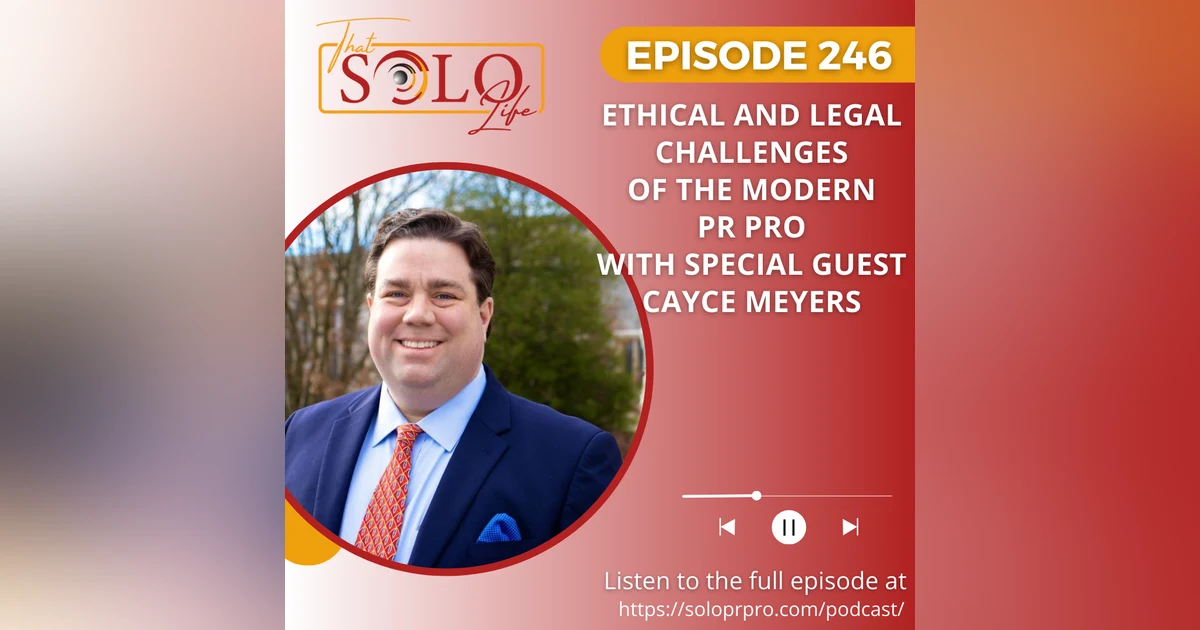
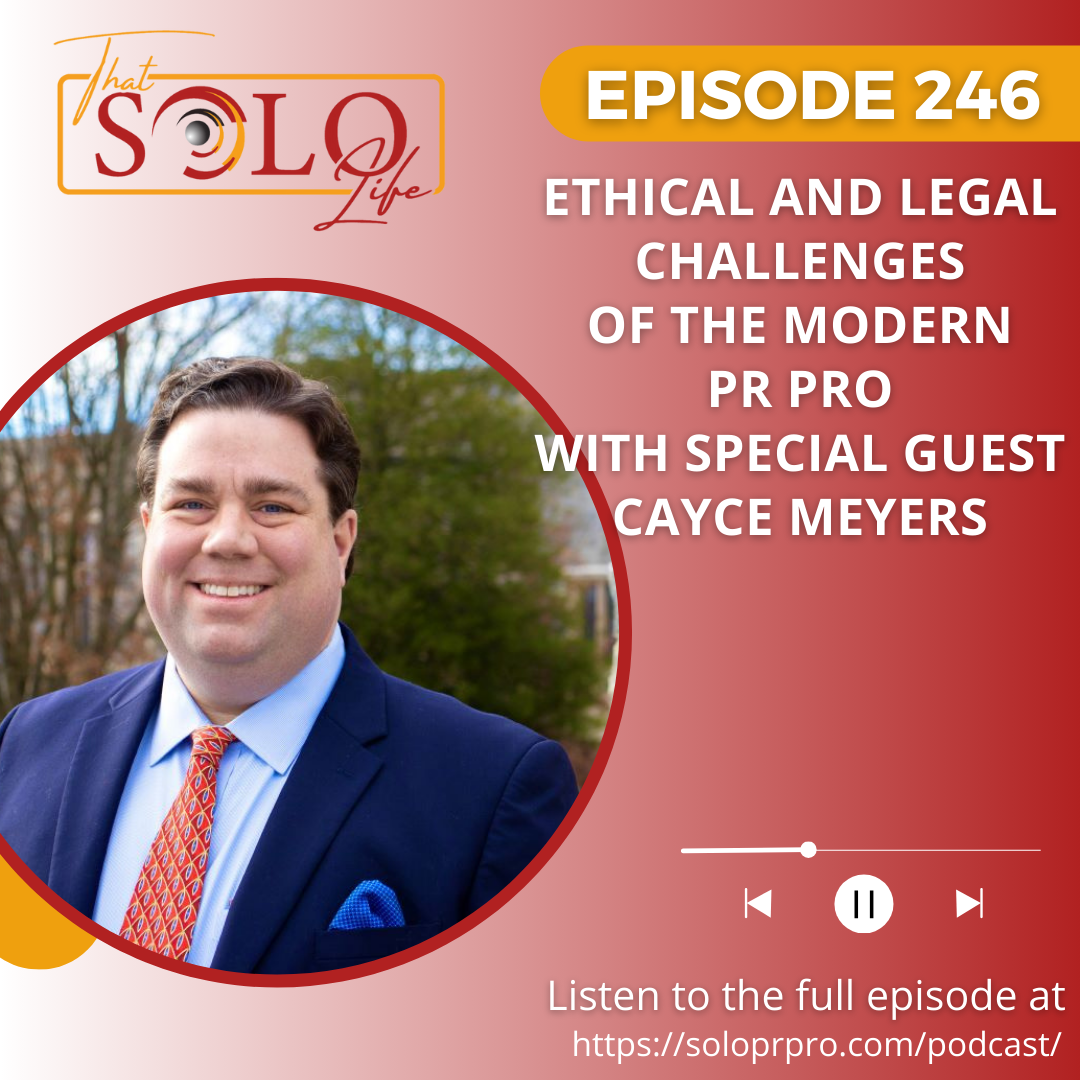
Discussing ethical and legal challenges for public relations professionals with Cayce Myers, Ph.D., LL.M., J.D., APR, an experienced PR professional, author and professor.


That Solo Life: Episode 246 Ethical and Legal Challenges of the Modern PR Pro with Special Guest, Cayce Myers
New episodes every Monday
In this Episode"That Solo Life" podcast hosts Karen Swim, APR and Michelle Kane sit down with Cayce Myers, Ph.D., LL.M., J.D., APR, an experienced public relations professional and author. In this episode, Myers discusses his latest book, "The Rules of Public Relations, Legal and Ethical Issues and Contemporary Practice," which tackles the intersection of public relations, law, and ethics.
Myers emphasizes the importance of understanding the legal implications of PR crises and the need for transparency when using artificial intelligence (AI) in PR. He stresses that PR professionals have a responsibility to navigate the challenges of disinformation and misinformation during election years. Brands are advised to align their communication strategies with their mission, vision, and values.
Throughout the episode, Myers draws from his extensive experience in the field to offer valuable insights into the ever-changing landscape of PR.
Whether you're a seasoned PR professional or just starting out in the industry, this episode is packed with practical advice and thought-provoking conversations about the legal and ethical challenges surrounding public relations. Don’t miss out on this fascinating discussion!
Cayce Myers, Ph.D., LL.M., J.D., APRCayce Myers is a professor of public relations and director of graduate studies at the School of Communication at Virginia, where he researches and teaches about the legal, regulatory, and ethical aspects of public relations. As a lawyer who also holds a Ph.D. in mass communication, Myers has authored five books and sixty publications including peer-reviewed articles, book chapters, law review articles, and trade press pieces, covering topics such as public relations history, strategy, political campaigns, and related laws and policies. His newest publication, "The Rules of Public Relations," delves into the current laws and ethical challenges in the field of PR practice. The release is scheduled for this July.
Episode Highlights:- [01:58] Risk and reputation. Lawyers and communicators view crises through a different lens, but do not have to be in opposition.
- [06:37] Oh my AI. The murkiness of AI and what PR pros need to navigate this new technology.
- [11:27] I’ll just wait it out. PR Pros are reluctant to use AI, fearing it could create issues.
- [14:29] Embracing the future. The bright future of PR and what companies need to know when they hire younger workers.
- [18:56] The politics of it all. Elections, elections all over the globe and the impact on PR pros in 2024.
Resources:
- The Rules of Public Relations: Legal and Ethical Issues in Contemporary Practice (Publisher) (Use RLFANDF25 to save 25% off print book )
- The Rules of Public Relations: Legal and Ethical Issues in Contemporary Practice (Amazon)
Enjoyed the episode?
Please leave a review here - even a sentence helps. Share and tag us (@SoloPR, @SoloPRPro) on social media so that we can thank you personally! Your support helps us keep bringing you insightful content every week. Thank you for tuning in!
Looking for more insights and support for your solo PR biz? Head over to Solo PR Pro and become part of our community. Don't forget to sign up for our newsletter for the latest tips and trends.
Say Thanks to Cayce Myers!
If you liked this episode with Cayce Myers, please say thanks on LinkedIn and follow his author page on Amazon.
Listen to the episode on our website, Apple Podcasts, Spotify, Amazon Music, or on your favorite podcast platform. You can watch the interview on YouTube here.
00:17 - Introduction to That’s Solo Life Podcast
02:34 - The Intersection of PR and Legal Crises
03:33 - The Impact of Technology on PR Ethics
06:18 - Inspiration Behind the Book on PR and Law
07:18 - The Unresolved Issues Surrounding AI
10:02 - Challenges of AI in PR and Reputation Management
14:05 - Observations on the New Generation of PR Professionals
18:23 - Navigating PR in an Election Year
21:22 - The Role of Mission and Values in PR Decision-Making
Ethical and Legal Challenges of the Modern PR Pro
Michelle Kane, Voice Matters (00:03):
Thank you for joining us for this episode of That Solo Life, the podcast for PR pros and marketers who work for themselves, people like me, Michelle Kane with The Voice Matters, and Karen Swim of Solo PR Pro. And today we are thrilled to have a guest joining us. We are so glad that today we'll be speaking with Cayce Myers. He is an accredited public relations professional who is a leading scholar in the field of public relations, history and law. He is a tenured full professor and director of graduate studies at the School of Communication at Virginia Tech. Cayce is the author of five books on public relations. His fifth and latest release is The Rules of Public Relations, legal and Ethical Issues and Contemporary Practice. And we are thrilled to have you with us today. Cayce, welcome to That Solo Life.
Cayce Myers, Ph.D., LL.M., J.D., APR (00:54):
Well, thank you for having me. I'm glad to be here.
Michelle Kane, Voice Matters (00:56):
Wonderful.
Karen Swim, APR, Solo PR PRo (00:58):
You do have a resume of someone who's 95, but you're so young. It's so impressive. We never could have fit it all into the intro, but I'm so thrilled to have you here today as well. And Cayce and I served on the Board of Ethics and Public Relations (BEPS) for PRSA for a while together. So it's good to chat with you about ethical issues again.
Cayce Myers, Ph.D., LL.M., J.D., APR (01:23):
Absolutely. And there's so many topics in ethics now that we can talk about that with technology and everything. It's not a topic. I know ethics sometimes looks at, sometimes it's presented as maybe a stale topic, but it's not. It's a very dynamic topic that affects everybody in the practice, particularly now with AI and all these new technologies.
Michelle Kane, Voice Matters (01:45):
So true. Which you do touch on in this new release that you have out
(01:50):
What really current topics, of course, probably being at the forefront. But what was your inspiration for this current book?
Cayce Myers, Ph.D., LL.M., J.D., APR (01:58):
So the book was an outgrowth of a lot of work that I'd done over the last 10, 12 years about law and PR. And in fact, when I first started researching the law and PR, what I saw was is there's a real gap between the understanding of the two professions on both sides, but there's also such a synergy between the two professions. You take for instance, in let's say crisis communication, a PR crisis oftentimes is a legal crisis as well. A lot of times that you're dealing with a similar fact pattern, similar issues, similar problems. How do you resolve it? Well, the law looks at that from a risk adverse standpoint or a preparation for litigation. PR practitioners look at it from a public relations standpoint, a reputation management standpoint, a communication standpoint. And so what they end up doing is that their solutions are communication based, where lawyers are more about risk aversion and limited exposure.
(02:59):
And so sometimes that goes along with each other and sometimes it doesn't. So for instance, an apology may win in the court of a public opinion, but in the court of law it may be seen as an admission of fault. And so that's really kind of the first thing that I explored was that dynamic. And then that just sort of grew into a lot of different things. And of course I was doing that research as social media was proliferating, social media regulations were proliferating. Now we have AI regulations or AI proliferating in the field, regulations trying to catch up. So there's a lot of development that has gone along with the law, PR and ethics as well with technology. And I try to capture some of that in the book as well. So it's really a culmination of the last 10 to 12 years. And so I'm proud to have it in a book format now.
Karen Swim, APR, Solo PR PRo (03:50):
Yeah, that's really great. I love that you make that connection between the law and public relations. And in my career, prior to public relations, I was in sales and then I was in marketing. And so I've been in all of the functions and I always thought that it was smart to have good relationships with the attorneys in the organization and the compliance officers and to understand what their challenges were. Because when you work in coordination, then you're really able to solve those problems and be proactive in how you approach things. So if you know how legal thinks and what their issues are, your contracts are going to go through a lot faster because you're able to look at it through that lens and not just the sales lens. And from the marketing standpoint, you start to understand the things that you should be saying to protect the organization and how the attorneys are going to look at it. And then they appreciate that you have a respect for their job as well and that you're not just pushing forward with your issues, but you really are trying to find that medium place where everyone gets what they need from their individual disciplines.
Cayce Myers, Ph.D., LL.M., J.D., APR (05:03):
Absolutely, 100%. And I think there's a mutual appreciation there too, where you have PR practitioners or marketers or communicators and we just use the term communicator, doing everything now and law and understanding that people are coming from their perspective, they're coming to the solution to the problem from a perspective that is very informed. I mean, it's not just a knee jerk reaction of saying no or saying we need to do this. They're coming from a profession and experience where there is an expertise. And for lawyers that expertise is created through the experience of maybe looking at potential lawsuits and trials. And through the PR person, they're coming at that from a perspective of, okay, how do we communicate really what we are? Because at the end of the day, we can't operate our organization in a bunker. We have to be out communicating with our publics, making meaningful conversations, listening and promoting our organization, whatever that may be.
Michelle Kane, Voice Matters (06:12):
Yeah, that's so true. So true. And of course, this book is aimed at the current issues of the day. Was there any one specific issue that was top of mind as you were putting this together? I know you said it was almost a decade, but of course we've got the looming specter in our lives of we're using AI more and more and trying to do that in an ethical way, yet using it to our favor.
Cayce Myers, Ph.D., LL.M., J.D., APR (06:37):
Well, I started this book out pre AI. Well, pre the proliferation of AI. AI has been around a long time. So when the industry started looking at AI as a way to do their business, I had to amend that book to have the final chapter be on AI that was not originally planned. And so one of the things that I did is that I started looking at AI and what are people saying? What are lawmakers saying? And it is a lot of questions being asked. I don't know that there's a lot of answers. And so that's really kind of the issue. I would say for the PR practitioner of 2024, AI is the number one issue because it's so unresolved. It intersects with a lot of different types of laws. But it's also to bring it back to that ethics component, it is an area where we have to make our own decisions.
(07:34):
I mean, a lot of people wait for the law and they say, oh, the law will tell us what to do, but the law isn't going to come and give this prescriptive thing for you to put in your press release or whatever about AI. They may have laws that say there should be transparency. Well, what is transparency? I don't know. I mean, I've been reading about transparency for years. It is a nebulous term. You take another approach. A lot of this, the law is trying to push back the onus of implementation and guardrails on the industry itself that produces the AI. And so maybe their infrastructure is going to be what is regulating this? So it's not necessarily going to be the practitioner. So you take, for instance, one of the big issues in practice today, I use AI. Do I need to disclose it to my clients?
(08:23):
Do I need to disclose it to my Publics? There's a lot of answers to that. A lot of vendors of AI will tell you no because they say it's just like spellcheck. It's just using the internet, it's just using any other tools. It's like Photoshop, right? I'm not going to disclose all that. I'm just going to put my content out there and I use all the tools of the trade. On the other hand, look at somewhere like some of these scandals that we've seen AI use, disinformation, deep fakes, voice clones, that calls for a certain accountability on the behalf of professional communicators to disclose. The law's not going to answer that question. We're going to answer that question as a practice.
Karen Swim, APR, Solo PR PRo (09:05):
I mean, I agree. It's interesting that vendors pretend that there's not a decision point because they're making it seem like it's just like Canva. You use Canva to create something, you created it so you interacted with a tool. However, Canva does have AI functions as well, and you can create content. And not everyone puts out photo images with their blog post that says created in Canva because you're creating an original image. You don't disclose that. You use Grammarly to just double check through a document that you wrote. But in the case of AI I think the difference is if you're writing wholesale something in AI and there's no human interaction, so it's not just ideation, it's not just creating a good drop for you to then work on and you put that out, you didn't really write it. And if you're using that on behalf of clients, that does require disclosure in my opinion, because I just think that's the right thing to do.
(10:11):
Law or no law. But one of the issues, AI, you're right, Cayce, that's just a whole area that it's created so many opportunities for mis- mal- and disinformation, but it's also created nightmares for public relations professionals and protecting reputations and having to learn how to spot these things and having to monitor for that and having to monitor clients and how they use it. And we haven't even talked about the whole issue. There are so many now that are saying that AI models are biased, that they discriminate politically, that some of them favor more libertarian policies versus more conservative policies and the way that they've been trained or that they are gender biased or racially biased. And so all of those are issues that we of course have to manage on behalf of our clients. And we have to think beyond the consumer use of generative AI to how they're used in businesses. So how do we talk to the public relations practitioner because this is a big old mess. Do we all need to have attorneys on staff? What do we do?
Cayce Myers, Ph.D., LL.M., J.D., APR (11:27):
Well, I've talked to a lot of PR folks over the last year really since the explosion of AI in the industry since 2022. And I would say that the first part is that a lot of practitioners are afraid of AI. They're afraid that it's going to take their job, and then they're also kind of leery of the technology because they think, well, it is going to do something bad. It's going to create this nefarious output. And so I'm just not, we're not getting on that. And so I understand that to a certain degree, but I think that we're getting to a place of normalcy. We're getting in that if you look at innovation, all innovation is met with all this trepidation, I don't care, social, the internet, fax machine, the telegraph, it's all met with trepidation. I mean a real concern. And then people kind of get over that and they start doing adoption and then eventually it goes mainstream.
(12:24):
And I think we're at that early adoption phase now. People are kind of getting over the initial fear and they're going to start probably adopting it a lot more. So one thing is is that practitioners need to lean into the conversation. They really have a voice in this space and they need to take the opportunity to really articulate what the standard is going to be in the industry. Now, I personally have a view that you should disclose when in doubt because that's what transparency is. And we as a profession are more scrutinized in a lot of ways than people in the media are because in public relations we talk about the public relations and the ethics of public relations. Well, who is more fact-checked than a public relations person? When's the last time a person from PR said something and it wasn't scrutinized by the press or it wasn't scrutinized by third parties on the, I mean, we're constantly in that mode of scrutiny.
(13:23):
So we had to be very, very honorable in how we communicate because we're going to be held to account for anything that we do that is a bad act much more than other people in other forms of communication, I think. So that's part of it. The other thing is that I think when you're talking about disinformation and misinformation, there are bad actors out there. They're going to put out that kind of content. What we need to make sure is that we as a profession are not inadvertently doing that by just taking something and not fact checking it. I'm all for AI use, but I think that ultimately you had to be accountable.
Michelle Kane, Voice Matters (14:01):
That's so true. And I love that you bring up that we need to be at the forefront of this. We've talked about that very thing on this podcast of we are professional communicators, so we really need to own this arena of communicating because we are the thought leaders in this. We are the ones who would lead the charge on guiding proper use of it. So that's wonderful to hear you say. Switching gears a little bit, because you are teaching, you're actively teaching, and so you're seeing the new crop of PR professionals coming up, what are you seeing in these young practitioners? What do you see on the horizon for our profession?
Cayce Myers, Ph.D., LL.M., J.D., APR (14:49):
I think our profession has got a lot of opportunity in the future. I think our students are smart and I think that they are very aware, but I think that they bring a different perspective where they get their information from is different than maybe someone my age older. How they communicate with each other is different than maybe the way that I would, for instance, I love the telephone, but nobody calls, nobody's calling anymore. Or if it is, it's like some kind of big emergency. So that's a change in kind of dynamics. I would say this about students, and this kind of gets back to the AI space and some of this digital space that we've been in for the last 10 years is that a lot of people that think of the generation of students as the here now as digital natives, they know a lot about social.
(15:49):
They're on social all the time. And that's true, but being on it in a personal way and being on it in a professional business way is totally different. And leveraging that for communications to strategic publics is something that is not necessarily going to be a skillset that people innately have. They're going to have to be trained. Students are on AI, but are they on AI in a way that really leverages that kind of platform for its maximum potential? I would say no. I encourage AI use in my classes because I don't want to teach people something that they're not in a way that they're not going to see the profession. So equate it to, I'm not going to teach them how to write press releases on the typewriter. They're not going to do that ever. They're going to be in a digital world. And so same thing, they're going to be in an AI world, but I don't know that there's really that kind of innate knowledge of AI and digital and the way that the PR world uses it. And so I think that's a lot of learning that we as professors can do, but experiential learning is really where that's going to come from. So I tell my students, get out there, get experienced because there's a lot of assumptions being made that a lot that you may not know. And so you're only going to know that through hands-on job knowledge.
Karen Swim, APR, Solo PR PRo (17:08):
That is a distinction that I haven't heard anyone make so clearly because employers make this assumption all the time. They assume that use of, equals knowledge of how to strategically deploy on behalf of a profession. And they're completely different things. I've seen this even in my personal network where there are digital natives who I show them something about social media and they never knew how to do it. Well, they never knew how to do it because personal use is very different from really thinking strategically about these tools and knowing some of the things that you may not be using them for, you don't even know exist. And so I love that you call that out, and I'm so glad that your students have you as a professor who's someone who is practicing and is up to date on all of the modern issues and can help them to navigate. We're in a political year, and I know that you have also written extensively on politics and AI and ethics. What are some of the things, issues that you're seeing today? And I know, didn't you just write a Wall Street Journal article on this topic as well, but
Cayce Myers, Ph.D., LL.M., J.D., APR (18:25):
I was quoted in a Wall Street Journal article about this topic about negative campaign ads.
Karen Swim, APR, Solo PR PRo (18:30):
Yeah. Talk to us about this year and communicators because whether or not you work in the political arena and election year impacts all of us. The tone is different, the conversations are different. There's definitely a lot more mis- mal- and disinformation in an election year. So what are you seeing and what advice would you give to public relations professionals this year?
Cayce Myers, Ph.D., LL.M., J.D., APR (18:56):
Well, I would say sort of two parts to this answer. So one is that 2024 is an election here globally. There are many elections globally in 2024. And so the concern over disinformation is not just the US presidential election. The concern is these elections at the EU, you have elections and Eastern Europe, you had elections all over the world where there's a concern of disinformation and how do you as a society have democracy when you have bad actors in that communication space creating discord? And so there was a famous example not too long ago of a fake image that emerged with a Pentagon and that ended up making the stock market react a little bit and it recovered. But that just goes to show you how insidious this problem is that these people in Wall Street who have access to all the information in the world would respond that it would respond to something that was fake.
(20:04):
And so if they're responding to something that's fake, what does that mean for the individual? And it means that the individual has to become more proactive. Like seeing is not believing, right? It used to be, but it's not. You have to verify everything. And so I think if you have to look at your sources, you have to look at, there are other people saying what I'm seeing on this platform, and you have to sort of be aware just looking for dis and misinformation. Moreover, just on a personal level, there's a lot of mis and disinformation that's used to scam people. I did a talk not too long ago about that. So I mean, it is not just in a media consumption, but it's very personal. I think for PR people who are maybe looking at organizations and the political year like this with it being so polarized is that there are going to be many political opportunities to comment on or not comment on, and there's going to have to be some strategic decision making about are you going to wade your organization into a political issue?
(21:04):
We see so much today. There's so many issues today, hot topic, culture wars types, issues that they're everywhere and it's all people talk about. And so a lot of times organizations face this challenge where they're being asked to weigh in on something that may or may not be related to what their mission is. And I think if it's not part of your mission and it's not part of your identity, then maybe you don't communicate on that issue. I think organizations have struggled to find out where they land on that because a lot of times they have a lot of demand and the demand's not just necessarily from their customers, it's from the people that are inside the organization. So that is a tough position to be in, and it doesn't mean you don't comment, but it means you have to be thoughtful of what you're going to say.
Karen Swim, APR, Solo PR PRo (21:53):
Yeah, so true. I love a good decision grid for that. That is shared organization wide. So everyone understands, and you're right, I mean we talk a lot about this or we did in BEPS as well, is about the importance of mission and how your mission, vision and values really help you to set that ethical foundation. And it is, brands are in a tough spot because you're right, consumers are demanding more activism, they're demanding brands to take a stand on things. However, as you point, and it gets harder every day. We didn't always have a war in Ukraine that didn't come up. So you're constantly having to address that as a communicator and making sure that as new issues pop up, like the war in Israel was something that you could have seen coming because historically it was going to happen, but it pushed some brands into a new sense of being pressured to have a stand and have a response. And I think that that again goes back to mission, visions and values, the makeup of your audience and makeup of your employee base, your involvement in the region and being prepared if you're going to take a stand that not everyone's going to agree with them. And I think that's hard for brands to today because we know not everyone's going to like you, but brands have a harder time accepting that. Correct.
Cayce Myers, Ph.D., LL.M., J.D., APR (23:22):
Yeah. And you have to also accept the unknown as issues and news stories evolve. So true. You look at this Kate Middleton photo story. Now, that's the brand involved itself in typically, but that story has evolved in a way that is unexpected. And then a lot of people in the media are having to really backpedal some of their statements. I mean, this is part of this not knowing the full information. And so we live in an age where there's a lot of things that may start off looking one way and then end up another, and then if you've come out front on this issue and then you get caught, I mean, so that's another kind of consideration brands have to take into account. How does it evolve?
Michelle Kane, Voice Matters (24:11):
True. So very true. My god, you're so white. Yeah, this day and age is keeping us on our toes, which is always a good thing. But my goodness, Cayce, thank you for giving us your time today. The very important question. How can our listeners buy your book and connect with you?
Cayce Myers, Ph.D., LL.M., J.D., APR (24:29):
Oh, well, I am on Amazon and I have an Amazon page. And so if you go to Cayce Meyers, there's all the books that I've written on there. Great. I am currently working on a new project about AI law and regulation, and so I'm hoping to get that out in the future, hopefully 2025. So that's a little bit longer project, but also I'm on LinkedIn, happy to connect. I'm also on X formerly Twitter and happy to see you there as well.
Michelle Kane, Voice Matters (24:58):
Fantastic. We thank you so, so much for joining us,
Karen Swim, APR, Solo PR PRo (25:02):
Cayce, you're such an important part of our profession. I'm so glad to have been able to work side by side with you on in depth, and I'm just so honored that you joined us today. We hope to have you back because there's just so many issues that you can speak to and I value your expertise and I am so proud to be in this profession and share a profession with you. Thank you for all that you do, for all of us because you really are lifting us all up and leveling us up and helping us to think higher and to serve our organizations and clients a lot better.
Cayce Myers, Ph.D., LL.M., J.D., APR (25:38):
Well, I appreciate it. Very kind words. Thank you so much.
Michelle Kane, Voice Matters (25:41):
Thank you. Thank you. And to our listeners, we know you found this of value, so we do ask that you please share this episode around head over to solo pr pro.com and subscribe and see all the good things of waiting you there. And until next time, thanks for listening to That Solo Life.