How PR Pros Can Use an Audit to Unlock Social Media Success
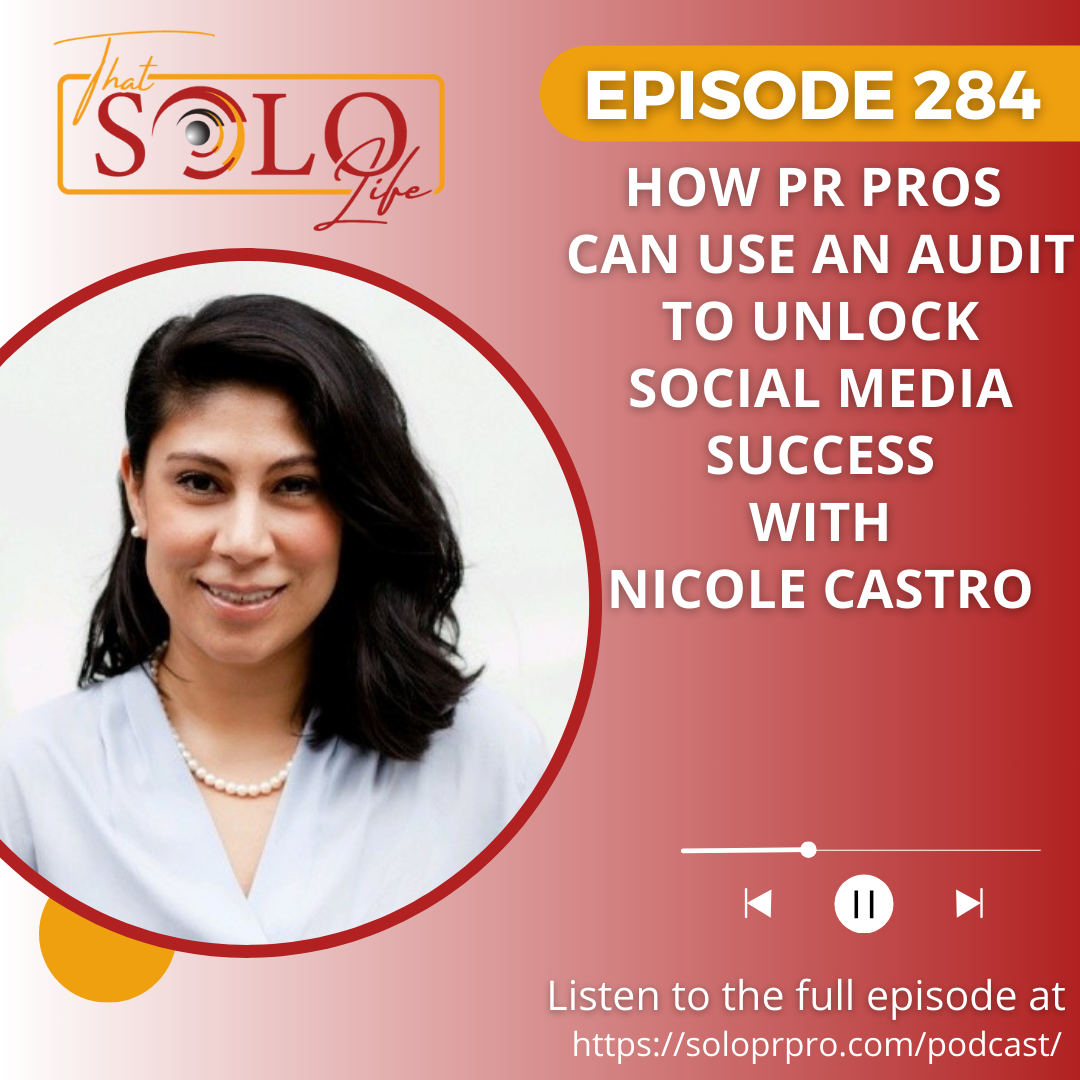


That Solo Life, Episode 284: How PR Pros Can Use an Audit to Unlock Social Media Success In This Episode
Today’s podcast discussion focuses on the importance of conducting social media audits and targeting specific audience personas when developing marketing and communications strategies. Key takeaways from this episode include:
- Conducting a social media audit can provide valuable insights to help organizations improve their social media presence and effectiveness, even if the audit process seems daunting at first.
- It is critical to deeply understand your target audience personas and tailor content and messaging accordingly, rather than trying to appeal to a broad, general audience.
- Focusing on the social media channels that are working best for your organization, rather than trying to be on every platform, can lead to more impactful results.
- This year presents a unique opportunity for companies and brands to build stronger, more engaged communities through social media by taking risks, experimenting, and being willing to learn from failures.
In this episode of That Solo Life, we are thrilled to welcome Nicole Castro, the principal of Nicole Lauren Consulting, to discuss the importance of social media audits and the power of targeted messaging in public relations and marketing. Public Relations professionals often face the challenge of effectively communicating our clients' stories and connecting them with the right audiences. Nicole brings her expertise to the table, sharing insights from a recent social media audit she conducted for a nonprofit client.
The conversation kicks off by acknowledging the common stigma associated with the term "audit." Nicole emphasizes that while audits can seem daunting, they are essential for understanding what works and what doesn’t in a client’s social media strategy. She recounts how her client, after years of posting on social media, realized they needed to assess their efforts to ensure they were reaching their target audiences effectively.
Nicole highlights three key takeaways from her audit experience.
- The importance of conducting a target audience exercise. This exercise allowed Nicole’s client to identify the diverse demographics they serve. By understanding their audience on a micro level, the organization could tailor their messaging to resonate with specific groups rather than adopting a one-size-fits-all approach.
- The capacity of your team. Nicole points out the common fear of missing out (FOMO) that leads organizations to spread themselves too thin across multiple social media platforms. She encourages clients to focus on the channels that yield the best results for them, rather than feeling pressure to be everywhere at once.
- Targeted messaging. Nicole emphasizes the significance of being targeted in messaging. She explains that specificity in communication not only helps in reaching the intended audience but also attracts others outside that persona. This targeted approach fosters clarity and effectiveness in messaging.
As we delve deeper into the discussion, Nicole introduces the concept of "The Year of the Niche." She believes that brands and organizations will find success by honing in on their audience personas and building content that speaks directly to them. In a time when social media is evolving, she stresses the need for brands to engage in two-way conversations with their audiences, moving beyond mere promotional messaging.
Throughout the episode, we explore the idea of failure as a natural part of the growth process. Nicole encourages brands to take risks and try new things, reminding us that failure is not fatal but rather a stepping stone to success. We discuss the importance of measuring success through meaningful metrics that go beyond surface-level engagement.
As we wrap up the episode, we reflect on the exciting opportunities that lie ahead for brands willing to connect authentically with their audiences. Nicole leaves us with a call to action: to build a strong communications foundation and embrace the potential for growth through experimentation.
Join us for this enlightening conversation that will inspire you to rethink your approach to social media and client engagement. Don't forget to connect with Nicole on LinkedIn to continue the discussion! Thank you for listening to That Solo Life.
About Nicole Castro
Nicole Castro is the principal of Nicole Lauren Consulting. She has spent the last 10 years cultivating results-driven public relations and marketing experiences for nonprofit and for-profit clients. The agency’s main goal is to help others tell their stories and connect clients with an audience that would truly benefit from their offering and mission.
Specialty areas of focus include brand development, social media management, competitive benchmarking, multi-platform editorial and content solutions.
You can connect with Nicole via her website or LinkedIn.
Episode Timeline
00:00:00 - Introduction to That Solo Life Podcast
00:01:15 - Welcoming Nicole Castro
00:02:01 - The Importance of Social Media Audits
00:04:36 - Insights from a Recent Social Media Audit
00:06:09 - Key Takeaways from the Audit
00:10:05 - Understanding Target Audiences
00:12:08 - The FOMO of Social Media Presence
00:14:02 - The Year of the Niche
00:18:49 - Building Community Through Social Media
00:20:41 - The Value of Taking Risks
00:24:53 - Embracing Failure as Part of Growth
00:29:30 - Conclusion and Connecting with Nicole
Key takeaways from the einclude:
- Conducting a social media audit can provide valuable insights to help organizations improve their social media presence and effectiveness, even if the audit process seems daunting at first.
- It is critical to deeply understand your target audience personas and tailor content and messaging accordingly, rather than trying to appeal to a broad, general audience.
- Focusing on the social media channels that are working best for your organization, rather than trying to be on every platform, can lead to more impactful results.
- This year presents a unique opportunity for companies and brands to build stronger, more engaged communities through social media by taking risks, experimenting, and being willing to learn from failures.
Enjoyed the episode?
Please leave a review here - even a sentence helps. Share and tag us (@SoloPR, @SoloPRPro) on social media so that we can thank you personally!
Michelle Kane (00:18):
Thank you for joining us for this episode of That Solo Life, the podcast for PR pros and marketers who work for themselves, people like me, Michelle Kane, with The Voice Matters. I'm a wonderful co-host, Karen Swim of Solo PR Pro, and we are joined by a guest today, which we love. We love guest episodes. We are joined by Nicole Castro. She is the principal of Nicole Lauren Consulting, and she cultivates results driven public relations and marketing experiences for nonprofit and for-profit clients. And her goal is to help others tell their stories and connect clients with audiences that truly benefit from their offerings and missions. And we are so happy you're here today with us. Nicole, welcome. Thank you.
Nicole Castro (01:04):
I'm so happy to be here with both of you.
Karen Swim, APR (01:07):
Welcome, welcome. It is a delight and we've had the pleasure of actually working together too, so I know how smart you are and how great you are at your job, so I'm so thankful that you decided to come today and share your expertise with our audience. Thank you, Darren.
Nicole Castro (01:26):
Absolutely. I have to say, I heard when you were talking to Lisa Gerber a few episodes ago, she said that she might make it part of her routine to have a Karen Swim. Pick me up Pep Trot, and I totally get it. I'm with you, Lisa. If you listen to this,
Karen Swim, APR (01:46):
Hey, maybe that could be my new thing on Instagram. I'm trying to find a way to have fun again.
Michelle Kane (01:51):
Oh my gosh. I would tune in. I'd subscribe to that. Karen, are you kidding me? The daily
Karen Swim, APR (01:55):
Pep talk.
Michelle Kane (01:58):
We need sunshine. We need light this year more than ever. Oh my gosh.
Karen Swim, APR (02:02):
We do. We do. Well,
Michelle Kane (02:04):
Speaking of light, Nicole, your work helps shed light for your clients. She sheds light on what they should be doing. And most recently, one of your audit projects really brought to mind the thought of wanting to share with us today what that was all about and the insights and how it can help our fellow solo PR pros do our best work for our clients. Could you just tell us a little bit about what brought you here?
Nicole Castro (02:30):
Sure. And I want to thank you both just for giving me the opportunity to talk about social media audits. I think that when people hear the word audit in general, there tends to be a not very nice stigma attached to it. I think most of us go into it thinking this is going to be kind of daunting, looking at a lot of data, just having to really sift through a lot of things. And what I love about this most recent social media audit was that I probably went into it feeling a little bit similar, knowing that this was very much going to be a little bit muddy in the beginning. What was really wonderful about getting to the other end of this audit was after I was working with a nonprofit client and they had decided, Hey, we've been on social media for a while now and we're posting stuff, but we don't really know how any of our channels are working.
(03:25):
We don't know if we're posting the right stuff. Are you able to dig in and give us an idea of what direction we should be taking next? And they approached me at the end, I want to say Q4 of 2024 to do this work. I love that. I love that as they were coming to the end or approaching the last quarter in their work year, that they decided, let's take a look at the work we've been doing and is there anything we could do better with any of my clients? I always take a very data centered approach. So social media can be so much fun and there's all this really great and rich content that comes out of all, I mean, you look at different companies, different organizations, and people are producing such wonderful stuff. But at the end of the day, I think it's really important that clients are able to just take a step back toward the end of the year and say, Hey, let's look at the data.
(04:19):
Let's dive in and let's take a look at what worked this year. What would we like to accomplish next year, and what are some tweaks that we can make in our social media strategy to help us get to a place that we'd like to be the following year? So going through the audit process, I think what was so rewarding for me at the end of the project was that the client at the end really felt like, oh my gosh, I'm armed with all this new information that I didn't have before doing the audit from a capacity standpoint. I think I know what platforms I should be focusing on, and it's just always nice to be able to give a client that clarity in terms of how they should be moving forward. So I'll take a pause here, but yeah, it was a lot of fun to work on it.
Karen Swim, APR (05:11):
I think what you're saying too that's really interesting is that a lot of times we might miss because we'll do end of the year recaps and we'll do metrics and we'll show things in other parts of the PR function, but that doesn't always happen for social media, and it's really important to do that. And I love that the client was so amenable to this whole process . The best results of data is that we can give clients data that they care about and that they can actually apply to the business. So you deliver not just social media insights, but business insights because it allowed them to see where they needed to truly deploy their resources. That's pretty powerful.
Michelle Kane (05:58):
Yeah, absolutely. And it's a great example of how we as comms pros, we are partners with our clients. We're here to support you, help you guide you, and really just prove that your message is having an impact, which is fantastic. What would you say were your key takeaways from this particular audit? Sure.
Nicole Castro (06:23):
So there were three big ones that stuck out to me. So the first was, so during this audit, the client allowed me to do an audience, a target audience, exercise with them. And this particular client had several programs despite being all under the roof of one organization, they had several programs that they offered to their audience. And we were able to dig into each of those programs and really figure out, well, who is this for? What do they value? What are they looking to get out of it? What information would be valuable to them? And because we were able to dig into their target audience and really get a sense of who they're serving and who they're talking to when they're creating content, it allowed the client to say, Hmm, we're not reaching this audience. We're not producing stories or messaging. So just to give a bit of a more specific example, this particular organization, their audience is so diverse in age where they have programs for youth and teens, but they also have programs that are more appropriate for an older demographic.
(07:38):
And they realized that they were trying to create messaging that appealed in the middle, so was sort of applicable to everyone on a very small level, but they weren't really looking at their audiences on a micro level. So they weren't taking a look at those little micro audiences that they were serving from each of these programs. And when they took the time as we were going through the audit, we all came to the realization that, hey, the general messaging, well, you should always have your key messages. Any organization should have that. If we're talking about social media, if you're talking about building community on social media and actually getting people through the doors so that they're being serviced by your programs, then you have to be talking directly to that audience, even if it means that particular message is going to hit one audience and perhaps not the other.
(08:34):
But I feel like something I think that has frustrated me a little bit in general is just that I think people are so afraid. Clients are so afraid of missing an audience, or if my messaging is too niche or if my messaging is connecting too much with this audience, I'm at a loss of connecting with this other audience that I'm supposed to serve. And I think at the end of the day, it's about finding balance. You don't want to just focus if you're serving three to five audiences, you don't want to focus on creating messaging just for the one, but you do want to make sure that your audiences know that you're thinking about them. And that has to come through messaging, that has to come through storytelling, that has to come through the content that you're posting on your social media channels. So I think it's hard.
(09:27):
I give businesses and the organizations a lot of credit. I mean, especially when you're talking about the nonprofit world, they serve so many different people. It's always such a wide array of people and you want to make sure that nobody feels left out, but you don't want to do it to the point where your organization isn't really telling the stories that are really happening. It's not really focused on where the organization is making the impact. And again, I think we can show impact through data too. I think that's what the other part that the data helps us with is it allows us to show the impacts by looking at the numbers, how these organizations are helping people. And then I think that the second thing that came up was, and this is business organization alike, when you start looking at capacity of your team, there's this desire or I don't know, I think it's like a FOMO
(10:26):
I have to be on every platform. I have to be everywhere at all times, or they will forget about me and Karen. It's really interesting because I think you shared a post on LinkedIn recently that I thought was so perfect for our chat today. It wasn't about social media, but it was about PR and media. And I think the point the person was making was media outlets. The New York Times and Wall Street Journal are wonderful, and most clients would love to get a hit there, but what happens when you get a hit in a newsletter that maybe has 200,000 subscribers, but those subscribers are exactly the audience that you want to be talking to. So the reason I loved that example so much is because the client that I worked with, and I love when clients listen, don't you? You love when they, it's the best. And they're like, oh my gosh, yes, this makes so much sense. My advice to them was, Hey, you have a small team. You don't have this. You're not working with a team of 10 to 12 social media, digital marketing people work the channels that are working for you.
(11:40):
For them, it was LinkedIn and Instagram where they were connecting with people. They were doing their best work there. And my advice was, Hey, I'm not telling you to shut down your other accounts. Make sure you keep on these other platforms, but work the platforms that are working for you. Stop trying to feel like you have to stretch yourself thin because of this fomo. What happens if I don't post on a platform? At the end of the day, it really will. It'll be okay. It
Michelle Kane (12:08):
It's so true and it's so easy for clients or even us to fall into that trap of I have to be there. I have to be everything to everyone. And it's so not true. It's not effective.
Karen Swim, APR (12:18):
It's
Michelle Kane (12:18):
So much more effective. And I don't know about the both of you. And sometimes too, I say what I've told clients is you're going to feel repetitive. You're going to feel like you're repeating yourself. You may even bore yourself, not that you do the same posts, but you are going to feel it, but your audience.
Karen Swim, APR (12:37):
Yeah, that's for sure. The big thing that ties those two things together is being extremely targeted.
(12:47):
And I love that you kind of called out. You do have different audiences. Most businesses have different personas that they're serving. But I love that you tied this back to say, it's really important to understand the audience you're talking to. So that doesn't mean that you, you're trying to do one message that fits three personas. It means that every single message needs to be so specific to a persona because they don't all need the same information. It's funny because in marketing, you're always taught that the more specific you are, the more that you can just level down and really dig into that persona and really map it out in detail. And the more specific your messages are, the more effective you are. And you catch people outside of that persona because your marketing language is so precise and so good, and it's clear, it brings clarity. And so even though you may be targeting Sally, the soccer mom, it doesn't mean that you're not going to get Bob the builder because you didn't specifically target him. It's that specificity that really gets you honed in and delivering solid, effective communications. You're right. It's hard to tell clients that because they want to make a soup where they throw in all the vegetables, and you can't do that. That does not work for anyone.
Michelle Kane (14:16):
Absolutely. Oh my goodness. Now I'm thinking of bad vegetable soups. Never wrong. It's Saturday. We won't go there. It's a good soup day. I'm not going to lie. Oh my gosh. Well, speaking of specifics in making the right soup, ooh, there's a segue for you. You are also telling us that you believe this is the year of the niche. Can you talk a little bit more about that for us?
Nicole Castro (14:44):
Yes, of course. The year of the niche, I have to tell you the end of 2024, I think even I wanted to be more specific and more focused on how I was going to help clients this year. And again, so much of my thought process came from going through this really successful audit with this past client, the year of the niche. So I really believe this year, companies, brands, organizations are going to have the most success if they can identify their audience personas and really start building messaging, storytelling content that is directly related to those audiences. I feel like social media is moving in a direction where it's more important than ever to build community. And I think people are going to hear me say that and go, wait a minute, isn't social media all about community? What is she talking about? I think it's really important for brands, for companies to focus on the people that they're serving, focus on their target audience, the clients that benefit from what they're giving out, and really start having a conversation with those people.
(16:06):
And conversations go both ways. So we have to go beyond just telling them what they should do. We have to go beyond, this is what you should buy because this will make you feel so much better. I think we really need to start getting into the habit of understanding our audience, understanding what they value, understanding what they're looking for from whether it's from your organization, from your brand, and now opening up the conversation so that it's two way. Talk to your audience. Find out how they feel about if you're running a campaign, how do they feel about this messaging? Are you looking at the comments? Are you looking at messages that are coming in based on what you're sharing? And I think that when we start to get to know our audience and understand them at almost like a cellular level where our understanding of our audience becomes more valuable or more important than our own need to just talk about ourselves.
(17:11):
I think once clients start understanding their audiences at that level, it's really going to inform the type of content and messaging that they're delivering. And I really believe that with more targeted messaging, they're going to start building a more tight knit community, one that is going to help their business be successful. Or you're going to find donors that really connect with your organization's story who say, oh my gosh, I heard of this organization. I didn't know the full story, and now I want to get involved. I want to be an invested party. I think at the end of the day, it's using storytelling to connect with people. And gosh, I remember joining Facebook right when I was in college, and I just feel that we're living in a time when social media started out as a connector, bringing people together, even if you weren't local. And we're just heading in a direction where I feel like both companies and brands and even organizations, it's become so much of this show where it's like I have to let them know how important I am. I have to let them know that I won this award and I went to this event, and I think we're losing out on what the foundation of this always was. It was about connecting people. And I really feel that brands can be more effective and more successful this year if they focus on connecting with their audiences.
Karen Swim, APR (18:49):
I also feel that there are people that maybe are not trained that do some of the functions of our job that do us a disservice because they will present a metric, but it doesn't give true business insight. So sometimes you have organizations doing phenomenal job on actually getting attention, but that's only one layer. And I like that you really dig deeper. Like, okay, so you got attention. Did you sustain attention? What did they do with this information that you presented? How did they feel about it? What was the sentiment? What was their engagement? Were there shares of that message? Because when people love something and it speaks to them, they'll share it. Did they visit your website? Did your call volumes go up? Did your donor donations go up? Did. If you're a nonprofit that helps others, did your request for services go up? You have to look and tie those things together and look at the metrics in a way that makes sense, where you really are seeing the whole story. But a lot of times I see people stop at that surface, well, we got X amount of views. Good for you, because you could have a million views and have $0 or zero donors. What does that really mean? That's step one, getting them there. It's like inviting somebody to your house, but if they come to the house and never enter it, and then they just walk away, what have you really done? You just, okay, there's a lot of foot traffic and there's stuff to clean up because a million people just trotted through your lawn. It's up, but it's not meaningful. So
Michelle Kane (20:21):
I love that analogy. Yeah, really. I mean, the building community, it's so true, and I see it with brands that do it so well and others that it's just like, eh. And what you want is you want them to sit down at your kitchen table and have that cup of coffee with you
Nicole Castro (20:36):
A hundred percent
Michelle Kane (20:37):
And engage. And that is everything.
Karen Swim, APR (20:40):
And I feel social media is a mess right now, but this is probably one of the most exciting times to build community because people are looking for places where they can genuinely connect with humanity. They genuinely want to have conversations. They want to get away from the divisiveness and the toxicity. And brands have such a beautiful opportunity right now to be a safe place to provide information to connect people together because when you connect your audience together, an old example, Harley Davidson, they do this really well. There are other companies that really form a community around a shared belief system and a joy and a love of the brand. This 2025, I don't think we've seen it as such a rich opportunity since the beginning of social media. I would say this takes us back to the early Twitter days when Twitter and not X
Nicole Castro (21:46):
A hundred Percent. Karen, I totally, and I think what people, like you said, we should see this as an opportunity this year. It kind of feels like social media is on fire right now. I feel that way. And gosh, I think to myself, there's issues of ethics and integrity that all of us are wrestling with right now, but I really feel like this is a year of opportunity. And if you do it right, I don't want to put the pressure on companies to think like, oh, well, I have to hit the ground running. I really believe it's just as simple as either getting an audit, but simply get your house in order. Let's build a strong, and it goes beyond social media, but let's build a strong communications foundation for your organization, for your company. In the end, you're going to save yourself a lot of time because you will have a clear plan moving forward. You will know what the goals are. And to Karen's point, Karen, you were talking about data. One of the great things that came out of this audit I did recently was we not only identified the goals, we identified how we were going to measure those goals and what did success look like?
(22:59):
And I think that more people have to work on sort of step two and three of what I just mentioned. It's not just about knowing what your goal is for the year. How are you going to measure that? So what data point makes sense for measuring that, right? And then what does success look like for that goal? And I think that's just such a beautiful thing. Let's create a really great foundation. Let's have a clear plan of how we're going to attack social media this year. And you end up saving yourself so much time. So much time. And the other really quick thing, if I can just add, I really feel like this is the year where brands should not be afraid to take chances. Don't be afraid to fail, try something new. One that came out of the audit was that the client was thinking about trying to build a community.
(23:52):
They wanted to use TikTok as a way to strictly communicate with their youth audience, and everybody's on the edge of their seat regarding the TikTok ban. But the whole idea was that they had ideas that maybe weren't traditional, but my advice to them was, Hey, invest three to four months trying out this idea. And as long as you understand that failure is part of the process, failure will let you know like, Hey, this just didn't work on this platform, or we weren't connecting with the community. Well, whatever the messaging was. But the idea is that I really hope, I would love to see more companies, more brands, including agency owners like ourselves, solos like ourselves. I want to take chances this year. I want to try things and I want to be brave enough to fall flat on my face and say, okay, it didn't work out, but I tried it so at least I know it doesn't work, and I'm going to move on to the next thing.
Michelle Kane (24:53):
That's so beautiful. And it's so true. I mean, because that's the beautiful thing about social media. You can try things and all it really costs is your time. The cost is minimal when compared to a paid media campaign and investing a lot in a print piece, you're not risking as much providing, of course, you don't do anything reputationally damaging. But just as far as the simple act of doing it, try it.
Karen Swim, APR (25:26):
I mean, I think as long as you're sticking to your vision values and your company mission, and you're true to who you are, I love building failure into the process because you're absolutely right. This is what keeps companies from moving forward is that they think failure is this fatal thing, and it is not. Failure is a part of growing. It's a part of success. I mean, we have thousands of examples of businesses that failed miserably or founders that failed miserably and went on to build successful companies. You learn something. There's rich lessons in that. And I think you're right, Nicole. Companies are afraid to take a risk. They don't want to look stupid, so they end up looking like everybody else, sounding like everybody else, and it's like, whoa, it's boring. And you're not really getting through because you're not doing anything different and you're afraid to try anything different because you're afraid to fail. And failure's not that big of a deal. It's just normal. And I wish we could learn to do that internally with employees too, like let and fail because that's how people grow. And you should say failure's cool. Make failure a thing in your company. It's okay to fail. Now, we of course don't want doctors, nurses, lives at stake. We don't want cars being built off of failure. Nope, not you ,Six Sigma and all the Lean that we can get, please, and thank you because that's deadly. But when you're talking about things like your communications approach or things that are not going to kill people, take risks,
Nicole Castro (27:08):
Not life or death. Yeah. There is an Instagram account called Subway Takes. I don't know if either of you are familiar. I love this guy Kareem. I watch his videos every time he has a new episode. And he did an episode maybe a week ago, a couple of weeks ago with the new CEO of Enron. And I watched as I watched the video, it's so funny because I didn't realize that that big incident for me, that was 20 years ago or close to 20 years ago,
(27:41):
And he does interviews with everyone. So don't think that by this guest. I don't want anybody to judge the show. But what was so great to me, and the reason I'm mentioning this is I remember telling my husband after I said, didn't Enron, didn't they fail miserably and have this horrible fallout? Let's talk about stigma around audits. And I said, and they've got this new CEO and the company is still kicking. And I told him, I said, you know what? If Enron can fail that badly and still come up from the ashes, I said, then nothing I have done could possibly kill my business or kill it can't be that bad. I
Karen Swim, APR (28:24):
Mean, look at Tylenol. They're so rare. Yeah, there've been so many. I mean, that wasn't their public failure, but you can recover from failure. You can blow it big time, and it's okay. I think that's true. That's a message I have been trying to tell myself a lot more, but I needed to hear that again today because we get in our own way because we're so afraid that people are going to go, you're, you're such a goof. Why are you doing
Michelle Kane (28:53):
This? That's it. You're done. We're done with you. I have to ask, is that the guy who uses the Metro card as a microphone?
Nicole Castro (29:00):
Yes, Michelle. Okay. Yes. Hold a metro card as if it's a microphone, and I love it. I left New York two and a half years ago, but I can't help it. I'm like, I still go back to all the little New York City stuff. Yes, Michelle, the guy who uses the Metro card
Michelle Kane (29:18):
Microphone. I love it. Oh my gosh, Nicole. Well, this has been so much fun, and I love when we have guests because I always end the episode. I'm fired up. I don't know about you, Karen, and I hope our listeners are fired up as well, because this was a great, great time together and just really helping us rethink and rejuvenate. And Nicole, we can't thank you enough. Where's a great place to connect with you. If people would like to do so.
Nicole Castro (29:45):
Sure. They can find me on LinkedIn under my first and last name, Nicole Castro. If they just look me up and yeah, they can find me there.
Michelle Kane (29:52):
Awesome. Well, we thank you so much for joining us today. We'll definitely have to have you back. And to our wonderful listeners, if you found benefit in this, and of course you did, please do share it around. And until next time, thanks for listening to That Solo Life.