How to Identify, Land and Retain Sponsorship Deals
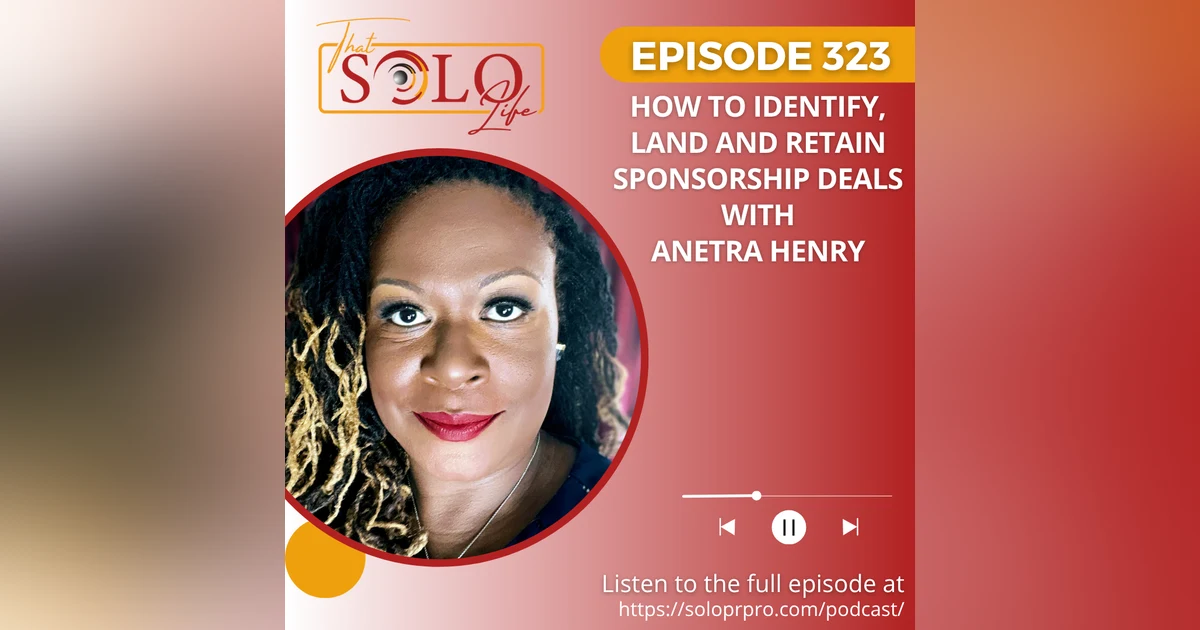


That Solo Life, Episode 323: How to Identify, Land, and Retain Sponsorship Deals Episode Summary
In this episode, Karen Swim, APR, and Michelle Kane welcome back Anetra Henry, founder of Anetra Henry Consulting. Anetra brings her expertise in nonprofit sponsorships to the table, guiding solo PR pros and communicators through each step of the sponsorship journey. The conversation covers the essentials: identifying aligned sponsors, developing sustainable strategies, managing relationships, and understanding the real costs and rewards of sponsorship. Whether you're new to sponsorship deals or want to deepen your approach, this episode is packed with insights, practical advice, and wisdom from the frontlines of nonprofit development and communications.
Episode Highlights- [01:13] Anetra shares her career update and the relaunch of Anetra Henry Consulting, focusing on helping nonprofits secure sustainable revenue through corporate sponsorships.
- [03:32] Adjusting sponsorship strategies in the face of industry shifts and navigating workforce and philanthropy changes.
- [04:39] Why most nonprofits overlook ongoing sponsor relationships and the pitfalls of only thinking about annual galas.
- [05:08] Viewing corporate sponsorship as a reliable stream of income and integrating it into long-term planning.
- [06:05] The communicator’s role in sponsorship: leveraging storytelling and impact reports to retain and nurture sponsors.
- [09:10] Managing PR crises and evaluating potential sponsors: assessing reputational risk and the importance of thorough vetting.
- [14:30] The four most common sponsor “personality types” and how to work effectively with each: The Fisher, The Decisive, The Egocentric, and The Infiltrator.
- [19:39] Understanding the true cost of sponsorship management for nonprofits and associations—what every dollar really takes to earn.
- [22:57] Are nonprofits embracing AI? The current landscape and smart ways to use AI for prospecting and admin without losing a human touch.
- [26:09] Balancing the heart and business of nonprofit work: reminders for communicators and PR pros who serve mission-driven organizations.
- [28:47] Anetra's advice for listeners: take care of yourself, know your value, and support nonprofits while maintaining sustainable business practices.
- [28:48] How to connect with Anetra: her website, LinkedIn, and book for practical guidance on sponsorship success.
Anetra Henry is the founder of Anetra Henry Consulting, where she helps nonprofits and associations secure strategic, sustainable corporate sponsorships. With over 20 years of experience in nonprofit growth, sponsorship strategy, and communication, Anetra partners with organizations to develop actionable plans that bolster revenue and impact. She is also the author of the “Sponsorship Success Guide,” designed for purpose-driven teams seeking reliable funding and practical tools. Please connect with Anetra on LinkedIn.
Related Episodes & Additional Information
- Get your copy of Anetra’s book: Sponsorship Success Guide
- Episode 254: The Work of Diversity, A Conversation with Anetra Henry
That Solo Life is a podcast created for public relations, communication, and marketing professionals who work as independent and small practitioners. Hosted by Karen Swim, APR, founder of Words For Hire and President of Solo PR Pro, and Michelle Kane, Principal of Voice Matters, the show delivers expert insights, encouragement, and advice for solo PR pros navigating today’s dynamic professional landscape.
Enjoyed this episode? Let us know! Subscribe and leave us a five-star review on Apple Podcasts, Spotify, or your favorite platform. Share this episode with your colleagues, connect with Anetra for more support, and help us empower more Solo pros to thrive in their businesses and communities.
Michelle Kane (00:11):
Thank you for joining us for this episode of That Solo Life, the podcast for PR pros and marketers who work for themselves, people like me, Michelle Kane, with Voice Matters and my wonderful co-host, Karen Swim of Solo PR Pro, and we are so excited to welcome back to the podcast, Anetra Henry. Hello Anetra, welcome back. Hello. Hello. It's such a pleasure
Anetra Henry (00:34):
To be back with both of you. Have you been,
Karen Swim, APR (00:37):
Oh my gosh, Anetra. We're so excited to chat with you today. You are our multi-talented communications colleague extraordinaire, and you always have something great to share, so thank you. Thank you, thank you for being with us today.
Michelle Kane (00:53):
Yes, thank you
Anetra Henry (00:53):
Thank you for having me.
Michelle Kane (00:55):
And we're so glad to have you because you've got a little update on your career journey and into a really cool new endeavor. Can you bring us up to date? What have you been up to?
Anetra Henry (01:07):
Well, I have relaunched my consultancy. About 15 years ago, I began a consultancy called Anetra Henry Consulting, and now what I'm doing is helping nonprofits build clarity, structure and sustainable revenue using corporate sponsorship. And that's what I was doing in my consultancy before it was marketing strategy as well as sponsorship strategy and helping nonprofits, whether they were membership based or just true nonprofits with an amazing mission to connect with corporate sponsors and understand how they can work together to fortify their mission.
Michelle Kane (01:48):
That's fantastic. I love it. That sounds like such fun work.
Anetra Henry (01:53):
It can be really fun work. It can also be very heartwarming work, right? I spend a lot of time with talking to and consulting with stressed out executive directors who are in this day and age really trying to make sure that their teams remain employed. They're juggling a lot of different balls in the air regarding funding. As we know coming up in 2026, there are going to be some significant changes to the way that philanthropy is taxed. And so we've got some great organizations out here with great leaders and teams that are wearing multiple hats trying to service different parts of our community that need help. And this is one way that I know I can help them just maintain as much as they can in their current roles and to be the best nonprofit that they can be and really fortify their mission and service the communities that are important to them.
Michelle Kane (03:04):
Yeah. Let's dig into that a little bit because as you said, of course the changes in tax looming in the coming year, but nonprofits are also facing challenges with the workforce regulations and many are undergoing significant changes just as the nature of who they are, but also in response to needing to pivot so many times over the years. How would you recommend that nonprofits adjust their sponsorship strategies for success?
Anetra Henry (03:38):
Well, first, for a lot of them it is just having one. Many nonprofit organizations, believe it or not, have not really paid attention to this. Most times their corporate strategy, a corporate sponsorship strategy is tied to an annual gala, and that's the only time that they think about it. They don't necessarily think about cultivating those relationships further to help support the mission outside of that one event. Many of them also just kind of treat it like a polite ask or understand it and process it within the organization like it's a donation and it's really not. Corporate sponsorship may start off as a very transactional situation where it is tied to maybe a gala or an annual event or something along those lines, but the reality of the situation, it has the potential to be so much more. What we've seen over the last few years is that the partnership when you transition from being just a sponsor into partnership, we see that sponsors begin to renew more often than they used to.
(04:51):
Renewal rates used to be around twice, so a corporate sponsorship may last for two years. We're seeing that extending out to a little over three years now. So the main thing I think is for these nonprofits to really understand that this is an opportunity, is it going to replace the big donor, the big grant that you might be losing right now? No, it's not necessarily going to replace that right in this moment, but it does give you an additional stream of income that can be reliable for the next few years as you do your strategic planning.
Karen Swim, APR (05:31):
I love that. And strategy is a key word that you said, but also I see so many parallels into just the function of communications in that we tend to never look at anything as transactional, whether it's securing, when we're doing media relations and outreach, we always are about building longer term relationships. So is that something that, I mean, I know that nonprofits focus on those who they're serving, but do they miss that aspect in the business side of what they do?
Anetra Henry (06:09):
Absolutely. One of the most helpful things that communications roles within or working alongside nonprofits can do is help them craft compelling stories. You guys know as PR professionals and communicators yourselves that storytelling is your superpower, right? And it is important that you begin to tell those stories, and nonprofits begin to align the mission with a potential corporate sponsor that has the ability to turn into a corporate partner. One of the big ways that I talk about in the sponsorship success guide is to produce impact reports. Say you land a corporate sponsor and you promise them all of these benefits, what happens after the event? If you can align that story and make it easy for the corporation to say yes, when it comes time to renew, they'll renew again and again. And because they don't have to reinvent the wheel by producing their own internal report, a communicator can come in, produce that report, show the alignment between the missions, show that the benefits that were promised were actually met, if not exceeded, and also show where things were missed a little bit and position it as an opportunity for the next time. And so that is something that I feel like communicators are the absolute best at and best positioned to do to help nonprofits make sure that they continue to keep corporate sponsors and turn them into long-term partners.
Karen Swim, APR (07:51):
Oh my God, my little measurement heart just sang. I love this. I love measurement, and I feel like we talk about it a lot on this podcast, and then I talk a lot about it offline, but that is such a nugget of wisdom right there that we really have to lean into measurement in this area as well. And I love the idea of showing an impact report because that is a powerful storytelling tool to say, here's what we were going for, here's how it impacted you, not the activities, but the impact. I mean, the activities are important, but what was the bottom line? I love that
Michelle Kane (08:36):
Because that does help if you are on the corporate side, making this consideration as someone who vets these opportunities and creates these relationships for a couple of clients, it's like, okay, we know it's not all about what's in it for us, but it's a little bit about what's in it for us. And that certainly does help move that along. It does,
Karen Swim, APR (08:59):
Yeah. Yeah. Unfortunately, you can grab people with the story of the need, but that's not going to necessarily keep dollars rolling in it. It's not enough.
Michelle Kane (09:12):
Yeah, yeah. No,
Karen Swim, APR (09:14):
It's not
Anetra Henry (09:15):
Enough.
Michelle Kane (09:15):
It's true. And we know it's crazy days out there that we live in a highly charged environment and we know that associating with the wrong person or brand and it can be detrimental. And sometimes the sad thing is you don't know at the time or it happens after, which is a real nightmare. But how do you counsel your nonprofits around that? I imagine you recommend a vetting strategy and talk us through that process a little bit.
Anetra Henry (09:47):
Absolutely. So one of the things that comes up often as an issue for these stressed out executive directors in these small and mid-sized nonprofit teams is I've been asking this corporation and they've not expressed any interest. And then the next thing you know there is a PR crisis that happens and all of a sudden they have money. The three of us all know intimately as well as the listeners. There's always money after a PR crisis, but the question that you need to ask is at what cost? Right? And what I advise these teams to do, small nonprofits, mid-size nonprofits, it really doesn't matter the size of the nonprofit. When I'm consulting with them, this is what I tell them. The big question is to ask, is this check worth the reputational risk? And so to dig down a little bit deeper into that, when you look at whatever the corporation is and whatever the PR crisis has become, you need to ask a couple of questions and think about it this way, will this company bounce back in six months or are we looking at a year or do we project that it's going to take them a longer time to turn their reputation around in the market?
(11:12):
Are you a part of the core stakeholder that's been offended? Because usually that's what the PR crisis is.
(11:19):
There's been something that has greatly offended or impacted, negatively impacted a stakeholder or people in the community. And if you're not one of those core stakeholders, who on your team is? And have you had a conversation with them about how they're feeling, how they perceive this PR crisis? Are they going back to doing business with them? Has there been a boycott? We've seen that over the last few years. There've been some major corporations that had some key stakeholders that decided that, you know what? We're just going to stop supporting this organization. Mainly it's simply this. Sometimes it is worth the risk because there is this strategic alignment on mission, and if that is the case, then you should consider it. However, it's important to not trade your community trust as the nonprofit for short term dollars. And that's the advice that I give.
Karen Swim, APR (12:29):
I think that is super wise because what you're saying, sponsorship implies that you are transferring your trust to that person. So we want to make sure that when we are taking money that we're comfortable endorsing it because essentially we are, we're saying this company, this organization is okay.
Michelle Kane (12:59):
At its base, it's saying, yes, I don't mind if I in the form of my logo is seen with you. Really. And that speaks so much louder than any dollar amount. It's almost like you have to consider, all right, you're giving me 20,000, but is this going to cost me 50,000 down the line?
Anetra Henry (13:19):
Absolutely. Absolutely.
(13:22):
And so there are just so many different aspects to consider. But again, I always say that sponsorship is a team sport, and although the proverbial bus may be driven by the executive director, it really is a team activity. And that's why it's important to consult. If you have one of these situations where someone is coming to you in a low hanging fruit, as I like to call it sort of situation, talk to your team. Are they a part of this? How are they feeling? What are they hearing? Everybody is taking their phone out sometimes at work, whether they should be or not, or afterward, and they're scrolling and they're being influenced by other people in social media. They're having conversations about it within their friend groups, and they have a perspective that is valuable. And you really need to consider those perspectives before you just take a check. And it's easier for a large corporation to, in essence, transfer some of their negative PR onto a nonprofit if they're not careful. And so that's why you must do a risk analysis and consider is it worth the risk to me?
Michelle Kane (14:43):
So true, so true. And also in your book, and please do plug your book, you talk about the different kinds of sponsors. Can you share a little bit about that with us now?
Anetra Henry (14:54):
Yes. So I will tell you there, it is not an exhaustive list of the types of personalities or types of sponsors that you will encounter on your sponsorship seeking journey, but these are the four most often encountered personality types. So I'll begin with the Fisher is what I call them. It's that sponsorship, the potential sponsor that is very cautious. They need a lot of info, they need a lot of time to make a decision. They keep coming back to the table and being like, oh, I got to go back and talk to so-and-so. And there can be a lot of space and gaps in between communications if they make a decision. So you may need to really consider how much time you want to spend on them because they may or may not make a decision in your favor. Now, there is what I like to call the sponsorship goal, the best kind of sponsor, and that's the decisive one.
(15:56):
It's the person that knows, Hey, here's what my budget is. I have read your sponsorship proposal. They know if something needs to be customized or if they're happy as is, you communicate with them, they're ready to sign. And these are the type of sponsors that you typically can depend on for the next three years to be a part of it. If you do your part as a nonprofit and deliver what I'm talking about in terms of impact reports and the benefits that you have promised, and you remind them of that in those impact reports. Now the third type is what I would call the egocentric, and this is the type of sponsor that needs a lot of handholding, needs recognition, they need the visibility. And there can be great partners, but you have got to be sure to set clear boundaries and expectations upfront. This is why with all sponsors, I don't care what type they are, you need a contract and not just a handshake, but the egocentric are those that they need to be ingrained into the mix.
(17:08):
It's not just about the logo, it's going to be about the other benefits that you offer. And it really is, particularly if it's tied to an event and they show up, you need to treat them like they are the king or the queen of the world. And then lastly, I'll talk about the infiltrators. And you find these more so in membership organizations, nonprofits like professional associations, and what happens is they come on as a sponsor, the organization does, and then the next thing you know, they send over three or four or five or more members and the organization is paying for that membership and they become members. They begin to serve on your board, and you get addicted to their presence, not only their money, but their support. And you begin to plan around it when it's time for you to do your annual budget as an organization.
(18:05):
And then one day, poof, they're kind of gone. And usually the first sign is they either scale back those sponsorship dollars that they give you or they cut them all together. When membership renewal comes up, a few of them don't renew. They begin to stop volunteering. They don't renew whatever board position that they have or accept another one on the board. Now they are great in the beginning. The issue is you cannot count to plan for them strategically for the next three to five years, because a lot of times they're not going to be there that long. So those are the ones that you most often encounter in sponsorship, but there are others as well. But in the sponsorship success guide, this is done in the course of giving you a guide to a four hour workshop. So we want to get through it in four hours for small teams that don't have a lot of time. So you need to be clear on who the types of sponsors are so you can plan accordingly.
Karen Swim, APR (19:12):
When you talk about the types of sponsors, it reminds me of as solos, the type of clients that we have. You have the people that are paying you big bucks, but they are high maintenance. And then that mid-level, which is kind of that sweet spot where they pay decent budgets and they treat you well and they don't require extra. And then you have that lower tier. And when we look at those three tiers, every single one has a cost of managing associated with it. So the lower tier becomes even lower. If that lower tier has high maintenance people that are going to suck all of your time and energy, you're going to decrease your budget. So when you're counseling organizations, are you also kind of teaching them that everything has a backend cost to it in terms of management and administration and your time? And you have to consider that when you're thinking about these deals as well, because when I think about that high maintenance sponsor, what was the name? What was their name again?
Anetra Henry (20:20):
It's the egocentric.
Karen Swim, APR (20:21):
Egocentric, yes. Yes. So that sounds like a lot of work. And I mean
Anetra Henry (20:26):
It can be,
Karen Swim, APR (20:27):
I've seen those people. I know those people. They want to come to the gala and they want to have a seat right up at the front. They want to have a whole table reserved for them. And by the way, they want the microphone so that they can speak. They want to be introduced as your premier sponsor that is responsible for this whole thing, even if they're only responsible for 15% of it. So are organizations at all savvy about like, Hey, every dollar comes with a cost, and the cost is not just what we put in our reports, but there's a cost associated with managing these sponsors too.
Anetra Henry (21:06):
There is a cost, and I would say that most are not super savvy about this, which is why I wrote this guide. Most of it's part of the strategy. You're going to encounter these people. And yes, there is a cost. One of the ways that I have personally dealt with the ego-centric types is I assign myself within the organization when I'm not consulting, when I've worked with a nonprofit, I know what it is. I can't expect a lower level employee, and I can't expect my executive director who has to be a little bit of everywhere at the same time to be the person to handle this particular need. So one, that's why contracts are important with an egocentric, and you better spell out what it is that they're going to get, and you can go a little bit above and beyond that, but you got to know that a lot of it is just going to be about how they feel.
Karen Swim, APR (22:13):
And
Anetra Henry (22:13):
If you can assign something, especially if it's tied to an event kind of situation, assign that person on your team that makes everybody feel like they're a superstar, to handhold them, to make them great. And they will go, I have done this. Go and check on them two more times than you check on everybody else and make sure that they're doing good. Pay attention to what cocktail they have, go get it for 'em and just present it. And that feeling goes a long, long way with them because sometimes they're not actually sponsoring your event because it's the low hanging fruit for them. Sometimes it is just a need to be seen and to feel good about doing something. They have this money, I've encountered that a lot as well. And the better you make them feel, the more money they give next year. So there is a cost to it, but there are ways to lower that cost by understanding who they are and what their needs are upfront. So as a nonprofit, what's for sale and what is not.
Michelle Kane (23:22):
Oh, so true. So true. This is a little bit of a sidebar question, but we're going to hit you with it. Are you finding that nonprofits are using AI in their organizations? And if they're not, what strategies can they adopt to really lighten their load?
Anetra Henry (23:39):
Well, I will tell you, I think that I find with, I think that a lot of nonprofits using AI, but they're not using it to their full potential. The ones that I have been working with lately, they definitely aren't using it to its full potential. And to be quite honest with you, I understand that because most of them don't know all of the things that AI can do.
(24:03):
I do address this a little bit in the sponsorship success guide about one of the main things that I do suggest that you use it for while you're doing this workshop, while you're reading this book, and when you're building out your sponsorship strategy, and that's how to create the list of potential sponsors. AI is available to do a bunch of different things from how to measure, help you with some of these reports and put systems together in place that are branded and all of this cool stuff. However, if you are at the beginning part of really considering corporate sponsorship as a stream of income and you need to create a strategy or you need to refine your strategy, identifying that potential sponsor's list is going to be very important. This is what I would advise though, a human check behind it. I have some prompts that I lay out in the Sponsorship success guide to help you find the ones that are mission aligned and local and have budgets. But a lot of times it'll also spit out information that isn't correct.
(25:15):
AI hallucinates, as we all know, and in this particular market, excuse me, where people are changing jobs, losing jobs, that kind of thing. If you depend on AI to tell you exactly who you need to go to in an organization to begin building this relationship, what AI spit out for you in a report today is incorrect tomorrow. So where it works best is the missions are definitely haven't changed between the corporation and the nonprofit. It can help you identify those alignments, but in order, if you need to find the person to talk to or the department to lean on in an organization to begin a conversation, AI is not the tool to help you fully do that. You're going to have to go through some different things. And as we all know, people take a long time to update their LinkedIn, their other materials online as they change, accept new jobs, all of that kind of stuff, but finding out where you should go, there are organizations in your market that you don't realize have a headquarters in your market A I can help you with that for sure.
Michelle Kane (26:32):
That's great.
Karen Swim, APR (26:34):
I feel like this whole conversation has, it's for nonprofits too, I think, for them to really learn how to think beyond those heartstrings that pull you into this work. But for PR posts too, because I've seen this with communicators taking on work with nonprofits because they connect to the mission, which is a beautiful thing for all of us. We are givers, but you've laid out and peeled back the layers to remind us that everything still has a business aspect. Because if you're not bringing in dollars, if you're not stabilizing your revenue source, you can't serve anyone whether you are a for-profit or a not-for-profit. And I think that that's such a sobering message, and I think that it makes the charge of working with nonprofits even more beautiful, even more noble, because we may be that voice that shines the light on that and teach that team, that small team, how to think more strategically and to think about businesses. It's the mission and the serve and serving those communities, but there's a business structure that has to be in place in order for those wills to keep turning. I love that you just call that out with such clarity and your expertise. So thank you for that because it had me thinking like,
(28:06):
Ding, ding, ding. Yeah,
Michelle Kane (28:09):
For real. So often we get caught up in the feel good of it all, and it's like, do
Karen Swim, APR (28:13):
No, I mean, I've even seen communicators, and this is a different story, like, oh, but they're doing such good and they don't have money to pay me. But girl, you still need to eat.
Michelle Kane (28:27):
Absolutely.
Karen Swim, APR (28:27):
You still need to pay your bills and keep a roof over your head like real good and all. But
Michelle Kane (28:33):
Yeah, until I've reached that ever elusive lady who lunches status,
Karen Swim, APR (28:37):
Yes,
Michelle Kane (28:38):
You're going to pay me.
Anetra Henry (28:41):
Absolutely. Absolutely. And listen, nonprofits, we all appreciate them. We all feel the impact of them in our community, and it is important to support them, and it is important to eat and to live. I do my best work when I am full and happy and housed,
Michelle Kane (29:09):
All those things. So little things truly, oh my goodness, the roof of our head to do our work.
Karen Swim, APR (29:14):
I'm just
Michelle Kane (29:14):
Saying maybe some electricity just saying, maybe some electricity, maybe. I dunno.
Karen Swim, APR (29:20):
Heat the
Anetra Henry (29:20):
Winter. Absolutely. Absolutely. Oh
Michelle Kane (29:25):
My goodness. Well, Anetra, how can our listeners best connect with you?
Anetra Henry (29:29):
The best way is to go to my website, which is Anetra henry.com, and that's A-N-E-T-R-A-H-E-N-R y.com. Also, join me up on LinkedIn, just search Anetra Henry, I'm having conversations, so many of the executive directors, comms people, marketing people in nonprofit spaces, we are having a good time having a conversation about what's going on. I'm also giving them some quick answers. We're also learning together in terms of polls and getting to the bottom of what is right in the nonprofit space right now regarding funding and what is not working and what they can do. And there are corporations out here that want to support you. When I talk about partnership, I just want to add this little caveat. Once a nonprofit begins to look at a corporation as a whole, the same way that they want to be looked at as a whole organization, they have people, they have this mission, and they have these stakeholders and this community that they serve.
(30:41):
But when you begin to look at a corporation as a whole, many corporations have a philanthropy arm that you're not tapping into or you don't know anything about because you don't have that. You have that gatekeeping that's blocking your way. Also, so many corporations have benefits that include giving back in terms of supporting their employees to volunteer at nonprofits that you're not tapping into. Also, some of them match the give that their employees want to give to a nonprofit. Are you tapping into that? Are you becoming a preferred nonprofit that is in their employee manual that goes out to all new employees or the updates? So we're having conversations about all that good stuff on LinkedIn, and I encourage you to join me there. But also if you know this is something that you need, first of all, just go to the website and order a book. It's only 1999. I've given you, I'm one of those people that I don't need all the fluff. Just tell me what it is I need to do, lay it out to me and let me do it. And so that's where this comes from. But if you need consulting, if you need a partner in this, you can reach out there, Anetra@Anetrahenry.com, send me an email and we can do some consulting or you can just hire me to come in and do the workshop for you and help you wrangle your team and get you all on board to open up this new stream of income.
Karen Swim, APR (32:21):
Definitely worth it to bring on professional help, because you'll bring in way more dollars, and those dollars will easily pay for it over and over and over again. So I highly recommend that we will have links to how you find Anetra to her book, to her website in the show. So check that out. If you're watching on YouTube, you're just going to scroll to the description. We'll have all of those links there. We will be sharing this episode on LinkedIn, and Anetra is on LinkedIn, so we will be tagging her in our posts. And if you know a deserving nonprofit, let us know because we might just send them a copy of the book. But you got to act fast because we don't have limited dollars. But if you know a great nonprofit who could really benefit from this and you just want to surprise them with a little book so that they can get started and take away some of these tips and get to know more about Anetra, let us know. Just drop us a line at info@soloprpro.com or comment on any of the channels and we will see your comment and we will definitely respond.
Michelle Kane (33:29):
Well, thank you. And of course, you've gotten something out of this. Yes, so please share it around. And thank you, Anetra. We can't thank you enough. We can't wait to have you back on. And to our listeners, please share this around because certainly there's a lot of people who need to hear this, and it's okay to ask for help and get guidance. And until next time, thanks for listening to that solo life.
Transcribing live conversations can be tricky so please be forgiving of any typos or errors that you find. Love something here and want to share? Great, please keep reading!
You are more than welcome to share the transcript (up to 500 words) in media articles (e.g., PR News, O’Dwyers), on your personal website, in a non-commercial article or blog post (e.g., Substack), and/or on a personal social media account for non-commercial purposes, provided that you include attribution to “That Solo Life” and link back to the soloprpro/podcast URL. For the sake of clarity, media outlets with advertising models are permitted to use excerpts from the transcript per the above.
But please note that no one is authorized to copy any portion of the podcast content or use That Solo Life’s name, image or likeness for any commercial purpose or use, including without limitation inclusion in any books, e-books, book summaries or synopses, or on a commercial website or social media site (e.g., Facebook, X, Instagram, etc.) that offers or promotes your or another’s products or services.
Got questions? Email us at info@soloprpro.com.