Navigating Public Information Campaigns and Crisis Comms with Cyndee Woolley
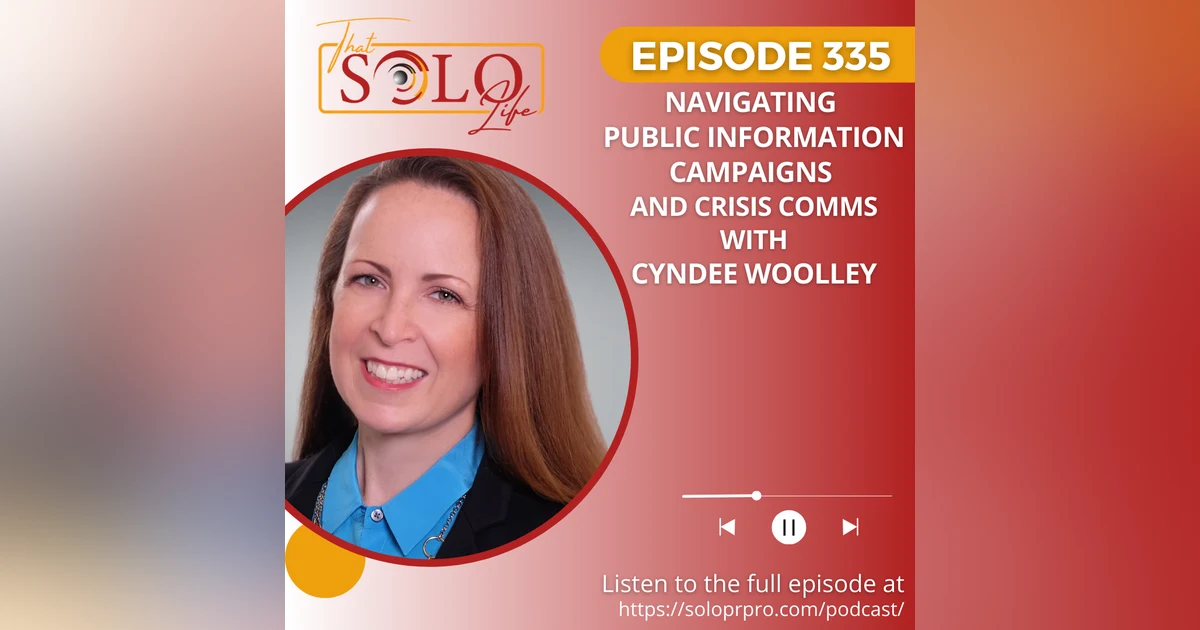


Episode 335: Navigating Public Information Campaigns and Crisis Comms with Cyndee Woolley Episode Summary
In this episode of That Solo Life, hosts Karen Swim, APR, and Michelle Kane are joined by Cyndee Woolley, MBA, APR, President and Founder of C2 Communications. Together, they dive deep into the nuanced world of public information campaigns and crisis communications for local communities. While national headlines often grab the most attention, Cyndee explains why decisions made at county commission meetings and in local municipalities often have a more direct impact on our daily lives.
Cyndee shares her extensive experience working with organizations like Waste Management and mosquito control districts to turn dry, often misunderstood topics into engaging community stories. From "bear-resistant carts" to turning landfill gas into energy, she illustrates how strategic messaging can cut through the clutter. The conversation also tackles the critical importance of crisis communications for small businesses and local leaders. Cyndee offers candid advice on why "owning it" and apologizing is often the best strategy when trust is broken, and why every PR pro needs to pass the "Mom Test" before releasing a statement.
Whether you are a solo PR pro looking to better serve local clients or a communicator interested in the power of community engagement, this episode is packed with actionable insights on building trust and activating audiences.
Episode Highlights- [02:01] Public Information Campaigns: Cyndee discusses the challenges of getting communities to understand government services and how local decisions impact daily life more than national ones.
- [03:38] The Recycling Reality: Insight into the misinformation surrounding recycling and how tours and transparency can change public perception.
- [06:39] Creative Storytelling: How Cyndee used "bear-resistant carts" and landfill gas-to-energy stories to engage the public in waste management topics.
- [08:10] Crisis Communications for Small Business: Why even small organizations need a plan for when—not if—a crisis occurs, from employee misconduct to leadership failures.
- [12:12] The Power of the Apology: A look at real-world examples where refusing to apologize prolonged a crisis, versus how owning mistakes can help rebuild trust.
- [14:51] The "Mom Test": A simple but powerful metric for decision-making in crisis management—would your mom be proud of the action you are taking?
- [21:47] Case Study - Mosquito Control: How the Zika crisis transformed a quiet organization into a proactive communicator by opening doors to community leaders.
- [26:50] Activating Audiences: Why tangible, meaningful involvement (like planting gardens) beats passive information consumption every time.
Cyndee Woolley, MBA, APR, is the President and Founder of C2 Communications. She has built her career on the principle that effective communication requires more than just data—it demands strategic messaging that resonates authentically. Cyndee specializes in community outreach and public information campaigns, helping organizations navigate complex challenges and build lasting trust with their stakeholders. She is a passionate advocate for the profession and a "giant nerd" when it comes to learning new story angles and tools.
Connect with Cyndee:
- LinkedIn Profile
- Website: C2-com.com
That Solo Life is a podcast created for public relations, communication, and marketing professionals who work as independent and small practitioners. Hosted by Karen Swim, APR, founder of Words For Hire and President of Solo PR, and Michelle Kane, Principal of Voice Matters, the show delivers expert insights, encouragement, and advice for solo PR pros navigating today’s dynamic professional landscape.
Stay Connected:
- Subscribe to the Podcast: Don't miss an episode! Subscribe on your favorite podcast platform to get the latest tips and tricks for your solo PR journey.
- Join the Community: Visit Solo PR Pro for resources, networking, and support designed specifically for independent communicators.
Enjoyed this episode? Please leave us a review and share it with a colleague!
Thank you for joining us for today's episode of that solo life, the podcast for PR pros, marketers and all communicators who work for themselves, people like me. Michelle Kane of voice matters, my wonderful co host, Karen swim of solo PR Pro, the group that brings us all together. And today, we are so happy to have a guest. We welcome Cindy Woolley. She is the president and founder of see to communications, and she has built her career on the principle that effective communication measures requires more than data. It demands strategic messaging that cuts through the Marketplace clutter and resonates authentically and wow, we could not agree more. Welcome, Cindy, it's great to have you here.
Cyndee Woolley 01:03
Thank you so much for having me. I mean, thank you for building such a network for solopreneurs, man. You know, it can be a long and lonely life, right? When you're when you're working at your home office and just trying to get through you know? So kudos to what you're doing. Yeah.
Karen Swim 01:20
Thank you so much. That was kind of the premise of our whole founding of the company so many years ago, is that there had to be other people working like this. And our founder, Kelly crane, she, before she passed the baton to me, did such a great job of bringing us all together, and we are forever thankful for this great community of super smart people,
Michelle Kane 01:45
and you are so glad to have our Smarties. Well, thank you. So when we had our introductory call to plan out this episode, we talked about public information campaigns, and you know, they're particularly timely and challenging right now. Can you share some examples of the campaigns you've worked on, because that's been part of your wheelhouse, for sure, and some of the unique strategies that you've used to connect with audiences?
Cyndee Woolley 02:19
Yeah, definitely. I so I was fortunate when I, when I was a baby PR agent, you know, and I worked in small business, and got to, got to test and trial a lot of things. And one of the things that my former boss with a construction company was get involved in the community, understand what's happening. And I think that set a tone, a real tone, for when I launched my business and and took, you know, took me so many places that that a lot of people take for granted in public information campaigns, right? Because you you have a county commission meeting that most of the community doesn't even know about. And so many decisions are happening there that impact your day to day life, even more so than what's happening on the national level. And you know, so there's a lot of conversations about how to get people to understand the government services that their taxes are paying for in their own backyard. And I think when I launched my business, you know, one of my first clients was with working with waste management and the solid, solid waste department right on recycling education. And you know, something that everyone feels good about recycling, but you just you don't even know how different it can be from municipality to municipality, and some of the the crazy misinformation that happens in that fun, right? Oh yeah, oh yeah, they aren't recycling picking it up. People literally think that you're picking up recycling and taking it to the dump and take and like, you've got a recycling label on the on the truck, but really it's just going to the the landfill, you know. So we've, we've tried a lot of, you know, different campaigns, from digital to social to, you know, and coming back to that content marketing, about about really what happens, and what are the impacts and and I'm still fortunate to be working with WM recycling Tampa, and I take, I say still, because it's been 16 years, I've been working in various consulting roles with Waste Management, and they're phenomenal with the community, but we take people literally through tours so that they can see what's what's working and what's broken in recycling, and see how they can have a big impact. And it leads to some real eye opening moments when
Michelle Kane 04:57
they see so cool and the debris. Yeah. Yeah, I love that, yeah, it gives your audience buy in, and that really helps create a community feel of sorts.
Karen Swim 05:08
And I think that that's harder than like, national things, because community oriented campaigns bring out a lot of passion, right? Because people are, they're so committed about things like recycle. And it's funny that you said recycling, because our Facebook pages for my county are recycling is probably the M waste management period is like the number one topic. And it does. It varies from, you know, each of our little townships. So some people over here, you know, they have stricter rules about how they can recycle and where it has to go and what they'll take. And then over here, it's different, and nobody ever quite gets it right, but everybody's passionate about how it should be done, and then they're like, I saw it pick up in the regular truck. No. Yeah,
Michelle Kane 06:04
thanks for having time.
Karen Swim 06:06
Yeah, I feel like there's my on their trash tease in those, you know, smaller focus campaigns,
Cyndee Woolley 06:12
yeah, oh gosh. I mean, and you don't even there's, there's a lot of fun campaigns, like we had bear resistant carts that we tested out and the, you know, so, like it was in that market, in that area, there were bears tipping over garbage cans, so we had to test out these bear resistant carts and, you know, so you've got to tell the story, and people understand how that locking mechanism works. Otherwise it's a big problem. Or what's one of the other fun campaigns we've done, landfill gas to energy. So when a landfill hits a certain age, the it, there's enough methane production within that the the waste that's, you know, decomposing, that they'll install a landfill gas to energy plant. It it provides safety, because it's, it's safely pulling the gas off. But it's also a renewable energy source that you might not even know about that's at your landfill, if it's, if you have a landfill gas to energy plant, and they could be powering homes in your community and, and you don't even know about it, you know,
Michelle Kane 07:23
that's incredible. Yeah, I did not know about that. That's amazing. That makes me feel a lot better about my trash. My trash is doing good. Oh, that's, that's incredible. Well, kind of segueing into that. I mean, of course, you, you've had to deal with crisis communications over the years. And you know, it's not just about the big things like hurricanes, but you know, how have you helped your local organizations prepare for, you know, the smaller community specific crises in effective ways? We know you've done a lot of work on that as well.
Cyndee Woolley 07:58
It's so funny. We've got clients that that, and I say we the collective. We hear that clients who go, oh, that's never going to happen. That's you know, say it. You know that we don't need to prepare for that. We're a small company. We don't need to worry about this issue or that issue. But what happens when one of your team members gets caught shoplifting? What? What happens when the CEO, the the founder, the the mayor of your town, gets a DUI and it's all over the news multiple times. How do you How does that break trust within the organization, within your stakeholders and with the people that you're serving, and you've got to really understand, you know, those impacts, and you've got to take the time to think through it before you get there, or you're going to run the risk of doing a lot more damage. So I think as PR pros, we have to really take that seat at the table, not just wait for someone to invite us, but take the seat and advise. You know, the CEO and the founder like these are real concerns. These are real issues that could come out in the future. And I just want to be proactive about the chain of command so that we can make it work, that we can make it make sense and we can protect the organization for everyone involved.
Karen Swim 09:26
I mean, I agree with you. We advise every new client that we need to do a crisis communications plan, and we walk them through specific scenarios. If you if your business deals with people, there's bound to be a crisis at some point. Now, the magnitude of that crisis can definitely be controlled by the preparation. But, you know, I think smaller businesses sometimes forget, like, what can be innocent? What if one of your employees post something on social media that is offensive and it blows up and it blows. Back on your business, because that certainly has happened. We have so many ways where conversations and actions are monitored these days, like it or not. You just do from doorbell cameras to people recording things on cell phone to social media, and you know your comments and your actions are so public, but I think we've all gotten so comfortable with that that people forget that something like that could turn into a crisis. I mean, it could be something tragic, like someone passes away at your place of business, maybe you have a small community bank and a customer dies, and it might not be your fault, but there needs to be a plan and action to address that. I mean, I've seen all kinds of crazy things happen. I know you have to, Cindy, what are some of the tactics that you're using to really drive home that message that it's not if it's when?
Cyndee Woolley 10:59
I think, in the past five years, most of my clients have seen the it's when and one of the things that pops into into mind is, you know, during the during Black Lives Matter protests, you know, some remarks were definitely called out as racist and Definitely didn't match the organization's profile, and it was such an unfortunate incident. And it happened at 930 at night on a Saturday, and I happened to get the alert on my phone, and had to make the call to the CEO at that time. And, yeah, you know, really deal with it swiftly. Yeah, I think it so. This isn't a client, but it's a situation I'm seeing play out in the news, on a on a local level, and I'll just keep some of the details, but there is a DUI that's out there right now and and I think that if this person, who is an elected official, would have apologized, pled guilty, paid the fine, done, you know, done, the the the, I'm sorry, you know, things that need to be done. It would have been long over. It was 18 months ago, and it's still making the news. And so the the court process allows you that latitude to be able to push back and and and see where things are at. And, you know, try and try and get what you need out of the situation, but you have to really weigh the the cost of that. And sometimes it's better. Sometimes it is better to just say I'm sorry and and fall on your sword, right? There was another instance, and this is a few years ago. I received a call from an executive aide that worked for a congress person. And again, I'll keep things vague, but this person had been drinking with their spouse, turned into a fight, turned into a domestic violence issue, and he called me and wanted to, wanted to figure out a way to mitigate the damage. And I, I honestly told him, I said, Write your resignation letter, sign up for marriage counseling, figure out if you're going to save your your marriage and just say I'm sorry. Just issue an apology, because trust is broken and there you are not going to preserve your job at this you know, once you get through the rest of the issues, you might be able to come back, but you have to come out and say, I'm sorry, and you have to do what you need to do for your family at that point. And Jim, Jim lukashef, big prsa, speaker for crisis communication. You know, I was attending one of his sessions. And this is probably one of those defining moments that I infuse into everything is, you know, if you you can go through all the steps, you can assess the stakeholders, you can check with legal, you can draft the statement, and at the end of the day to know whether that's the right actions or the wrong actions, he said, call your mom and ask your mom, because if your mom would be proud of what you're doing, then you're taking the right action. And if your mom would not, then you need the Shift. Shift.
Karen Swim 14:39
Course, I love Jen. So good the mom surfing the Mom Test. Yeah, so much wisdom from Him. And I think you know, for me, that really boils down to, and it's, it's funny how so often we have to remind people that while we have the technical expertise. And while we are trained in these things, at the end of the day, PR pros are always asking you to be a human being, and taking accountability for your actions is something that adults are supposed to do. It happens far too less these days. But you know, as adults we are, we're supposed to take accountability and some and that, you know, unfortunately means sometimes suffering the consequences, but it doesn't mean that you can't come back from that. And that's the thing that I I really love, is that when you're we all blow it, we're all going to make mistakes, we're all going to do or say stupid things. You can come back from that, just be a human being, own up to it, you know. And if there needs to be corrective action, take it just you know. And if that means losing your job in that moment, you will rise again. We've seen this happen. We've seen people, quote, unquote, get canceled publicly, but then be able to resume and regain public trust. But you have to it starts with admitting that you were now if you didn't do something wrong and you're being wrongly accused, you know, you that's a different battle. But yeah, be a human being. Be a grown up.
Cyndee Woolley 16:15
Be a grown up, exactly, and right? You know, earlier you mentioned, like the cameras, and I was on another podcast interview, and it was about, you know, police cameras and what they're seeing and and I just think so even if you have that ring camera, or someone's got that phone and they're seeing a split second, or they're seeing one angle, they're not seeing the whole story. And so you have to recognize, especially in this crisis communications, you know, people are recording you, and if you're not understanding that, if you're denying it, if you're trying to cover up, there are multiple angle videos that are going to that are going to show exactly what you did, and it's something to be scared
Karen Swim 17:04
of, for sure. I agree. Yeah. Well, that kind of, and
Michelle Kane 17:07
that kind of segues into, you know, part of our role as PR pros is to help leadership build and maintain that trust, and when that is broken, you know, you definitely need to take those steps in rebuilding that trust in you and your company and everything that you represent.
Cyndee Woolley 17:26
And I feel like trust is what you encountered, that I feel like trust itself is like such a high value item right now, because everyone's questioning everything you know the the national media being so divisive is is hitting on a local level, and everyone has a conspiracy theory and you know it so that trust. You've you've you've got to take a stand. You've got to let people know what your culture is and and what's important to you as a leader and your business as a as an organization, and when that, when that trust gets broken, you have to fix it. You have to say, I'm sorry, and you have to come back and fix it and make sure that your actions align with what you told people. Because if you, if you tell them who you are and you don't live up to it, that's that you're never going to repair. But if you tell them who you are, and you break that trust, and you take the swift action to repair it, you can, you can earn, you know, trust for a lifetime, because they know that you'll stand by your word.
Karen Swim 18:40
That's so bad. I agree. I mean, it's, you know, trust definitely is. It's declining. It's been declining for years in institutions, and it's unfortunate because, you know, you mentioned the conspiracy theory and, and whether that's in business, politics, whatever, it's really about believing a different narrative than the one that you're being told. Because once you don't trust something, then it's easier to believe that you know they will if they weren't trustworthy about this, what else did they not tell the truth about? And someone else comes along with a narrative that seems more believable from a source that you trust, maybe just because it's alternative, it can lead to a cascade of mismall and disinformation that's really hard to come back from, because no matter what the what, what someone else tells you, even with verifiable facts, you'll start to question the facts. And so to me, that makes it all the more all the more important for brands to understand that trust is something that you have to fight, to protect so you really have to be authentic, genuine and respect your audiences, because a break in trust can just continue. To be a decline that you can't come back from, because no matter what you say, they won't believe you.
Cyndee Woolley 20:06
I think too, that, you know, some organizations have kept radio silence on on certain channels because they're afraid of deep fakes. They're afraid of, you know, information being used. And I said, you know, honestly, if you create that vacuum, people are going to make stuff up and you leave, you leave it open for someone else to create the fake channel. You know, create something, a spoof site or a spoof channel, because you don't have that authentic and regular communication. So, you know, earlier you asked, like, how do you build that trust? Or, how do you, you know, like, how do you connect? I think that that regular communication that they know, that they can expect from you, is going to help them question when they don't get something from you, or when they get something that doesn't quite look right, you know, so, and I'll tell you, this is an older client, too, but I worked with Collier County mosquito control. And I think, I think we're hitting our 10 year anniversary, but the Zika crisis, yeah, oh, it was so that was such a hotbed, literally. And you we had critical information about health and vector borne diseases and monitoring different areas and trying to protect confidentiality and and you know, for 50 years, the organization went completely under their radar. No one really needed to know. No one asked. And so there wasn't a communications plan. Well, lo and behold, something went wrong, and everything went wrong, you know, it turned into a big, very big mess. And our first, my first recommendation at that point was we need to open the doors and bring in our community leaders so they know what you're doing, so that when they're talking to the media, they can actually speak eloquently about you know what you're doing. So within that first month, we held a we hosted all of the local elected officials and congressmen and so forth to be able to give them the behind the scenes look at at what the Mosquito Control District was doing for safety sake. And after that, a communications position was built within the organization, because they recognized we've got to be proactive about connecting with the community and not only telling them what we're doing, but listening to them for other solutions that we need. It was really a fantastic growth moment for the organization, and, you know, a really, I'm really proud to have been part of that turning moment, you know, or turning point, yeah,
Michelle Kane 23:03
it was a great learning moment for them, for sure. And it's, it really is, I mean, I I say time and again, you know, business is really about a relationship. And, you know, I don't mean in that parasocial way, but there, there is really, you know, authentic bonds to create between the entity and the community, because otherwise, you know, anything they say won't again, it comes back to trust, right? And it's, you know, it's kind of like, like you said, you build up that track record. It's kind of like, you know, if you hear something a friend has done out of turn, you're like, that doesn't sound like them. What's the context? And really to help people think through whether something's legit. I mean, that's these organizations have been so fortunate to have you on board and walking alongside them, because I think so many know that something needs to happen and they're not sure what, and that's where a good communicator comes in. So you know, you definitely have a passion for this. So some some things we talk about, it's like, Oh, we've been at this a long time. We stay excited. How do you what do you do? What's your secret to stay engaged and excited about the work that we do?
Cyndee Woolley 24:17
Gosh, I think, I think the thing that keeps me the most excited is learning, learning that next story, angle, learning the next tool, learning about the generational influences. And so I guess, I guess you could call me a giant nerd, because I'm a I love to just dig into and understand how, how these different issues influence and perspectives and and, and if you go back into generational marketing and what, what impacts them the most, that's that's a lot of fun too. But, you know, just discovering new ideas, building a community around it, and looking back and reflect. Collecting and going, Wow, I helped build. I helped build and shape the community. You know, not just, not just, I didn't just sell widgets. And for the marketers out there, I 100% recognize that's a valuable skill and everything. But, man, I helped build a community with its elected officials with the businesses you know made things safer for people I advocated. Man, that's that fires me up, right there. So it's super exciting. And that's that's no small
Karen Swim 25:31
feat, either it isn't. And when you talk about community, I'm curious too. You know communication is changing. The landscape has shifted so much around how we do that thing that's so important, we don't just put information out, but how do we get people engaged with the information, and how do we get those audiences activated? What are some some key lessons that you have learned, especially in recent years, about activating audiences in this chaotic environment that's spread across so many different channels.
Cyndee Woolley 26:08
I think one of the biggest lessons is that you have to engage them in something meaningful and actually let them get their hands dirty in in what it is, right, whether that's planting a garden or picking up cigarette butts, because once they feel that real impact of what they're doing, of what what that issue is, then they get excited about it, and they want to contribute, and They want to keep coming back and, you know, they want to see the light in the kids eyes. So I think it's not just about pushing a newsletter out or pushing a social media post. It's about, you know, that that real meaningful, something meaningful so less quantity and more quality that that really tugs on your heartstrings, that's going to be that's, that's where you move people.
Karen Swim 27:09
That is amazing advice, because you're taking it from that that esoteric, to really tangible, to people and and you know when you say that, that excites me too, because it's really cool to see people get it, but then get excited about it. I mean, I think that's one of the best parts of our job, right? Is it's they not only get it, but they they really get it, and they want to be part of it. And that's humans. We're tribal by nature. We want to be part of something. And I think at our core, we do like to be excited about things. We like to attach meaning to things that that makes us all happy. So we are so lucky to be doing this job,
Cyndee Woolley 27:52
you know, but we are. It's so easy as solopreneurs to say, Oh, check I got I got that press release out. Oh, check I got that done. Proof, moving on to the next task, moving on to the next task, and you don't take the time to appreciate how it's touched people and and, you know, you don't always get the direct feedback, but, you know, like, that's where you have to count and go, Wow, that was a beautiful story. I'm so, I'm so happy I shared that. I'm so, like, I'm so glad that we did that.
Karen Swim 28:23
Yeah, yeah, you're right, and it's probably thinking about the 18 other things, and we're running crisis scenarios in our head all the time, and we don't, we don't just stop and appreciate our own work as a whole. Yeah, thank you for reminding
Michelle Kane 28:43
us, absolutely, absolutely, oh my goodness. Well, gosh, Cindy, this has been incredible. Thank you so much for spending this time with us. How can listeners connect with you?
Cyndee Woolley 28:56
Yeah, definitely the best way, I think, to reach out. Is definitely on LinkedIn. If you look me up, I've got a unique spelling, so I'm easily easy to find. That's C, y, n, d, e, wooly is W, O, O, L, L, E, y, lots of o's and L's. To keep things interesting, you can also visit my website and it's just c2, hyphen, COM, COM, the letter C, the number two, hyphen, c o m, dot, c o m. Got to get the extra communications
Karen Swim 29:29
on it right. I know that our audience will be following you, because you are clearly one of the top pros in this area. I have so many more questions that I'd like to ask you, so we have to have you back to talk again, because there's just so much more to this conversation. But what a joy to have somebody that not only really knows their stuff, continues to learn and continues to be super passionate about it. Thank you so much for sharing your wisdom, for helping us. To be better at our jobs and for inspiring us to keep moving forward.
Cyndee Woolley 30:04
Thank you so much for having me. It's been my pleasure.
Michelle Kane 30:07
Oh my goodness, it's been our pleasure as well. And to our listeners, if you found value in this, and how could you not please share it around. We would so appreciate that, and check us out over at solo PR pro.com and until next time, thanks for listening to That Solo Life.