One PR Pro Shows There is Purpose in the Press
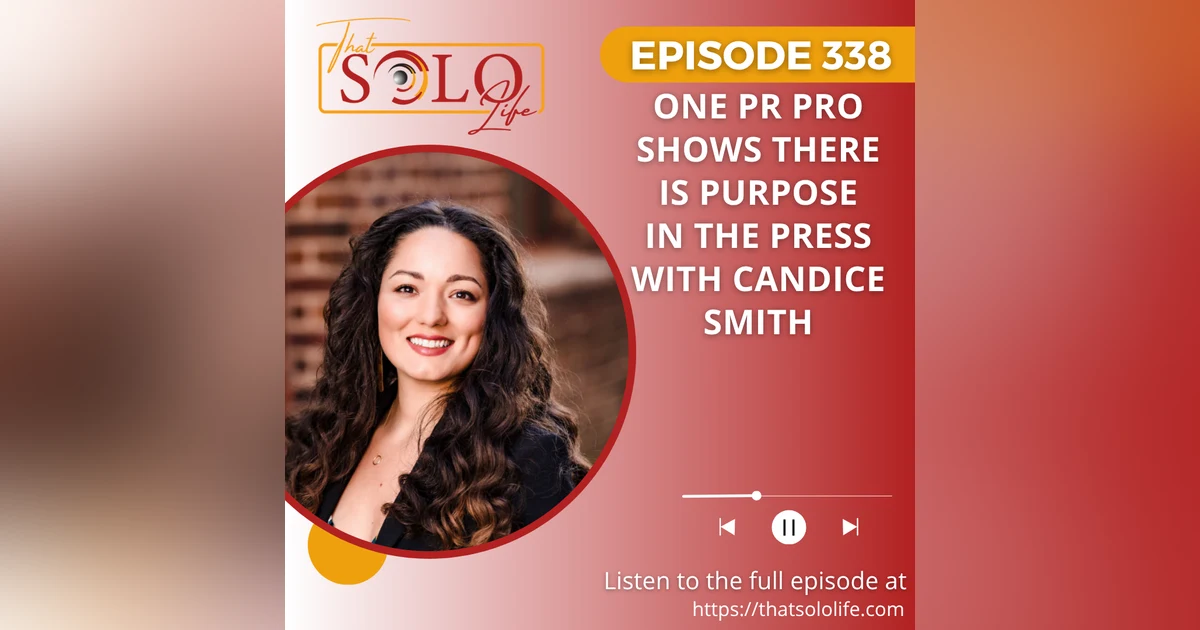


Episode 338: One PR Pro Shows There is Purpose in the Press
With Candice Smith, MEd, Founder & Chief Strategist @ French Press Communications
Episode Summary
Running an independent public relations business requires more than just excellent communication skills. You need a solid strategy, a growth mindset, and a commitment to continuous learning. In episode 338 of That Solo Life, hosts Karen Swim, APR and Michelle Kane sit down with Candice Smith, MEd, to explore how educational frameworks can transform your solo practice.
Candice brings a unique perspective to the table, blending her background in education with extensive experience in communications. We discuss the importance of structuring your business to support both your personal goals and your clients' success. The conversation covers practical ways to implement better systems, the value of defining your core services, and how to position yourself as an authority in your niche.
Whether you are just starting your independent journey or looking to scale your existing practice, this episode provides actionable advice to help you build a sustainable business. Candice shares her proven strategies for managing client expectations and creating workflows that save time and reduce stress. We also dive into the psychological aspects of running a solo business, addressing how to overcome self-doubt and step fully into your role as a trusted consultant.
Episode Highlights
- [02:15] How Candice applied her Master of Education background to the public relations sector.
- [08:30] Using instructional design principles to improve your PR client onboarding process.
- [15:45] Proven strategies for defining your core services and establishing healthy boundaries.
- [24:20] Overcoming self-doubt and positioning yourself as a premium communications consultant.
- [32:10] The specific systems Candice uses to streamline her daily workflow and boost productivity.
About Candice Smith, MEd
Candice Smith, MEd, is a strategic communications professional who leverages her educational background to help brands and practitioners tell better stories. With a deep understanding of how people learn and process information, she builds compelling public relations campaigns and helps fellow solo professionals refine their business systems. You can connect with Candice and learn more about her work on LinkedIn.
Related Episodes & Additional Information
- Episode 325: Structuring Your Solo PR Business for Sustainable Growth
- Episode 312: Going Big by Going Small
- Resource: Solo PR Pro Premium Membership
Host & Show Info
That Solo Life is a podcast created for public relations, communication, and marketing professionals who work as independent and small practitioners. Hosted by Karen Swim, APR, founder of Words For Hire and President of Solo PR, and Michelle Kane, Principal of Voice Matters, the show delivers expert insights, encouragement, and advice for solo PR pros navigating today’s dynamic professional landscape.
Take the Next Step in Your Solo Journey
If you found value in this conversation, we encourage you to subscribe to That Solo Life on your favorite podcast platform and leave us a review. To connect with a supportive network of like-minded independent practitioners, visit soloprpro.com/join and join our community today. Your thriving solo business awaits!
00:21 - Welcome to That’s Solo Life
01:28 - Candice’s Journey in PR
05:33 - Evolution of French Press Communications
11:47 - The Shift to VizDev
13:29 - Understanding the AMORE Framework
17:44 - The Role of Relationships
19:05 - Navigating AI in Communications
28:40 - The Importance of Context
31:07 - Sustaining Business Development
36:28 - Finding Joy in Your Work
40:39 - Intentional Visibility and Connection
41:59 - Closing Thoughts and Connections
With Candice Smith, MEd, Founder & Chief Strategist @ French Press Communications
Michelle Kane (00:12):
Thank you for joining us for this episode of That Solo Life, the podcast for our PR pros, marketers, all sorts of communicators who work for themselves. People like me, Michelle Kane with Voice Matters, my wonderful co-host, Karen Swim of Solo PR Pro. And today we are so fortunate to have a guest with us. We are joined by Candace Smith. She is the founder of French Press Communications. Hi, Candace. How are you today?
Candice Smith (00:42):
Hi. I'm great. Doing really well. Excited to be here. Thank you for having me.
Karen Swim, APR (00:47):
We are so excited to chat with you today. Our listeners, I want you all to know right now, let me just give you a minute to grab a cup of tea or coffee or water because you are going to want to be planted and lean in to your AirPods, earbuds, however you're listening or if you're watching, you're going to want to just take a moment distraction free because Candace is amazing.
Candice Smith (01:18):
Oh, thank you. Absolutely. Grab your French
Michelle Kane (01:19):
Press. Yeah, exactly. Right? Once you try French press coffee, it's hard to go back to that drip stuff. Yeah, totally. We could have a whole other episode about coffee, right? But let's talk about you and your business. I mean, your path to PR is something. Let's start with that because that'll give us a little background on you. It certainly wasn't linear. You went from Harvard to Teach America to educational technology before you landed in the world of comms. But through that, there's a through line. Now, what would you say is the through line that draws through all that chapters? And how does that show up in your work today with your clients?
Candice Smith (02:04):
Yeah, absolutely. I mean, gosh, through line, if I had to look at everything across my career trajectory, meandering, though it has been, I would say storytelling is really the through line. And thinking through how to tell my own story and how to share others' stories as well. If I could dive a little bit into my past, I actually am the first person in my family to go to and through college. And with that, especially being someone who is mixed race, Latina, I am half white, half Puerto Rican, German English, Irish, whole mescla of different backgrounds and identities from Europe. But being very white presenting, I have always found it difficult to share my own story. There has inherently been a lot of shame that I either inherited or was taught to have inadvertently or openly by some family members about the way that I present myself.
(03:33):
And so other listeners who might have mixed race backgrounds will recognize code switching. It was something I did a lot, something I still do a lot. I mean, gosh, you put me in a room of New Yorkers today. My accent just changes out of nowhere. Love it. I've been living in Raleigh, North Carolina for six years and then get me back in Brooklyn, baby. And I'm totally different, girl. So it really is interesting when we think about how do we show up to the world and how do we tell our stories? And so when I went into college for the first time, I didn't really know what to choose for myself as a path. And I landed on women, gender and sexuality studies. I also got a minor called a concentration in art and art history and Spanish language and literature. But my big focus was women, gender and sexuality studies.
(04:44):
And through that, I was very interested in the silencing of the other, right? And the silencing of the minority versus the majority and who gets a voice, who gets to say what is saved in the annals of history. And through that, I also became interested in education as a vehicle to tell those stories, which really brought me into Teach for America, my first business, and so on and so forth.
Michelle Kane (05:18):
That's incredible. That
Karen Swim, APR (05:19):
Is a very rich background. And we are definitely going to have you back on our show again because there are just so many themes that I feel like we could unpack even further. But I love that in this era where we're questioning and communicators are trying to figure out how to continue with being inclusive and continuing to drive forward DEI when the focus has been taken off of the human issue and it's become a political issue that you are one of those people that fully highlight that diversity is humanity. Like your background, we're talking about a human being who has diversity as part of who she is. That is your identity. Your parents are who they are and that ... So you were born with this richness, these multiple heritages that are part of what shaped you. And I fear that we're kind of losing that, but I know that communicators are fighting for ways to still make that relevant and to tell those stories and to tell stories in meaningful ways to various cultures because we hear things differently, we have different experiences that we tap into.
(06:53):
So that's a topic for another day.
(06:58):
I do want to ask though, this has come up a lot in the PR community recently. At one point, you were French press PR, and then you moved over to French press communications. And I'd love to know about that change and what motivated this evolution of your business.
Candice Smith (07:20):
Yeah. Yeah. I love that you called it an evolution because that's what it really feels like. I think there are macro and micro moments in our careers, in our work with others, in our work with industry leaders and within the news that we're reading that give us an understanding, especially as communicators, perhaps a little bit earlier of where the tides are turning. And something that I started to notice with not only AI and the advent of AI a few years ago, but also in terms of the quality of pitches and the types of pitches that were starting to land and not landing with clients, things that had been working that suddenly stopped working, those started to give me indicators that we were in a shift with PR. And I think, especially because I started my career as a social entrepreneur and not necessarily learning the quote unquote right way or the academic way to approach public relations, I started looking at patterns of what was working for my clients and also what was working for myself when I was closing clients.
(08:56):
The questions were different. The needs were starting to shift in terms of outcomes, in terms of reporting. And something that I started to really see was that experiences across the board, they were really the thing that was making a difference when I was trying to get a foot in the door with a journalist, let's say. And that was just one of the indicators, right? So the traditional pitches, the press releases, and we can talk about press releases now and how it helps with AIEO and SEO and digital footprint and all that, right? But I really started to notice that the traditional way of doing things when I started years ago, it had stopped working as efficiently. And what was working was when I said, "Hey, listen, here's how you can experience this thing. How can we package it differently? Can we provide a different unboxing experience?
(10:02):
Can we have some sort of special quiz or something that we can do to provide a different hook, a more authentic or relatable angle?" So that was one piece that started to get me thinking, okay, something shifting here. And then the other piece for me where we started to go from PR to communications more holistically was also looking at where founders were. I work with a lot of founders. I work with a lot of startup scale up, small, medium businesses. And what I was seeing, and actually interestingly, not just with founders, but with some larger scale businesses that need to think about some of the new initiatives that they're launching as if they are little businesses in their own right, that they were lacking systems, that because what had been working was no longer working, the inherent systems that they had become used to were no longer working and people were starting to scramble.
(11:17):
They weren't understanding the value of PR traditionally in the same way. And so we had to really start thinking, "Okay, how is marketing connecting with PR? And are we really making sure that when we bring folks to the top of your funnel, that they are moving through?" And how do we do that? Because our job is supposed to be to bring the horse to water, but what do you do if the horse isn't drinking the water? And so we needed to start having more and more of those conversations about really taking the inbound opportunities that were coming and understanding them as systems, understanding it. And this is where Visdev started to come about. That's my own approach, my framework, as opposed to BizDev. So Vistev really BizDev is where you figure out your pipeline to revenue. And Vizdev for me is where you figure out your pipeline to trust and authority, right?
(12:25):
And those two things are very closely interconnected and intertwined more so than people think. So that's really where we started to make that shift is going from sole execution to execution with strategy first, right? And having that deeper understanding of a client's business and where they want to go with their visibility and why, and how does that translate into traction for them. So
(12:57):
That's really the shift over the past couple years.
Michelle Kane (13:01):
And such a wise shift. And really it led to your developing your Amoray framework, which I love the name of that. All right, shout out to old school Philly people. It's the Hooters first EP. But anyway, but tell us a little bit more about that as well, because I think that is just, it's so smart and it encapsulizes it so well, and I'm sure it helps clients wrap their minds around your approach.
Candice Smith (13:30):
Yeah, absolutely. So like I said, Visdev, to bring it back just a second, when I say visibility, because I'm an educator, big on definitions and getting aligned from the beginning,
(13:46):
Visibility is the system that combines marketing and PR together. And how do I define marketing and PR? This is not a business school definition, but marketing I define as the story that you tell the world about yourself and PR is the story that others tell the world about you. And so when you have a solid proactive visibility strategy that combines those two pieces of marketing and PR together tangibly and in a way that you can repeat, that is very important. It becomes the foundation of your brand or your business, and it's how you show up and how you become known. And so when we think of Visdev being the pipeline to trust and authority, we need to start by understanding where are we showing up? And that's where Amore comes in. Amora is an acronym for the pillars of channels that you can show up to build love or Amori for your brand.
(14:57):
So when we think about Amoray, we start with A for authority, right? So A is anywhere that you're sharing your opinion, your voice, your ... Yeah, I said opinion, your opinion or your voice on somebody else's platform, right? So that could be podcasts like what we're doing right here. That could be standing on a stage. That could be sharing your opinions in an op-ed, something like that, but it is on somebody else's platform. M, slight bit of a misnomer because I say M is for marketing, but it's paid marketing, right? So you are amplifying, you are paying to amplify the posts or the opinions that you're putting out into the world. That could be paid promotions, boosting, that sort of thing. That's where you lump in your retargeting ads and things like that. Oh, it's for owned media. That is the one pillar where you have the most control over your voice, right?
(16:05):
And that's your platform that you are building. So that could be your website, your podcast, your blog, your Substack, your social media hub, right, your profile page. That in and of itself is the place or are the places where people come find you. Our is for relationships. I think this is the most underappreciated part of visibility because it's not on any official trackers. You're not sharing your relationship metrics to VCs to say, "Hey, I made five new contacts this week and I know that they're going to potentially turn into leads or what have you. " But ours for relationships and relationship building. For me, that's my most powerful and has had the most impact on my own career trajectory. That's my channel. That's where I live in that pillar. And then E is for earned media, and that's what we think of as the traditional PR.
(17:24):
So
Michelle Kane (17:24):
Showing
Candice Smith (17:25):
Up in other folks, showing up on other folks' platforms, but they are publishing about you, and that builds that trust and authority. So when we think about that Amora framework as a whole and look at those pillars, you don't want to be in all five all the time. You want to be putting most of your effort into two or three and letting that be a part of your pipeline because there are multiple ways to then convert, nurture, convert, measure, amplify, iterate, et cetera.
Karen Swim, APR (18:05):
I love that you called out relationships in your framework because in my own work, relationships have played a role in our strategic planning. We have introduced clients to other executives for networking, for brainstorming, for opportunities. We've introduced them to partners, to investors, to customers, to customer communities. And I think that many in communications may do that as just kind of the day-to-day, but not putting a structure around that being part of the strategic plan that you're operating under. And as you noted, it's seasonal, right? We think about introducing people to the media, but all of those other connections that we are making, that we're facilitating on behalf of that client drives the business forward and that's vital. And that kind of leads into another question, relationships, human beings, people are questioning that value in this era of AI. And I know on one hand, we're all sick to death of hearing AI.
(19:18):
We're sick to death, hearing people sing the praises. We're seeing companies make rash decisions where they believe that you can just replace people with ChatGPT. I want to talk about how you address that with prospective clients or your own clients when they are not seeing the full picture.
Michelle Kane (19:46):
Just a little
Candice Smith (19:47):
Question. No big one. It's heavy. It's heavy. It is. It's something
(19:55):
That I've found at times demoralizing. And I think a number of people that are listening might agree with that. There's a lot to be said about confidence and AI has it in spades. And so when you are making a case with a client to not trust something that seems to be presented and packaged in a way that is clearly faster, seems logical enough at first glance or maybe even second or third glance, and it yeses you to death. I mean, that becomes a very difficult conversation to have, especially because it's not a one-time conversation, it is an ongoing conversation because I use AI in my workflows, I think there's quite a lot of value to be had from AI at the right place at the right time, but there are many places where especially clients feel like they can skip some of the steps that perhaps aren't as immediately valuable or feel a little frustrating because of the in between time that all creative communications work takes.
(21:40):
They're like, "Well, let's just get to the good part. Let's just skip ahead." I know what I want my content calendar to be. I know because I fed in to ChatGPT, create my content calendar, and I want 150 posts. And all of a sudden they have 150 post ideas and, "Oh my gosh, now we're going this direction." And it's like, hang on a minute.
(22:08):
What we're missing here is context. What we're missing here is lived experience. Just because you can pull from a hive mind and a very, very, very intelligent code does not make that authentically your brand. And it also does not mean that you are able to replace good strategy, brand identity, thoughtful brand identity, and your unique value proposition with something that could be spit out and is probably being spit out for a bunch of other people, right? So what you're ultimately doing when you are creating this vomit of content, honestly, what you're doing is you're just creating more slop as people are calling it, right? Yeah. It's just generic. And I've found it myself when I was ... I've been doing a lot of research into my own brand and having a lot of conversations with AI just to test it, to see can I actually get some of the smarter, more sophisticated LLMs to give me something concrete of value and really spark interest and spark newness and ideas.
(23:44):
And the more that I read it, the more I'm like, "This is not it. " It's missing the spark. It can regurgitate back to me a lot of what I say and it's fantastic for finding patterns. And I will say I use that to find patterns. I use AI, for example, to examine transcripts of conversations that I've had of
(24:12):
Mentorship conversations, anonymized conversations with clients to see, what are the things that I keep saying? What am I talking about? What is my own secret sauce and how does it keep evolving? Brilliant at that, terrible at turning it into the next step. And that's what we have to keep telling and reminding our clients is that I'm here to get to know you and your brand and no matter how much you prompt and give context, and I'll tell you, most clients who aren't communications professionals don't know how to properly prompt, miss a lot of context, which is a whole other issue, but the LLM doesn't know who you are
Michelle Kane (25:08):
And that's
Candice Smith (25:09):
Why we're working together.
Michelle Kane (25:11):
Yeah. Which is what our job is, is to build that relationship. It's funny, as you were talking, when you said spark, it sparked in my mind, you could have the really pretty YouTube fireplace running, but it shows no warmth. You don't get the warmth of the real fire as the difference. It's like, "Yeah, I can hit a button, but it's not going to get us all the way there." Exactly.
Karen Swim, APR (25:35):
I think you hit on a couple things. Number one, the confidence because I use AI a ton, like a ton. I built workflows, I built programs, I've built all kinds of things that are beautiful. And even content where I will take raw notes and I will prompt it to do certain things. And I've prompted my AI to ask me probing questions after everything. And some of those questions are
(26:04):
Just get you thinking levels deeper. So I think it's important for communicators. Sometimes it's humbling like it would have taken me three hours to do that and Claude just did it in 20 minutes, but use AI because from the beginning, I heard this theme from communicators, robots can't write for us, robots can't do this. And so there was this anti-AI, use it, use it deeply, master it, get ahead of it because the more you use it, you have a deeper understanding of how it strengthens you and the work that you can do. And I think that that makes you better able to articulate your differentiation and your value to clients. And it actually can make you more confident. I noticed that I've always cared deeply about the work, but I care even more deeply because some of the things that
(27:08):
Were had to dos with the relief of that, me not having to work through all of these manual tasks that did not require higher value thinking have freed me up to really spend three hours just thinking through and testing strategies and really being able to use what really is a value to the client. That's what you're paying me for. You're paying me for my lived experience, you're paying me for how I think, you're paying me for my creativity, you're paying me for things that AI cannot do. AI can support that. AI can help me to execute a lot of things. So I think that if you don't use it, you won't have a good answer. And then people will think that they can just reduce you and that they can do this stuff. And I love teaching clients how to use it in their own businesses.
(28:05):
Here's the smart way that you can apply it. Far too many people turn people loose in their clients. And I've seen this from content people that use AI and they turn out a bunch of garbage. Yeah. This sucks and you didn't even fact check any of it. This is not good.
Candice Smith (28:22):
It's so true. It's
Karen Swim, APR (28:24):
So true. Neature people invest in courses for them and show them how to use their brain with AI, not outsource their brain and just say, "It's words on a page and it meets the word count." No, mm-mm.
Michelle Kane (28:39):
Not
Karen Swim, APR (28:39):
Going to work.
Michelle Kane (28:39):
No, no. That's
Candice Smith (28:40):
Not it.
Michelle Kane (28:41):
It's not it. Like you said, the context is king.
Candice Smith (28:44):
It is. The context is king. And I got to say, I think some of us, I can't obviously speak for everybody, but I know that a lot of people in communications at least, I don't know if it's some kind of an uncanny valley type of lizard brain recognition, but I'm starting to glate, my eyes glaze over the second I start to recognize the repetition of the patterns, the way in which the logical arguments are laid out, it is an immediate red flag and I'm done. And we live in an attention economy, there's no question. We live in an attention economy and when you are fighting to grab the attention of someone who is scrolling and has an algorithm that is pushing, pushing, pushing you to keep moving forward, you have very, very limited bandwidth and they have limited bandwidth, so you better make it work.
Michelle Kane (29:57):
Yeah, for sure. For sure. Sure. And it's interesting when this eventually airs, it'll be a few weeks after the Artemis two voyage. And I don't know if you've heard one of the items that have been bandied about is NASA's take, that yeah, AI is great, but there are some things that only the human eye and human mind
(30:25):
Can process, take care of, take in. And for an organization that of course you just think science, automation numbers, no, no, no, no. There's artistry in everything and our humanity is needed. And as we navigate our workflows, our businesses, our volume, it's a scary and wonderful time to be in this business. It really isn't a sad sack time. But I mean, you're seeing that reality. There's a feast or famine reality in our solo work and microagency work. And you're navigating that yourself, but what does it actually look like from your point of view to sustain business development when you're also deep in client work? Because isn't that where we all live? And is there anything you've had to unlearn?
Candice Smith (31:24):
Oh, gosh. Yeah. I mean, plenty. I feel like I'm unlearning and relearning things all the time. When it comes to business development for myself and getting new clients, I mean, I'll be honest with you, I was in a pretty, what's the word I'm looking for? Secure. I felt secure last year. For I'd say Q1 through Q3, I had a really solid roster of clients. We had multi-year contracts figured out and I was allowing myself mistake to get into the mindset of, all right, I can cruise a little bit. I'm working on these clients. I got a ton of work to do. And pipeline smipline. I don't have to worry about that for a little bit. I've got so much on my plate right now. And gosh, we put together some incredible work. We built out events from scratch and invited media to come. And I was out there building furniture to build out a booth of all the branding that we created for this gorilla marketing campaign, Gorilla Marketing PR campaign.
(32:59):
It was so much fun. And gosh, the lack of sleep was actually invigorating. It was one of those things where I was like, "Man, this is pretty good. I feel pretty good." And then I had the rug pulled out from underneath me. And there were a number of scenarios that were outside of my control, abrupt change in leadership that was unexpected, abrupt change in budget for the next year that was unexpected.
(33:35):
There was even a hostile takeover that happened with one of my clients that I can't get into. But needless to say, I went from having four or five really solid clients to two and then one. And I was like, "Oh my God, I haven't been focusing on this. What do I do? " And I was in a place where I was thinking about this pivot and how much further do I go into it, et cetera, expansion, scale. And it was humbling. It was very humbling.
Michelle Kane (34:14):
Sure.
Candice Smith (34:17):
And I took some time as I was thinking through what are the next steps, right? Because I've been in a place where I had almost no money left in my bank account. I stopped paying myself so that I could continue paying my team so they wouldn't go elsewhere. There are ups and downs in business, there's seasons. And it was a fantastic reminder to me, especially because I took a step back and I was like, "What am I doing this for?
(35:00):
Why have I worked so hard when it doesn't matter?" And I had a chat with a client of mine who's a personal friend as well, and she said, "God, it makes me so sad that you say that because you came into my business when I was getting started and you saw things in me and my brand that I was unable to see and you changed my entire trajectory." Yeah, we got into Time Magazine. Yeah, we got into Wall Street Journal, all of those things. Amazing. And you helped us with that. But what remains when those features get buried and more things come about is I have this identity as a business owner that I can lean back on. She said, "You have done so much for me. Don't forget that. Don't forget that value." And I'm like, "Oh, thank you. " Validation. But I took a step back and I was like,
Michelle Kane (36:07):
"You
Candice Smith (36:07):
Know what? She's right." I do pride myself in the work that I'm able to do to connect with people and to see their stories in different ways and be able to tease those out and see how can I continue to provide value in that way, right? That value is not gone because I've lost some clients due to circumstances that were out of my control. Exactly. In fact, the people that I connected with, they're like, "Gosh, the next time we have opportunities for you will come back." Burned bridges. So in a roundabout way, I mean, this is a very long way of answering a short question.
Michelle Kane (36:52):
It's okay.
Candice Smith (36:53):
I'm working on it. I'm
Michelle Kane (36:55):
Working
Candice Smith (36:55):
On it. I'm continuing to go back to my network. I'm continuing to think about my own media. I'm continuing to think about my relationships and who I've connected with over the years. And also, maybe this sounds a little hokey, but what brings me joy? What do I want to be working on right now in this season? I don't want to start lowering my prices and taking on folks because of a feeling of desperation and going back to my early days where I was working with folks that really weren't aligned with the way that I work because they were like, "Well, no, I just want a quick in and out, get me this feature here and get me this feature there." And I'm like, "You want me to pay them under the table?" I can't do that how that works. If you want to pay to play to get into Forbes, I know how you could do it, but I mean, the value, why are you doing it?
(38:03):
I'm done having those conversations. I'm looking for something more aligned with Vistev and with me.
Karen Swim, APR (38:14):
And that's a scary place to be. We've all been there more than one time. And something I've been saying a lot recently to other people, because the past year has been tumultuous for everyone. I don't care what kind of business you run. It's been tumultuous. It's just been a lot of upheaval and uncertainty and we're here. No, we're there. We're doing this. So price is going up. Just all these things that we're being hit by. And I've been saying, because I took this advice myself, let yourself be quiet. Don't fear the space that's being created because that space can serve you. You are not acting out of desperation as you noted because that's what we do, right? We're scrappy and it's like, okay, I'm just going to go get this work. I'm going to do this. I'm going to do that. If I have to take on this project that's smaller than what I would like.
(39:13):
And it really does ... No,
(39:16):
Let yourself be quiet and really start to reflect and think about what do I want? What really makes me happy? And I think that takes courage of living in that state of being uncomfortable. But you know what comes from that is growth, real growth. Yeah. Because what got you to where you are today is not necessarily what you're going to need to get you to the next level, whatever that means for you. So I like that you said, I stopped and I asked that question, and I think that that can just reveal so many things about our work and the path forward. And often that space comes at a time that we don't even realize that we need it to define how we're going to operate going forward. There are changes that need to be made, growth that needs to happen. There are skills that need to be sharpened.
(40:16):
So thank you for being so transparent because I think solos and microagencies, you always think it's just you. Everybody else, they're on LinkedIn and they're like happy shiny and they got it all figured out and business is pouring in and they're not affected by any of this. They are. Absolutely.
Candice Smith (40:39):
Absolutely. And if I can add as well to the moments of silence that we need to honor within ourselves, I also want to say, listen and start being intentional about where you're showing up, right?
Michelle Kane (40:58):
Yes.
Candice Smith (40:58):
Because that has been the other side of the coin for me. I'm a visibility expert who feels largely or who has felt invisible in many ways, right? Because I'm working in my business and not on my business. And right now, with the moments of silence, I am able to start asking others, "What do you need? What are you looking for? How can I be of service? How can I support?" And that goes for any business owner, right? Not just agency owner, PR, professional, anything like that. Really thinking, where can I bring value to the audience that I want to be working with and just listen, listen and go from there.
Michelle Kane (41:58):
I love that. Oh, Candace, this has been an incredible time with you. We're so glad you're here and we will definitely have you back. Where can people find you online? What's the best way for our listeners to connect with you if they wish?
Candice Smith (42:13):
Yeah. So you can find us at frenchpresspr.com. I know. Still the old URL, but you can find us there. You can find me on LinkedIn, Candace Smith, MED. Reach out, connect. Always happy to answer questions and meet new folks. And then if you're interested in learning more about Visibility Development, Visdev, and you want to know what are some of your primary channels that you should be leaning into, you should take our VizDev quiz. So you can find that at Bitly/Vizdev, V-I-Z-D-E-V, Bitly.com or B-I-T.ly/Vizdev.
Karen Swim, APR (43:06):
And we will definitely have that makes it- It's very comprehensive. I started going through it a couple weeks ago and I loved it. I love the thinking and the questions. So I highly recommend that to communicators to
Michelle Kane (43:20):
Do
Karen Swim, APR (43:20):
That because not only do we have to take care of clients and their visibility, but we need to do that for our own brands as well.
Michelle Kane (43:30):
Exactly. We do, don't we? Yeah. Yeah. Well, thanks so much, Candace, and to our listeners. Thanks for joining us for this episode of That Solo Life. Share it around, hit us up with your reviews, check us out at soloprpro.com and soon or maybe now, I don't know, that sololife.com. We'll see. Go check it out and see if it's up yet. Anyway, we are so glad you joined us and thank you again, Candace. We will be talking to you again soon. I know that for sure. And until next time. Amazing. Thanks for listening toThat Solo Life.