The Big Idea with Jess Sato
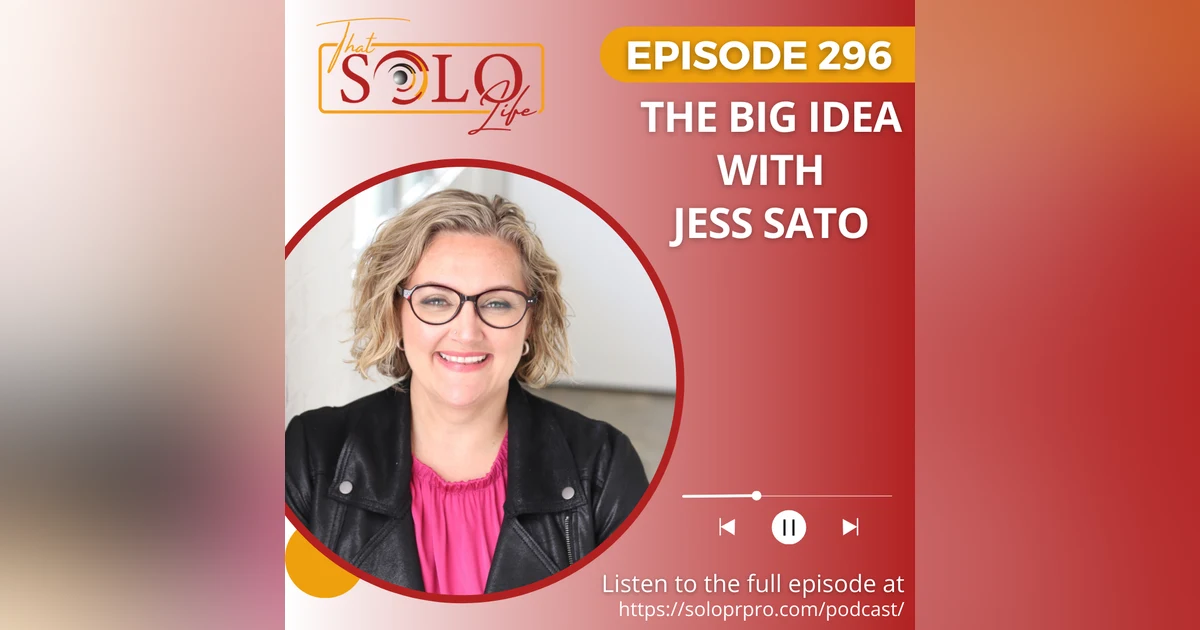

In today’s episode, co-hosts Karen Swim, APR (Solo PR Pro) and Michelle Kane (Voice Matters) discuss how to strategically decide which awareness and marketing campaigns to align with (and when to pass).


That Solo Life - Episode 296: The Big Idea with Jess Sato Episode Summary
This episode of That Solo Life dives deep into the world of business growth, messaging, and creating meaningful impact. Co-hosts Karen Swim, APR of Solo PR Pro, and Michelle Kane of Voice Matters are joined by special guest Jess Sato, a business growth and visibility strategist. Jess shares powerful insights on how purpose-driven entrepreneurs and thought leaders can identify their “big idea,” use it to stand out in a crowded marketplace, and create lasting change. Whether you’re looking to refine your messaging, grow your visibility, or tackle roadblocks on your entrepreneurial path, this episode offers actionable strategies and thought-provoking advice to move the needle in your work.
Key Takeaways- Defining the Big Idea: A “big idea” doesn’t have to be completely new. Instead, it’s an audacious or bold concept that challenges the status quo, demands attention, and inspires action.
- The Bolt Method Framework: Jess's Bolt Method helps clarify and amplify big ideas by focusing on four pillars - Bold, Original, Loud, and Tenacious.
- Living Your Passion: Entrepreneurs can align their personal passions with business objectives to create both purpose and profit.
- Overcoming Challenges: Common roadblocks like imposter syndrome, impatience, or messaging struggles can be overcome with introspection and strategy.
- The Power of Rebuilding: If your work no longer feels aligned, don’t be afraid to take the time to pause, reflect, and pivot to rediscover your authentic purpose.
Jessica Soto is a business growth and visibility strategist who helps purpose-driven female entrepreneurs, thought leaders and change makers clarify their big ideas, amplify their message and create lasting social impact. In this podcast episode, she discusses her process for helping clients find their "big idea" - a bold, original perspective that challenges the status quo and inspires people to take action. Soto highlights common roadblocks her clients face, such as distilling complex expertise into a cohesive core message, and provides strategies for overcoming these challenges. She also advises on building a platform for thought leadership, evolving one's message over time, and the importance of authenticity and transparency with one's audience.
Episode Timeline
- [00:00] - Introduction from co-hosts Karen Swim and Michelle Kane
- [00:32] - Welcoming guest Jess Sato and learning about her background in corporate strategy and leadership development
- [01:14] - Jess describes her transition to working with female entrepreneurs and social impact leaders
- [03:33] - The definition of a big idea and why it doesn’t have to be groundbreaking to be bold or impactful
- [05:12] - How passion, experience, and identifying audience needs converge to form a functional big idea
- [09:13] - Common roadblocks faced by entrepreneurs when refining and presenting their big ideas
- [13:03] - The Bolt Method explained and how it helps craft unique and powerful messaging
- [20:13] - Aligning your big idea with platforms, stages, and communication styles to amplify your message
- [26:02] - Evolving your message and giving yourself permission to pivot when your work no longer feels aligned
- [35:12] - What it means to create a lasting legacy through your work and voice
- [37:05] - How to connect with Jess Sato and closing thoughts from the co-hosts
- Connect with Jess Sato on LinkedIn
- Visit Jess Sato’s website at jessicasato.com
- Learn more about Solo PR Pro at soloprpro.com
- Karen Swim, APR - Solo PR Pro, LinkedIn
- Michelle Kane - Voice Matters, LinkedIn
Enjoyed this episode? Subscribe to That Solo Life on your favorite podcast platform and leave us a review! Your support helps us share inspiring conversations with solo PR pros and marketers everywhere.
We hope you enjoy this conversation with Jess, Karen, and Michelle!
Michelle Kane (00:13):
Hello, and thank you for joining us for yet another episode of That Solo Life, the podcast for PR pros and marketers who work for themselves, people like me, Michelle Kane, with Voice Matters, my wonderful co-host Karen Swim of Solo PR Pro, and today we are so happy to welcome a guest with us today. Her name is Jessica Soto and she is a business growth and visibility strategist who helps purpose-driven female entrepreneurs, thought leaders and change makers, clarify their big ideas, amplify their message and create lasting social impact. So we are ready to hunker down and talk shop with you. Jess, thank you for joining us today.
Jess Sato (00:54):
Thanks so much for having me. I'm excited to have this conversation with you two
Karen Swim, APR (00:59):
You are going to wow our audience, I'm so excited to dig in. Jess, thank you. Thank you for being here with us today.
Jess Sato (01:08):
Glad to be here.
Karen Swim, APR (01:10):
Well, let's jump in. Tell us a little bit more about your background. Let our audience know besides that brilliant intro and what you do, tell us a little bit more.
Jess Sato (01:22):
Yeah, so I'm guessing probably many of you, I grew up on the corporate track. I spent my early career doing strategic decision making for the military. I was a civilian contractor and really did a lot of digging in and really helping people think through how do we make big strategic decisions in a really structured and thoughtful way. And then moved into what ultimately has been a bit of a calling, which was around leadership development. How do we help leaders be the best version of themselves, whether that's in corporations, as entrepreneurs, in social settings, how do we really help people step into that place where they're bringing the fullness of who they are to the table and inviting other people into that journey. And in the last, I would say probably five or six years, I focused almost exclusively on female entrepreneurs, particularly Karen, Michelle, as you mentioned, those people who are really passionate about making social impact and a recognition that you can run and build businesses in a way that is balancing both the purpose angle that you want to do more than just make money, but also that you do have to make money as a business owner.
(02:45):
So really holding that tension and space and working with entrepreneurs to really figure out how do we do that well, how do we do that? And also speak out about the issues or challenges that we're seeing. Whether that's on a social level depends or more likely in our industries, how do we use our voice to take a stand against the things that we're seeing or to differentiate ourselves more likely and use that as a tool for creating impact.
Michelle Kane (03:11):
I think that's what you do so beautifully when you work with people, right? Because we all have these different experiences and expertise. How can people take all of that and create their aligned message? I know that's a big ask for sure, but just the essence of that when you're working with people so they stand out.
Jess Sato (03:33):
Yeah. I want to start, maybe start answering this question by giving a definition for what I think a big idea is because I think there can be in some cases misconceptions about do I even have a big idea? And for me, a big idea doesn't have to be this brand new invention. It doesn't have to be this brand new perspective. It really comes down to having a, I sometimes add the word audacious, an audacious or bold idea that challenges the status quo, inspires people to take action and really demands or commands attention in the marketplace. And that stems from a couple of things. It starts probably first and foremost with what is that thing that you're really passionate about or that really gets you that you think this isn't quite right. So we start with passion and really looking at that as the primary thing.
(04:33):
And then we pull in your experience and your expertise because we do need to be credible, especially if you're an entrepreneur or a thought leader, you have to be a credible person. And that usually comes either from your professional background, your educational background, some of it could be your lived experience. And then is there a need? Is this even an issue that people care about? Because you could be super passionate about something, you could have a lot of experience and expertise around it and it could completely fall flat from a messaging perspective because it's just not that interesting or there's just no general sense that this is an issue that's worth addressing. And so we try to get this almost like if you think about it like a Venn diagram, we try to bring these three elements together and that big idea lives in this sweet spot where they are all overlapping.
(05:24):
So for me, the way I work with clients is really getting them to think about and go deep on what first and foremost, what is that thing that when you look at your industry, when you look at what's happening on a social level, when you look at something and it just really, when you start to think about it, it really likes you up. It's like you can't stop thinking about it or if only this would change or if pushing back against something that just doesn't feel right. Those are the things that we start with and it allows us to really start to sink our teeth into it and then dig deeply to figure out, okay, well what does this look like? How do we frame our work, our message, our thought leadership around it?
Karen Swim, APR (06:11):
You said something that was really intriguing. A lot of people start businesses from a passion, it's a problem or something that bothers them and they want to solve it, but all those businesses aren't successful. And you hit on something that I think people don't talk about when it comes to big ideas. It has to resonate with a big enough audience. So tell us how do you align that if somebody is really passionate about something, it's their big idea, but there's just not a big enough audience to make a difference. Are there other ways? Do you channel that into something different? Do you redirect the expectation or do you try to help them find something that is bigger and more important to the audiences that they want to reach?
Jess Sato (06:59):
What's interesting about that question as you're saying it? I'm thinking I've literally never had that happen. Mostly because what people come to me with are either too many ideas or an idea that's too big and we have to scale it down. So I think if I were to flip that and maybe there was an idea that was maybe a little too niche, we might try to do the opposite approach and open it up a little because we all know being niched down is actually really effective. So yeah, I think if I were to have a situation like that, I probably would dig into that by asking a lot more questions. And we would almost certainly end up doing, at least from a business perspective, we would end up doing some pretty significant market research to figure out, well, what is adjacent to this that allows us to expand but still hold the integrity of the idea? Because at the end of the day, we don't want to blow it up too big because then it doesn't work for us. And then on the other hand, if we blow it up too big and it loses the personal passion connection, then that doesn't work for us either. So it's a really interesting question, Karen. I've never actually had a scenario where it was too niche.
(08:27):
I might need to think about that. It's a really good question.
Michelle Kane (08:31):
Do you ever, along your process, do you find that clients hit certain roadblocks and how do you work through that with them or how do you advise them to handle that? Because I'm sure that's bound to come up from time to time.
Jess Sato (08:47):
Yeah, that's a great question. So I would say probably the biggest question or the biggest roadblock that comes up more often than not stems from that core problem we were just talking about. Where many of the people I'm working with are true experts in their field. So these are PhDs, these are doctors, these are people who have a lot of experience and expertise. So for them, it's actually a real challenge to take all of that expertise and bring it down into a cohesive core idea. So that is, I would say probably one of the biggest, most challenging problems is how do you distill expertise down into a core perspective and then use that perspective to then inform all the other things that you're doing. That's one thing. Another thing I see a lot is people tend to minimize their expertise. They will say, oh, this isn't that interesting.
(09:47):
This isn't really that new. This isn't. Maybe there are other people who are better suited to the message than I am. We have this way of minimizing our expertise and pretending like it's not as impactful or needed. And I always go back to you are uniquely suited to your message because again, like I said at the beginning, a big idea doesn't have to be this brand new thing. It can very much be what is your unique take on this issue or perspective because of your lived or professional experience? And because of that, that makes you uniquely qualified to actually put that idea out there. And then I guess maybe the third roadblock I see is people tend to be impatient. We're very much operating in a culture where people want instant gratification. They want to see instant traction and from your own work that just because you put it out there doesn't mean it's going to land the first time.
(10:47):
And so the way I think about this is people just aren't tenacious enough or their message isn't tenacious enough, and so we have to keep going back and putting it out there. Sometimes that message has to be reworked, sometimes the idea has to be twisted a little bit to land properly. But I find that most people are unwilling to give it the time it needs in order to really get traction. And so it's like, oh yeah, I had this really great idea, but it didn't land when in reality, no, you have this really great idea that's not landing right now, or it doesn't appear to be landing. But in reality it's just like people are like, wow, I need time to process that, and we're not giving them that time. That's sort of the three big roadblocks I see a lot.
Michelle Kane (11:32):
And I mean, my goodness, we come upon that with clients all the time, right? I tried it out. It didn't work. Okay.
Jess Sato (11:38):
Yeah,
Michelle Kane (11:38):
Exactly. Just so our wonderful comms pros out there listening who could definitely benefit from your help, if you could distill down your process, just get an idea of what the experience might be like.
Jess Sato (11:56):
Yeah, so I always go back to what is that thing that you really want to say? That's a core question that we ultimately answer. And I say it as if it's this simple, simple thing, but it's actually quite difficult. If you really take a step back and I say to you, what do you really want to say? Most of us are so bogged down in cultural barriers, systemic things that it's really hard to unpack this. So what I do with my clients is we dig into, again, we start with that passion. What is really lighting you up? What really gets your goat? And you're just like, I cannot stand what I'm seeing in my industry and I need to take a stand because I know better based on my experience and expertise. So we start with the passion piece and we dig through that. We pull in the experience and expertise that you bring that make you a credible person and that give you this unique lens.
(12:56):
And one of the things that I often find, I use a framework that I call the bolt method BOLT, and I really get people thinking about, is this idea that you're talking about, is it bold? Does it make you a little bit uncomfortable? Do you get that kind of squirmy feeling in your gut when you start to talk about it? Or when you think about even putting it out there because it's so counter to what everybody else in your industry is saying, is it original? This is where we pull in all of that unique experience and your expertise. We bring in your stories. Why do you care about this? What makes this so important to you that you are willing to be uncomfortable enough to actually put it out there? Then we dig into how do we frame this message? A big part, as you both know, is the industries that we're in the marketplace, the ecosystem is very noisy, so we have to cut through that noise, and that's what I call being loud.
(13:56):
How do you be loud in a way that is unique to you and that allows your message to do the work that it's intended to do? And then bringing in that last piece is that tenacity. What do we need to do to be tenacious in it? How do we, I don't want to say be a bulldog about the message, but there is an element of that where we do need to tell people, see why, and we stay persistent in that. And we are constantly refining the message, not from, this isn't working mentality, but from an adaptation and evolution perspective. Because as events in events are occurring, it's very easy for the message to lose its potency. So we're constantly looking at how do we reframe this in order to keep the message alive? Because usually what we're dealing with are not these fly by night ideas.
(14:52):
These are core perspectives that influence sort of the entirety of how you are doing your work, whether you're an entrepreneur and it's the foundation of your business and the way in which you do everything in it. Or if you're a professional in a workplace setting, how are you bringing your idea and your expertise to the table in a way that serves people over the long term? So a lot of it is deep one-on-one work where we're doing reflection, we're really tapping into experiences and expertise that maybe you have compartmentalized way back. That's a thing I used to do, but I don't do now. But isn't it relevant? And then we work our way through that bolt framework and then reformat our messaging from there.
Karen Swim, APR (15:40):
Wow, that's tremendous. I mean, in addition to having a specific reason for this process, this process alone sounds like it would benefit any professional, because as you're talking, I think it helps you to connect with what defines you, what makes you happy. And when you're really in touch with that, it allows you to pick where you want to spend your time and energy, the things that really drive you, what's important, what's going to move you towards the goals that are most important to you. Because sometimes we do lose that, right? In the process of just doing work, we lose that motivator. We lose our why, our big why, and sometimes we're putting our hands in place. It's just because that's what we're supposed to do, and there may be a time to pull back. So I love that. So once you've gone through this fantastic process and you're super clear, what next? Where does this big idea go?
Jess Sato (16:41):
Oh, this is a great question. So I talk a lot about finding what I call stages of your own making. And this is very much about you thinking about where does your thought leadership need to go? And it really comes down to a couple of things. It comes down to, well, let me back up. I think there's sort of two angles to this, and this is probably not going to be a surprise if you're in the media space, owned media versus I think it's borrowed media. You can tell that's not my total expertise. I'm trying to speak the lingo here, but I think about this as what are the stages that you own? What are the platforms that you own? And then what are the ones that you are borrowing? So I'm a huge believer, especially if you're an entrepreneur or if you are a person who is really trying to create change in an industry, it serves you well to own a platform.
(17:43):
And what I often see are you having your own blog or space where you are writing, this is on your own real estate, usually a website or something like that. Perhaps it's a podcast, perhaps it's new hosting events that are 100% your own, where your thought leadership can find a home. And then there's the other side of the equation, which is necessary, right? Because you do have to create awareness about your work and invite people in. And that's often easier done when you're doing that in front of other people's audiences. And so that could be social media, that could be on other people's stages. So big stages, little stages. A lot of my clients do TEDx as a primary stage, but it's not the only one could be that you are a guest on other people's podcasts. It's like you need to think about what's necessary for the message itself in order for it to have the resonance that it needs.
(18:43):
And then from there we really dig into what is the way in which you like to communicate the information. I know for me, I am not a huge video person. Everyone's like, you've got to do a video. You've got to do video. And I do video, but it's not my preference. My preference and the best work I do is in writing. I am a deep thinker and I like to take the time to process. And so a lot of my thought leadership comes out first in the form of written stuff. And so I host that on my own blog, then I talk about it on my podcast, and then it goes out onto other stages, et cetera. So it's really thinking about how you like to bring information to the table, and then we marry that up with, well, where is your audience? How are they receiving information?
(19:36):
And then what is the message itself? How does it lend itself to being communicated? And I think a lot of times we often feel like we have to fit ourselves into a bucket that may or may not serve us. And I'm really trying to help people reclaim the authenticity within their business. I know that's a total buzzword, but I do believe very strongly that it's hard to be a thought leader, fitting yourself into a bucket that does not match who you are and how you like to communicate and maybe are even the most effective at it and how your audience needs to receive it. So there's some tension in that space, but it really comes down to really thinking about what is the stage that I own and the stages that I get to create that allow this message in particular to shine.
Michelle Kane (20:28):
That's fantastic. And it's so true. And there's that, right? There's establishing yourself, getting this going. And then let's say after a while you get a new kind of itch and you think maybe this doesn't suit me anymore. And I know you've been working with that as well. Can you tell us a little more about it?
Jess Sato (20:50):
Yeah, I mean, it's interesting because I know I have reinvented myself many times over the years, and I have found recently that there's this sense that maybe we are, again, forcing ourselves to stay in buckets or containers that maybe don't quite feel like they fit anymore. And I think that's a product of wanting to keep doing what's working. If you're running a business for sure, you don't want to walk away from something that's generating revenue is seemingly working for you, but I'm finding more and more that there's this misalignment that's happening where who you are, the issues that you care about, the way you think about those things is like 2, 3, 4, 5 steps ahead. And when you're trying to talk about those things, you feel actually hamstrung because the thing that you have created, the container that you're in, whether you're a professional or an entrepreneur, is no longer working for you.
(21:57):
So I think that's when you feel that tension, like, I want to say this, but if I say this, it's going to create confusion for my people, for the team, for whomever. I think that's a good indication that you need to maybe push the pause button. Look, I recognize we can't all push the pause button in our businesses outright, but I think that's an opportunity to push the pause button internally and just do some self-examination like, is this working for me? Can I really say what I want to say? And if the answer to those questions is no, if you keep feeling that resistance, that is an invitation to go back to the drawing board. And what I say to my clients is, let's get rerouted in. What is your big idea? Because that does evolve. That's that tenacity that we were talking about. Those ideas do evolve.
(22:51):
And if we're not responsive to that, then again, we don't cut through the noise. We're not loud, the message doesn't land, it's ultimately not serving anyway. So I really invite people to get quiet, and we all have our own way of doing that to get quiet and ask ourselves a couple of those core questions. What is it that I really want to say? Am I saying the thing that I think will make the most impact? And if not, why not? For some of us, that's because it's scary, quite frankly. And we're also living in a time that is quite challenging to feel the courage and confidence to actually say some things. Or it could be like, oh, I don't know. That feels like a huge leap for me to do. What is my audience going to think? What are my people going to think? And we have to do that work. I think in community, I think it's best done with thought partners who can really ask those challenging questions and help you really think through the end game. And then from there, that invites us, to your point, Michelle, to really reevaluate. Am I on the stages that make the most sense? Does that allow me to communicate in the best possible way? Is this going to have the ultimate impact that I really want it to have?
Karen Swim, APR (24:07):
I love this topic because it's what you just talked about when you evolve, because I don't think sometimes we hear people say that they blew up their career and did this. It's not really blowing it up, it's just we're human beings. We do not stay stagnant. We are impacted by the things that we learn from experience, the things that happen in the world in our own personal world. And so we change, we grow. And I think sometimes that we're influenced, God bless social media, but I think this has a big thing to do with it. It makes us feel this pressure that we're not allowed to do that. If you're an artist, you've got to stay in a genre. You're never allowed to explore your artistry in other ways. If you're a writer, do not stray from the genre. If you are in pr, you've got to do this. And that's just not true because that's not even natural to the human experience. So I think like you say, you've invented yourself. So have I in terms of how people think of reinvention, but it's really just that as I grow and change, my interests evolve a little bit. The things that I have changed a little bit as I'm getting older, there are some things I used to enjoy that I don't anymore, but there's new things that I like more
(25:31):
And I should be able to bring that experience.
Jess Sato (25:34):
Absolutely.
Karen Swim, APR (25:34):
So when they come to this realization, what I think I hear you saying too is address it early on. Don't get to the point where you are just so dead sick of what you're doing that you really are ready to just blow it up. But then what does the strategic process look like to realign align, kind of an evolving message while you're continuing to bring your audience along with you?
Jess Sato (26:02):
Yeah, so I love this so much, Karen, because I do think what ends up happening is sort of two things, two options. Most people either burn it all down and try to start from scratch, and it is painful. I've been there, done that. I do not recommend it. Or they just keep spiraling. They keep trying to force fit it. It's like, oh, if I just tweak this, if I just tweak that, if I just do this, it will eventually feel right and maybe it will, but it takes a long time to do that. So I really think about there being a third option here, which is in my world, I call that the bold rebuild, which is really going back to the basics and starting again with what about this thing isn't working for you? Just really trying to get the lay of the land and almost really kind of opening up your soul a little bit.
(27:00):
And I know for some people that might seem a little bit too, and I don't mean it that way. I call myself woo adjacent. I'm just not that woo. But I think we do have to get ourselves the space to really think about why isn't this working for me anymore? And then we shift into that deeper conversation that we talked about around the big idea and really having you do that deep thought work. And I call it thought work because it's very much a thought partnership where we're working side by side to pull these ideas from each other and using it as a way to bring that core idea. For some people, look, it could be a complete left turn, and that may just be what it needs to be. I would say for the vast majority of people, it's a fine tuning. And that's why I call it a little bit of a rebuild, because usually when you're rebuilding something, you do kind of pull it back to the basics.
(28:05):
You get back to the studs if you're thinking about this in a construction vernacular, but it doesn't mean you're burning the whole thing down. And so we go back to that big idea and really allow it to take the form that it needs to take. And then from there we start to look at, okay, well what would this look like if I rolled this perspective out in my messaging? What would this look like if I tweaked my offers so that everything felt more aligned? What would it look like if I stopped being on this social media platform because that doesn't feel very good and it's not where my people are and they don't care about this, and I built a presence elsewhere or reopened a presence that maybe I haven't really tapped into that much, but I've maybe had a presence. What if I started talking about this on different stages? So I think there's something to be said about pausing and going back not from a place of, it's a little bit of that slow down to speed up mindset because once you feel that internal alignment, then everything speeds back up because it feels more natural, and you can bring the fullness of who you are, the fullness of your ideas, your messaging and everything to the conversation in a way that you can't do right now because you're trying to force it all into a bucket that doesn't fit you anymore.
Michelle Kane (29:29):
I think that makes so much sense. And as you were talking about the fine tuning, I just went back to my violin playing days, and when you get out of tune, it's like rather than trying to reach for the note, you just stop and you tune your instrument and get it realigned again, and then you're fine. And I think only ever having been a woman, I think sometimes we feel the things first, and I don't mean just like, oh, I've had a bad day. Forget it. No, just more like something in your gut. You're just day to day and you're thinking, wait a second. I think this means I need to really look at what's happening and see what is the work I need to do.
Jess Sato (30:13):
Yeah, yeah. Well, and I think too, because like you said, we're all women here, and I only work with women. I'm finding more and more that there's a permission that has to be, you have to give yourself, it's kind of like if you build a career, I just think back to my corporate days. I laid out a map for myself. I'm like, this is the career track I'm going on. I get to the pinnacle and I'm like, oh, what is this? This is not what I thought it was going to be, and it's not going to work for me. And yet we keep on keeping on. And over time though, you hit a wall. To your point, Karen, we get to a place where we're like, Ugh, forget it. I just want to burn it all down. I'm quitting tomorrow. Well, that is ineffective, barring really toxic situations.
(31:03):
So this is where I think giving ourselves permission to actually pause and do this introspection and say, you know what? I don't have to keep on this path. I don't have to keep talking about this thing that, yeah, I used to care a lot about it, but I care about something more now. Or probably more likely. We've just evolved our perspective. It's shifted three or four degrees and we need to match that angle now and be willing to say, yeah, okay, this might be a little bit uncomfortable, but I need to do it. And I think the other thing, some of the fear that comes with that is, especially on the business side, is what if my audience doesn't get it? What if I lose people and the process and part of me wants to say, flippantly, okay, bye. Those people don't get it. They're not for you.
(31:57):
But I recognize that that is a little bit of a luxury. So one of the things that I often encourage people to do, and I have done this myself with great success, is just be transparent. Just say to your audience, Hey, I would get a little bit into that process before you just blurt it out, but just say, Hey, I've been doing a lot of deep thinking and one of the things I've realized is X, Y, and Z. And I want you to know that while I do care a lot about what we've all been doing, I recognize that it needs to shift a little, and that's what it's going to look like for me going forward. And I invite you to be on that journey with us. There are many ways that we can bring people along, and in doing that, we are actually giving other people permission to do the exact same thing, to evolve in a really beautiful and graceful way. I
Karen Swim, APR (32:51):
Love it. And I think you're talking, you're giving nuts and bolts to people, the younger generation and retirees who I think are the most free of everybody who works, because the younger generation carries a different perspective. They don't carry that burden of being the same thing or doing this. They just don't. And retirees who are now working in their encore careers also don't carry those burdens. They've been freed from that. So they feel free to shift. I liked that job for six months, but I don't anymore. So I'm just going to leave and I'm going to do something else. They follow their bliss. But that middle portion between those two generations, this is where we can sometimes feel ourselves stuck because we're afraid and we've got obligations and we're adulting at a PhD level, and we've got bills to pay and people to take care of, and people depend on us, and we've got workers, and we get so bogged down in other people's expectations upon our life that we can lose little pieces of ourselves. So I think this is just beautiful advice. Whether or not you want to be a speaker, whether or not you want to do a TEDx talk, this is the kind of stuff that I think keeps us excited and more productive when we're in touch with what's really important to us.
Jess Sato (34:19):
Yeah, I agree. And I don't know about you guys, but I feel exhausted from staying on the path that other people have plotted for me.
(34:34):
And I don't care if you are a young person in middle career, a retiree, I really think there is power in going back to who do I want to be? What do I want to create in the world? How do I want to serve? What impact do I want to make? And giving yourself permission to do that and look for some people that will stay in the hobby zone, that will stay as a passion project. That doesn't have to be this monetized business thing for other people, it will become the source of their career, whether they're an entrepreneur or a professional. For others, it might take a different form, but I think we're at a critical juncture where the things that got us to this point will not be the things that we need to move us forward. I believe very strongly in doing the work to create a kinder, more, just more equitable world.
(35:34):
And what we have done up to this point will probably not do it. And so that means we have to find the courage to do the inner work and to take the risk to put ourselves out there in a way that maybe does make us feel a little bit uncomfortable, but invites other people into that journey with us. And when we do that, that's when we get to create the impact that we really want to see in our lives and in our businesses, in our careers. And to me, I can't think of a better, more worthy legacy than to be able to say, I did the thing that was important to me. I said the things that I really wanted to say, and one of the questions I always ask my clients, it's a little bit cheeky, but seriously, what in the world would change if you said what you wanted to say? If you know that you have something, and some of this requires some belief, but if you know that you have something that's necessary and needed, what in the world would change if you actually said it, if you actually brought it to life?
Michelle Kane (36:45):
That's incredible. I truly believe that if someone has that inside them, there's someone out there that is waiting for their message. They need to hear it
Jess Sato (36:58):
100%.
Michelle Kane (36:59):
Well, on that note, we hope there are many of our listeners who have been waiting for this episode, they needed to hear it. So where can they best find you and connect with you, Jess?
Jess Sato (37:10):
Yeah, so I spend a lot of time on LinkedIn, so I'm just Jess Soto, SATO over there. Feel free to just send me a connection request, love to connect, and then of course on my website@jessicasoto.com.
Michelle Kane (37:25):
Fabulous. Well, we thank you. Oh my goodness. Thank you for this. Every time I speak with you, I'm
Jess Sato (37:33):
Inspired to do all things. Thank you.
Michelle Kane (37:36):
So we thank you so much for joining us, and please do connect with Jess online if you've got something out of this episode, and how could you not please share it around because we want to amplify Jess's message For sure. And hit us up@solopro.com with your thoughts. And until next time, thanks for listening to That Solo Life.