The Folly of AI First Strategies
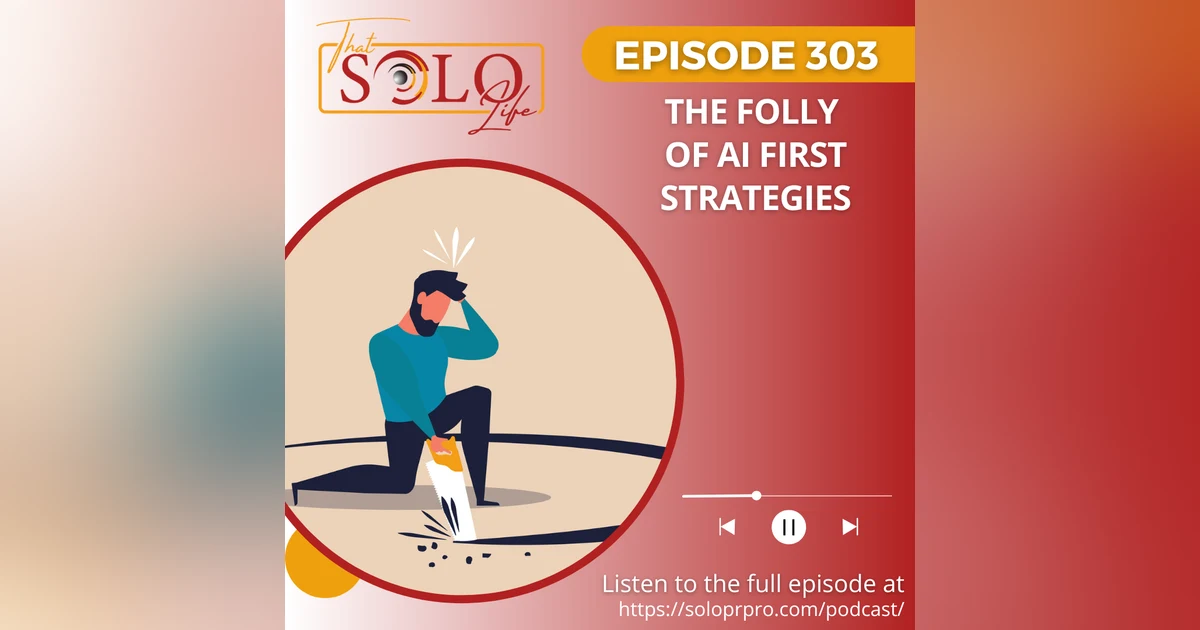


That Solo Life, Episode 303: The Folly of AI First Strategies
Episode Summary:
In this episode of That Solo Life, co-hosts Karen Swim, APR of Solo PR Pro and Michelle Kane of Voice Matters explore the growing trend of adopting an “AI-first” strategy in business and marketing. While artificial intelligence has proven to be a valuable tool, Michelle and Karen argue for a balanced approach that prioritizes human expertise and thoughtful integration. They discuss examples of companies misusing AI, how it impacts customer experiences, and smart ways organizations can combine AI with human intelligence for the best outcomes. The episode is a must-listen for PR pros and marketers navigating the evolving digital landscape.
Episode Highlights:
- The risks of an AI-first strategy: Why adopting AI without enough forethought or balance creates inefficiencies, costs, and poor customer experiences.
- Examples of misuse: Companies like Xfinity and Business Insider illustrate how over-reliance on AI can backfire.
- The human factor: The importance of human intelligence in areas like PR, customer service, and even medical diagnostics.
- Using AI wisely: How organizations can leverage AI as a complementary tool rather than a full replacement for human effort.
- Lessons for PR pros: Why PR professionals must adapt to AI tools while continuing to demonstrate their unique value to organizations.
- 00:18 - Introductions and episode overview.
- 00:48 - The rise of AI in marketing and business strategies.
- 01:40 - Examples of companies going all-in on AI and walking it back (Duolingo, Business Insider).
- 02:34 - Michelle and Karen discuss Xfinity’s chatbot issues and the customer frustration it causes.
- 04:36 - Why prioritizing customer experience should always come first.
- 05:25 - Effective uses of AI in ad tools and automation versus areas where human expertise is irreplaceable.
- 07:17 - Human connection and the ongoing need for person-to-person community in a digital age.
- 09:57 - The integration of AI in PR and marketing fields; potential risks and opportunities.
- 12:04 - How PR pros can become trusted advisors by skillfully blending AI tools with human insight.
- 12:53 - Closing thoughts and encouragement to share the episode.
- 00:12:56 - Conclusion and Call to Action
Related Episodes & Additional Resources
- PR Daily: Business Insider layoffs
- Fast Company: Going ‘AI first’ appears to be backfiring on Klarna and Duolingo
- Brandnation: Social Media and AI
That Solo Life is a podcast for public relations, communication and marketing professionals that work as independent and small hosted by Karen Swim, APR and Michelle Kane. Karen is the founder of Words For Hire, a PR agency that specializes in B2B, Technology and Healthcare, and the President of Solo PR, a community dedicated to independent practitioners in public relations, communications and related fields. Michelle Kane is the Principal of Voice Matters, a company that offers PR, Communications Consulting, Editorial and Voiceover Services.
Talk to Us Please Share and ReviewIf you found this episode helpful, please share it with your network! Don’t forget to subscribe to That Solo Life for weekly insights tailored for PR pros and solo marketers. You can also connect with us at SoloPRPro.com with your questions or comments. Thank you for listening!
Please leave a review here - even a sentence helps. Share and tag us (@SoloPRPro) on social media so that we can thank you personally!
Thanks for listening! 🎙️
Transcribing live conversations can be tricky so please be forgiving of any typos or errors that you find. Love something here and want to share? Great, please read the notes at the end. Enjoy!
Michelle Kane (00:12):
Thank you for joining us for this episode of That Solo Life, the podcast for PR pros and marketers who work for themselves, people like me, Michelle Kane of Voice Matters, and my wonderful co-host, Karen Swim of Solo PR Pro. Hi Karen, how are you doing?
Karen Swim, APR (00:28):
I am good, Michelle. How are you doing today?
Michelle Kane (00:32):
Im doing all right. Doing good today. Doing good. This moment, which is all we can ask for life. Life is decent, right? So
(00:39):
We're going to have a little fun today. Well, I hope we always have some fun, right? But today we're going to dig into the folly of an AI first approach to your business, to your marketing. I mean, look, there's no escaping ai, which has its ups and downs, but we've seen a lot of examples lately where companies are just like, yeah, we're just going to use AI and who needs people, and it's just not the way to go a tool that can be very good, but at this point, I don't think it's a full on replacement for actual people with skills and thoughts.
Karen Swim, APR (01:26):
I agree with you, and I don't think it ever should be for some things I still
Michelle Kane (01:33):
Right
Karen Swim, APR (01:34):
Am of the mind that technology should serve us not the other way around.
Michelle Kane (01:39):
Agree,
(01:42):
Agree. For sure. Yeah, I think a lot of this we're seeing with Business Insider losing staff, and we're going to point to an example of Duolingo, which also went all in AI, and now they're walking it back. So it seems like kind of anything new and shiny. We've seen businesses go all in, yeah, we're going to replace X with the new shiny, and then they learn that it was too much too soon and not the right fit, and then they have to walk it back, and that ends up costing more money and being more inefficient than if maybe you just took your time and didn't feel like you were missing out if you didn't jump on the train right away and just did a little more research to how it truly could benefit your enterprise.
Karen Swim, APR (02:39):
Yeah, it's interesting because I think about bots. So here in Michigan, Xfinity is one of our few options for internet service, and you cannot speak to a human being on the phone. I love AI chatbots when there's a simple question that I don't have to wait on an answer when it's simple, but when you get into complexities and you need the nuance of a human brain, it only serves to make customers angry when they can only deal with a bot that's not answering their questions and doesn't have the ability to think like a human being and to get the nuance of your problem that's not fitting whatever is in their language model. And I would say that companies went to these bots to prevent paying human beings to do a job that they deemed as simple, but in reality, you've created more work for the human beings that are left. You've probably increased your cost in some areas with angry customers. And what people do here is that they just then go to the local Xfinity store. And so you were trying to take a burden off of the humans and have fewer human beings, but now you've actually increased their burden. And that doesn't seem to make sense to
Michelle Kane (04:09):
Me. And not to mention increasing the burden of your customers, because I'm sure we've all screamed representative time and time again because oftentimes the prompts don't fit your particular issue or you know, just need a quick a person. And rather than spending a half hour trying to get to the person, you could have maybe taken five to 10 minutes, reached an actual representative and handled it. And all that does is create more frustration for the brand. Even if it is a limited choice, if something better comes along, you're less likely to stick with them just because of all those layers of the bad experience. And I wish companies would think through that more rather than look at what's on paper and the bottom line and think, oh, well, this is the way to go. It's great. Without really thinking about isn't customer experience supposed to be at the forefront of most decisions in this digital age?
Karen Swim, APR (05:15):
I agree. I mean, we've seen some strategies that work like Meta who we all have a not great relationship with these days, but they're going on ai, on their ad consoles, on their ad products with the budgeting and suggestions. I mean, something like that kind of makes sense to me. But when you say that you're a news organization and you are eliminating jobs because of ai, that doesn't really sit well when you are at the seat of trust and when you are supposed to be right. You need human beings who can think, who can we through information. I do believe AI is a great tool, but it is, again, it's a tool that humans can use. So the way I love to see people deploy AI in their organizations is absolutely use it for things that can be automated. I don't think any of us will argue things that can be automated.
(06:23):
Please do use AI and use your human beings for higher value thinking, train people and give them license to actually be able to help customers use AI to help the people to sift through information quickly and to find answers that they can then filter through their human experience and intelligence. So I think about if you had the beauty of AI married with the customer service of Chewy, because Chewy has fantastic customer service. The human beings think they're able to offer things, they have some autonomy for things that they can do, which makes 'em happy to do their jobs, and it makes 'em serve you well. That's a great use. And in theory, can you have fewer people when you are making people efficient and equipping them? Yes. But it doesn't mean that you are eliminating jobs because you're replacing human beings with AI only. I do think that is a mistake.
Michelle Kane (07:29):
Yeah, I fully agree. There's a smart way to use it, and I've even seen articles talking about it in the medical field, how radiologists are pretty much saying that they're dinosaurs because they're going to be able to use a RI to read ai, A RI, hello AI to read things. And I don't know, 90% of me I think is okay with that, but there's still that we want a person who's had actual experience with anomalies and things to give their insight. It just,
Karen Swim, APR (08:01):
Yeah, true story. Many years ago, a friend of mine was diagnosed with cancer and it wasn't her first bout with cancer, and we both worked for the same company in the medical field and we knew all the oncologist, and one of the oncologists and researchers that we worked with referred us to someone, and he literally picked a book off of the shelf and he goes, oh, I specialize in this very specific type of cancer. He had written an entire book on it, and I cannot do that. This is a human being who looked at it and said, oh, hey, pull the book off the shelf. I wrote about this. I know this. And was able to navigate her through that journey to get cancer free. And just again, I think about that a lot because you're right, in certain fields, you still do need that human experience and a human to see something that a robot, a tool, because artificial intelligence is artificial. It's not
Michelle Kane (09:15):
Human intelligence.
(09:16):
Exactly. I almost think it's parallel to when social media came along and we thought, oh, we never have to do things in person again. We know we don't need this. And now we found out we still long to be together in some way, shape, or form. We long for that person to person community. Yes. Has it changed post COVID with turnout to events because people are prioritizing their time differently? Yes, but they still crave that human connection, and that absolutely translates to your business interactions for sure. I fully agree. AI is a great tool, can be very helpful, but it definitely shouldn't be a full on replacement for many things.
Karen Swim, APR (10:06):
Yeah, I feel like the scary thing for us in public relations is that for a lot of us, I think we're just like, oh, I can't wait till the day when I can walk away from all of these tools, live off the grid on a farm somewhere and not care about it. But for now, while we're still in this industry, we do have to care about it and we have to be ahead of the curve.
Michelle Kane (10:30):
And
Karen Swim, APR (10:30):
For us, I think it is just a constant wake up call that we better learn how to harness the tool, but more importantly, we really have to double down and really be able to articulate and demonstrate our value and our jobs because we've already been in this position where we've had to fight against marketing or people mistaking that their PR and marketing are the same, it's the same discipline or making a choice between marketing or pr,
(11:11):
Sometimes choosing marketing because they didn't see the ROI in pr. So I think it's getting harder for us. And then of course we're dealing with the media landscape where we see a lot of ai, but then we're having publications tell us, don't you dare use AI in anything that you bring to us. Right? Wait a second, there's a lot going on, but we've got to protect our turf. We've got to protect our jobs and we've got to protect our place. I hate AI first strategy, and I do fear that some companies are like, we don't need PR people.
Michelle Kane (11:46):
Don’t worry, just use AI
Karen Swim, APR (11:47):
We can use these tools that connect you with reporters and we can our own stuff. AI can write a pitch. AI can read my emails, AI can do this, AI can do that. And so again, I think that as PR people, especially if you've been in this business for a while, it's not letting go of everything that you knew before, but it's remembering. And again, being able to clearly articulate and demonstrate with metrics what it is that we really do, and adapting our strategies to fit the now and not holding on clenching for dear life to the old ways because we're in a new era
Michelle Kane (12:32):
And that's holding on dearly to the old ways has never served us well. And those of us in this business, we do know how to adapt. And you do. You need to embrace AI and use it as best you can understand it, understand as you say how businesses are planning to adopt it or thinking of adopting it, and honestly be that voice in the room to advise and say, Hey, you need to think about all these things as you do this and how it's going to affect your public. And really be thoughtful about it. Because again, that just points back to our role in PR as being a trusted advisor of how things are going to go down, because not everyone in the room is going to be thinking that way, even if it is their company. And oftentimes our outside, that's where our status as an outsider is helpful. We can see it a little differently to their benefit. Well, we hope this has been helpful to you, and if it has, please do share this episode around. Pease help us amplify the information we share each week. That would mean so very much to us. And if you have any questions or comments, hit us up at solopro.com. And until next time, thanks for listening to That Solo Life.
We ask that you honor the following if you want to use the transcripts for this or any episode.
You are more than welcome to share the transcript (up to 500 words) in media articles (e.g., PR News, O’Dwyers), on your personal website, in a non-commercial article or blog post (e.g., Substack), and/or on a personal social media account for non-commercial purposes, provided that you include attribution to “That Solo Life” and link back to the soloprpro/podcast URL. For the sake of clarity, media outlets with advertising models are permitted to use excerpts from the transcript per the above.
But please note that no one is authorized to copy any portion of the podcast content or use That Solo Life’s name, image or likeness for any commercial purpose or use, including without limitation inclusion in any books, e-books, book summaries or synopses, or on a commercial website or social media site (e.g., Facebook, X, Instagram, etc.) that offers or promotes your or another’s products or services.
Got questions? Email us at info@soloprpro.com.