The Power of Purpose-Driven Branding with Cat Holt
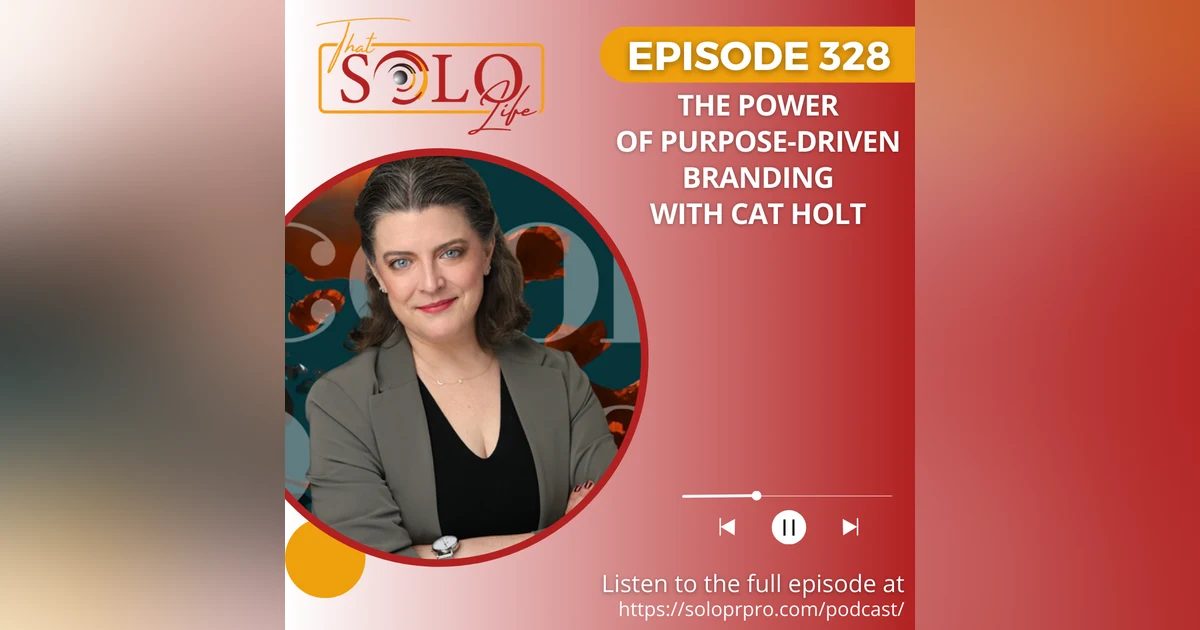


That Solo Life Episode 328: The Power of Purpose-Driven Branding with Cat Holt Episode Summary
This week, Karen and Michelle are joined by Catherine "Cat" Holt, a seasoned marketing executive with over 25 years of experience building major US brands. Cat shares her journey from the corporate world to founding her own company, driven by a desire to help businesses create purpose-driven cultures. She offers a masterclass on aligning a company's internal values with its external brand message to build a strategic business asset. The conversation also explores how women in their 40s are reshaping their careers, the democratizing power of AI in communications, and the critical importance of women supporting each other to foster community and shared success.
Episode HighlightsCa- [01:12] From Corporate to Founder: Cat explains why she left a successful corporate marketing career in 2021 to start her own company.
- [03:51] The Great Reassessment: A look at the trend of women in their 40s reevaluating their priorities to seek more meaning and fulfillment in their professional lives.
- [08:06] Building a Purpose-Driven Culture: Cat breaks down the concept of purpose-driven branding and how to get started.
- [09:56] Aligning Inside and Out: Learn how to connect your company's internal culture and values with your external brand messaging for authentic impact.
- [10:24] Behind the Scenes of Dr. Rick: Cat gives an inside look at the creation of the famous "Dr. Rick" campaign, highlighting the power of honesty and relatability in advertising.
- [16:40] Brand as a Business Asset: Shifting the perspective from brand as a marketing function to a core strategic asset that drives growth.
- [27:37] AI as a Communication Equalizer: How artificial intelligence is democratizing brand management and communication, opening doors for solo practitioners.
- [30:31] Shaping the Future of AI: A call for more women to get involved in AI engineering to ensure the technology is inclusive and representative.
- [33:42] Finding Your "Female Posse": The undeniable value of women creating supportive communities and championing each other in the workplace.
Cat Holt is the architect behind one of the most enduring and beloved campaigns in insurance history — Dr. Rick for Progressive Insurance. With a rare blend of strategic rigor and creative soul, Cat has helped legacy brands evolve, challenger brands emerge, and leadership teams navigate the unknown. Today, as President & CEO of Coologee, Inc., she brings that same clarity and courage to companies facing transformation, uncertainty, or opportunity.
Connect with Cat on LinkedIn: https://www.linkedin.com/in/catkolodij/
Resources & Additional InformationCat Holt Website: Coologee, Inc.
Cat Holt Newsletter: Brand is Business
Host & Show InfoThat Solo Life is a podcast created for public relations, communication, and marketing professionals who work as independent and small practitioners. Hosted by Karen Swim, APR, founder of Words For Hire and President of Solo PR, and Michelle Kane, Principal of Voice Matters, the show delivers expert insights, encouragement, and advice for solo PR pros navigating today’s dynamic professional landscape.
Did this episode inspire you? If you found value in this conversation, please take a moment to leave us a review on your favorite podcast platform. Your feedback helps us reach more solo pros just like you! Don't forget to subscribe so you never miss an episode.
Transcript Summary: Cat Holt started her own company in 2021 because she had a hard time fitting into the corporate machine and felt constrained by the typical corporate structure where ideas had to be optimized for an extended period of time, which did not align with her creative approach [1:12]. She was inspired to start her own company after discussing the challenges of corporate life with a group of friends who were also in their forties and had similar experiences [2:58].
Holt believes that one can "do well while doing good" and has tried throughout her career to find ways to enable positive outcomes from marketing and communication budgets [15:02]. She emphasizes that brand is a strategic business asset that should be managed and measured at the executive level, rather than just as a creative execution [16:21].
Holt sees purpose-driven branding as a way to authentically express a company's culture and values to both employees and customers, creating a sense of community and humanity that can help address societal disconnectedness [22:10]. She believes that the future of strong company-customer relationships will return to more human, in-person interactions, and that even a single moment of connection can make a meaningful difference [25:27].
Holt also discusses how AI can democratize brand communication by automating certain tasks, allowing companies to be more strategic in their brand management [27:14]. However, she cautions that women should be actively involved in the development of AI to ensure it is not designed from a single, biased perspective [30:25] [31:27] [32:21] [32:42] [33:38].
Michelle Kane (00:13):
Thank you for joining us for this episode of That Solo Life, the podcast for PR pros and marketers who work for themselves, people like me, Michelle Kane, and my wonderful co-host, Karen Swim of Solo PR Pro. And today, Karen, we have a guest. We love having guests we love today, we're welcoming. Yes, today we welcome Cat Holt of Coologee, and she has done some amazing work and we cannot wait to dig in because we are so excited to have you on here. Cat, welcome
Cat Holt (00:49):
Ladies. It is such a pleasure to be here and I cannot wait to kind of dig into everything.
Karen Swim, APR (00:56):
Yay. Listeners in for a huge trait today.
Michelle Kane (01:01):
Yes. Let's kick it off with just tell us a little bit about your work and what inspired you to start your own company since we're all about that solo life.
Cat Holt (01:12):
Well, I think I started my own company because I had a hard time fitting into the corporate machine. My entire career spanning over 25 years has been working in either ad agencies, digital agencies, or in-house for some big brands in the us. And I'm one of those people that have lots of ideas and oftentimes the corporate scope structure wants you to have an idea and do it for a while and keep on optimizing and that's not my jam. And so in 2021 when everybody was slowly emerging from our cocoons and our safety nest, my partner and I decided it was a really good time to start our own company. So we've been at it since September of 2021, and I couldn't be more grateful.
Karen Swim, APR (02:06):
I believe that there are so many people out there that for thinking about stepping away and starting their own company and they're wondering about the right time. And I'm sure that many in our audience, and I want to say particularly women maybe have felt out of step, you had a fantastic corporate career. I mean, you were killing it. So this wasn't that the things that were happening prevented you from failing, it's just that it didn't fit. So tell us a little bit more, how did you really discern between what had become normal over a two decade career, two decades plus career, to the thing that really finally pushed you out of the nest and said, now it's time.
Cat Holt (02:58):
It's funny, I'm fortunate enough to have my little girl posse that we always support each other, lift each other up, and we all entered into our forties and our stories were very similar. We had worked extraordinarily hard to earn recognition and to receive a promotion and to be able to get to that next level in life. And we were looking around and seeing some of the folks that were also in those positions and in those roles, not necessarily putting in as much effort, it felt like to us that they were getting things that we had to spend sleepless nights working towards and making sacrifices in our lives usually at the detriment of our own physical and mental wellbeing and our social wellbeing. And it's something amazing that happens I think for humans, especially females. We get into our forties and we look around where we say, I don't think I want to give a shit about this anymore. And because we have put so much time into it, I always joke with my team, you're going to look back at this year and realize that inevitably we've put 2, 3, 4 years of work and learning and accomplishment into one year. And so I guess we could do a coining of a phrase in women years.
Michelle Kane (04:27):
Oh, love that.
Cat Holt (04:28):
Each year is more like two or three cat lives. And so I realized with the support of a number of folks, and in particular my founding partner, Dina Catio, that I owed it to myself to try it for myself because I was very emotionally and spiritually exhausted by not being able to be true to my values, to being stymied and being able to create team and work cultures that were lifting everybody up and feeling good
(05:04):
And always doing so at the expense of oneself for the betterment of the bottom line. And I thought, man, is this real? Is this really what it has to be? And so I decided I don't care about that anymore. And I had to have the faith and the courage and ability to look back at 20 plus years and say, okay, it's going to be okay. Let's try it. And I think that just giving yourself a moment to look back and to take a little bit of an analysis of what you've been able to do and let that be your own internal sort of confidence to do it for yourself instead of for others. Because I think women are socialized to do the work and make others successful because we are raised with this notion of the betterment of the group. And I think that in your forties in particular, and by the way, you don't have to wait until your forties. I did. My girl posse kind of has been doing that, but I think it's okay to say, all right, I can do this for myself now. And that's not bad. And in fact, I think it's probably right because in my opinion, what I'm doing right now is allowing others to see their own potential and to see there can be another way. And that's my service because this world certainly needs another way. And I can't fix ruling parties or clashes, but I can create little pockets where it's not so bad.
Michelle Kane (06:48):
That is so true. And I do think something in women, especially as we reach those years, things do shift for us, which is wonderful. People talk about, oh, getting older, but there are some great things to embrace. And I love that you stepped out into, well, the strengths you've always had, but stepped out into this. And before I get to the next question real quick, is it okay to share one of the fabulous brands or campaigns you created? Yeah, go for. It happens to be a personal favorite of mine. Cat is responsible for the Dr. Rick character on certain insurance companies commercials as in he has blue hair, or we turn into our parents, which eternally love. So my goodness, based on that alone, you are going to shine. And it's so lucky for the brands that now that you're helping that they have your mind. And now that you're onto this new phase of, well, it's not really new, but you're helping these brands create a purpose-driven culture. Can you share more about how you're approaching that process?
Cat Holt (08:10):
Yeah, for sure. And I had the great fortune when I was working in-house at Progressive to be continuing a partnership with the agency I used to work at. So I had been at Arnold, which is based in Boston, working with a fabulous team there and was in some ways traded sides to swim upstream and help to influence strategy before it became a brief. And the reason I'm mentioning that is because while I was sort of the strategic architect at Cook Village to do that, and I think what really was driving me in early years and also today is understanding how to take that friction that we all feel out of what we think we're supposed to be versus what we are and who we are on the inside. And I use the purpose-driven branding in order to do that because typically organizations spend a lot of time, especially high performing organizations, they spend a lot of time understanding and identifying what is their culture, how do we make sure it's upheld through all of the ranks?
(09:21):
How do we set an expectation that there is a way we want to work with each other and with our customers or our partners? And frankly, usually there's a vision for what kind of positive impact organizations want to have in the world. And what had always been really interesting to me is that many times that story, that purpose, that sort of withstanding central identity was not necessarily applied to the way a brand had conversations externally. And the whole notion here is, number one, the brand needs to be an expression of who you are as an organization internally because it truly tends to be what sets you apart, not for everyone. We can get into that in a second because sometimes it's done in a mail it in kind of way, and it's vanilla. But if you have a culture that truly is unique and people say, I really like this culture, it's worth figuring out how to tell that story so others see you too.
(10:24):
Similarly, in a campaign like Dr. Rick, it is approaching that thing that is very scary for a lot of people. So when you are taking that step as a person and really becoming a first time homeowner, it's super scary. It's usually the biggest check you've ever written. I mean, I personally remember sending my first mortgage and my hands were literally shaking because I thought, well, am I going to be able to do this? And then what do I do? Because the playbook, the adult playbook for owning a home is different. And I remember having a conversation with a young planner at Arnold where she looked at me and I was 12, 15 years older than she was, had kids, had a mortgage, was in a senior position, and we were talking about something and I said, well, you know what? I really don't know what I'm supposed to do, but I'm going to make the best decision I can and then learn from it.
(11:31):
She kind of blanched and she looked at me and she said, but you're an adult what you're supposed to do. I said, oh, no, no, honey. We don't know what we're supposed to do. We're only making the best we can and then hopefully have the humanity and the humility to learn from it and do the next best thing. And so that sort of was the whole beginning of it because especially in the United States, home ownership is such a mark of I have become an adult. It's sort of written in the ethos and mythology of American success. You've made it because, but the reality is the economic situation that our young people are entering now is vastly different than the one that their parents did in the eighties. And they're looking at it and they're thinking, I failed. And I'm like, you didn't fail.
(12:32):
Society has not set it up so that you can actually have that promise. And so that whole insight of, hey, when we have to become an adult, we look to the others in the room that are adults, and oftentimes those are our parents. That's sort the psychological truth. And what I didn't anticipate, and by the way, the brilliance of Dr. Rick as a character and this whole new, we call it parent amorphis, that was a team effort. Fabulous. It takes a village, right? Sure, of course that was the mindset at Arnold that did that. But what I didn't understand is I wanted it to work with the young homeowners. What I didn't anticipate is its universal appeal, which in hindsight I should have done. Because when you have a truism, people like to talk about it and sometimes the teachers say, yeah, mom and dad on the nose, that's you. But I think that if we take a minute and say, okay, our job as communicators, as branders isn't to create a false sense, it's to really have the courage to be more honest and then forge bonds that feel a little bit better than being talked at, screamed at, disrupted at sold to. Absolutely. Honestly, we just don't want that.
Karen Swim, APR (13:56):
I agree. There's a couple threads I want to pull there. One is the purpose driven branding because many of us use that term and we all have an approach for how we really make that reality and not just a label. So walk us through some of the key elements that you utilize in your work to take this from this really nice, very, it's like a very virtuous sounding way,
Cat Holt (14:30):
Rainbows and sprinkles
Karen Swim, APR (14:33):
To the hardcore reality of working in that corporate machine. And I'm calling it a machine for a very specific reason. And we all know that at some point among the humans, it becomes a machine. What are some of the key elements that you have found? Take this from that nice sounding label to a reality that's truly consistently applied throughout the thought process of this machine.
Cat Holt (15:02):
And I think this goes to, I don't know why, but I have a founding principle of I think you can do well while doing good. And my entire career, I have tried to find ways to enable some kind of positive outcome from what usually is pretty large marketing or communication budgets. And so I think that when you have this mindset of you start internally, there is some kind of culture, oftentimes there is a mission, a vision in addition to those values or those cultural norms. Then if you take that mindset of, okay, well what would happen if we tried to create something that allowed for us to live this on the outside so people would take notice and believe that we are a different kind of company. And when you use the internal actions as a filter for identifying a thing, it doesn't have to be everything.
(16:05):
It can be one thing that will allow for you to take the same kind of ethos and also sort of objective driven action to the folks that you're benefiting from, which is your audience. It can create something that people really get excited about, and the first and foremost group that gets excited about it are your employees. So I think the notion of how do I take what already is and then apply that to something externally is the first foundational idea. The second one, and this is really, really, really critical, and it's in fact the thing that I'm pounding the drum on, which is brand is in fact a business asset. So I just said, Hey, your culture is really important. Most executives boards nod their head. They agree. I just said also that your brand is an expression of your culture. Well, the reality is is that most organizations have not fully understand the strategic operations of brand management.
(17:12):
And when I say that, I say, oftentimes I'm having conversations, and by the way, these are people who want to talk with me about brand. And they say, I just want to have a nice logo, nice fonts and color palette, a creative way of telling the story. I say, great, but what's at the foundation of that? How are you managing your brand so that it really truly becomes something that is an asset that can be measured and managed at the executive suite and then also at the boards or for a lot of folks are looking for capital, they're looking for valuations. They want to be seen as having a higher stock price in order to be able to create a revenue stream And brand. Is that because done well, brand actually helps you decide where you're going to expand into new markets or new products or services.
(18:08):
It helps you to understand who you're going after and why. And frankly, it helps you to create an ability to do something different in call it three, five, ten years than you're doing right now. Because if you don't have a brand that people can believe, we'll do that next thing, we call it brand elasticity, then you're going to be spending a lot of dollars in order to be successful in the future. And that's on top of the dollars you're spending to be successful today. And so if you take a different mindset and really ask, understand who you are as a brand, what the position is, what are you going to stick to? And I'm not saying we're going to be, I worked with p and g to launch the Dunkin Donuts brand in the grocery store, and they wanted to have the single point of differentiation. And for p and g, it was like that one thing, the product does different. That's not why they were licensing with Duncan, right? They were licensing with Duncan because it had a community, a culting of the brand. The value of that cannot be translated into an expel excel spreadsheet. By the way we did. Our point of differentiation was delicious, but that's not why people buy it. And the reason we were able to do it is because it was when I was at Hill Holiday many years ago, was that we were able to tell the story that actually shone a light on who these people are
Michelle Kane (19:38):
And
Cat Holt (19:39):
Who these people are, are the regular people that show up every day. They don't want to fuss. It's the fuel that gets them through when they're usually doing the unsung hero jobs in our communities. It's the teachers, it's the policemen. There's a reason why there's a joke about policemen with coffee and donuts because what they're doing is hard. A little bit of caffeine and sugar helps. And when you go into a store where you're seeing the other people that are normal, or I say normal, that's not fair. That was a me bias. I'll call myself out everyday people. That's what you're looking for. And then when you bring it into your kitchen, you're just like, okay, I can start my day.
Michelle Kane (20:25):
Yes.
Cat Holt (20:26):
Right? And so when I'm talking about positioning, it's really understanding who you're for and why it matters.
Michelle Kane (20:31):
Yeah, no, so true. I thought one of the most brilliant pairings was a community event I worked at a few years ago, the local small town police department were sponsored by their dunk tank was sponsored by the local Dunking
Cat Holt (20:45):
A hundred percent.
Michelle Kane (20:46):
I'm like, lean into that. That's fabulous. Beautiful community brand.
Cat Holt (20:51):
But the thing that's beautiful about that, and again, where purpose can then mark decisions
(20:57):
Is that if you think, and I graduated with a degree in psychology and one of my best friends is actually a PhD in psychology. He's like, you're using that word wrong. And I'm like, okay, that's fine. But it's working for the armchair psychologist that I am. But if you think about it right now, there are so many things that are really tense about the community's relationship with the police force. And a lot of it's right, and a lot of it's misunderstood, and there's a lot that goes around it that's way beyond the control of you and I as people and police forces as an institution. But if you bring everyone together and take the conflict out because you're not pretending it's not a thing, but you're having fun with it in a way that's not saying you are the other, I'm having a joke at your expense, but we're actually creating a moment of happiness together. Yes,
Michelle Kane (21:52):
We are owning it.
Cat Holt (21:54):
That's purpose. That's purpose in real life for a moment. People laughed when we laugh, when we have humor, when we have the happiness, when we have optimism, we have an openness to do something a little bit different next.
Karen Swim, APR (22:10):
I think that's such a profound point that you just made because we have this culture of disconnectedness now, and we have, because we're disconnected, we're not seeing each other, we're not forming these relationships with other people. We have lost the community. We've lost our ability to listen to one another to show grace. You're serving a purpose and we've kind of taken pieces of the human experience and they've unfortunately become polarizing. So when we talk about inclusivity, which really shouldn't be a dirty term, it should be a worthy human goal. Of course, we want to see people as people and respect them, but we've taken that as a little piece and said, okay, this is part of the brand of one party and this is the other party's brand of that same thing. And so we've weaponized all these things. But you're saying purpose is that thread that can run through when you have purpose, you're bringing these other elements back together. It's like a glue that holds the whole human experience together. And I love that. This is another approach I feel that communicators should really lean hard into when you focus on that thing. The other elements fall into place very nicely. I think some of us feel like we're fighting against the external world, but you just unlocked a beautiful thing that we're already doing. But by systematically approaching it in this way, it solves a lot of problems.
Cat Holt (23:59):
I couldn't have said it more beautifully than what you just said, so thank you for that. That's right. In my opinion. So I come with all of my life experiences, my purpose, but I also come with a lot of arrows in my back
(24:20):
Because I was actually talking about this with the dear friend who asked if I was precocious as a child, and I was like, I'm not even sure if I was or not, because I always felt outsider even on the inside. And that disconnect, let me see people in a moment where they might not have known they were being seen. And I've just carried that through in my life because of the way I am. And I think some people say it's empath, some people it says that you're just truly attuned to a situation. But I've lived my whole life with my heart on my sleeve and just feeling the world. And it's gotten so difficult to feel, I even say this for myself because it's so overwhelming.
(25:16):
And I think that with the advent of technology, with the proliferation of digital experiences would take us away from the physical. I mean, even you and I we're having this conversation right now through a technical screen. I think we've lost touch with the humanity of life. And as I think about AI and what AI will enable companies to do, people to do where it will be able to come up with answers and define actions without having to do some kind of processing, I do believe that the future of strong relationships between companies and people is going to return to a more human one-on-one in the real world moment. And if we can do that, we are creating tiny communities and oftentimes our communities that will come together for the first time and maybe the only time. And so I believe that even one moment can make a difference. And so if you can use humor, if you can use insight, if you can use something that makes everyone feel just a little bit more healed, what can happen? And if everybody's doing that.
Michelle Kane (26:28):
Yeah. And you can see that with some of the younger generations being intentionally analog, even for a part of their day, we crave story. We crave and relationship with each other, and the shiny toy is only shiny for so long, which is just so incredibly true. You also shared a study that touched on the decentralization and democratization of productivity and impact. Hello mouth.
Cat Holt (27:02):
Yes.
Michelle Kane (27:07):
Why is that so important for us as communicators to really understand that concept?
Cat Holt (27:14):
Yeah, and I think this goes back to this idea of what is AI going to allow for us as communicators to do? And I would also add as women who have had to do more work in order to be seen and recognized, and I just positioned AI as maybe not the greatest thing, but it's also the greatest thing. It just depends on how you're using it. And so I see AI as democratizing this ability to communicate and build brand because it's going to allow for people to become their own brand managers without having to have the big budgets that some of the larger brands have. One of some of the work that we're doing right now, and we're playing around with creating our own AI agents is to feed in positioning to feed in the mission, vision, values, the way we want to communicate the type of personality that we have.
(28:16):
And in doing so, then we can say, and now we would like to create X, Y, and Z. And AI is enabling us to do that in a half an hour, sitting and yield two articles and a couple of social promotions, whereas it would've taken a staff to do that in 10 hours. And so I feel like there is going to be this ability for those that do understand strategy, that have figured out what their brand stands for and wants to manage it like an asset that AI is going to allow them to do so in a way that felt a little bit harder before. And then for women in particular, you are able to do those maybe extra layers of work to make sure you're sure. I know I do it all the time. I tend to go back to the stone and say, all right, well what's the business background here?
(29:09):
What's the market? What are the other competitive advertising campaigns that are out there? What do the people want? These are steps I've taken where you look at the company, the culture, the competition, and then the consumer you're going after. So it's the four Cs that account planners were always trained in. It would take me two weeks and lots of time to get to that point. I can do it in a few hours and then I can remind ai, remember, you just did that. Now I want to do this and feed in the mission, vision, values of proposition, the personality. And I'll tell you what comes from that is not what you're seeing out there, which is the danger of ai, right? AI wants to just create an answer as quickly as possible, which means it's going to go to the lowest common denominator's going to give you a C plus at best quality of work. And so I think it's going to be super empowering, particularly for women who are wanting to go out and do this, start playing around with it if you haven't, but do so in a way where both of your hands are on the steering wheel because you got here so far and a lot teacher AI to do it with you, not for you.
Karen Swim, APR (30:25):
And teaching AI is something, again, and I'm going to speak to women, we have such a huge opportunity here to not only use this technology to shape it, to challenge it, to hold it accountable, any women out in the audience that are in school and thinking about future careers consider AI engineering considering being a part of creating this technology. Because with every other advance in our history, women have not been a part of this innovation. So it's not designed for us, it doesn't think like us, it doesn't include us. We see this in big things like medicine where women have not been a part of studies drugs that fix things or how our symptoms differ. And that has not,
Cat Holt (31:21):
Oh God, yes.
Karen Swim, APR (31:22):
Don't even get me started on the
Cat Holt (31:24):
Real bias in medical research.
Karen Swim, APR (31:27):
And not to be on a feminist soapbox, but again, as communicators, as we talk about making a more equitable, inclusive world, this is one area right now that we can actively participate in and shape and lend our voices in such a meaningful way so that the models that we're even training are not from a single lens as so many other things have been automakers in the way that they make seatbacks. But we won't talk about that. Women do have hairstyle,
Cat Holt (32:01):
Seat belts, by the way.
Karen Swim, APR (32:03):
We like to wear the bun sometimes. We wear our hair up and we want the seat to fit us. Can you do that in the seatbelt? Yeah, in the seatbelt. Come on. It rubs. Alright. Let's just admit.
Michelle Kane (32:14):
Yeah.
Cat Holt (32:15):
Thank
Karen Swim, APR (32:15):
You.
Michelle Kane (32:16):
Yeah. Who doesn't use the thing that holds the seatbelt?
Cat Holt (32:21):
I know. So Yes, yes, yes. So what's interesting is that my company is actually, we're pretty deep in building AI experiences full stack, and I am the founder, owner, majority owner of the company. And there are times when I look around the room like I am the only woman here.
Michelle Kane (32:42):
And
Cat Holt (32:42):
By the way, this team wouldn't be together if it weren't for me. I have again, in the giving zero shits, and you can block it out. I'm sorry, fine. But giving zero shits about it now because I'm a woman in my forties, but I have built myself to this place where I can be comfortable in that room. And I am at the forefront. I know I am. I know what I'm doing, and there's not a single female there with me. And so as an addition to that, yes, yes, yes, please, you will learn it. Nobody knows. We go back to nobody knows what they're doing. They're just doing the best they can in the moment they're in. This AI wave is going so fast that even those at the forefront do not know what is next.
(33:32):
So you might as well be there in that swirling pool of, I'm not sure, but let's try. But the other thing, please, please find another female or two, create your own female posse because the hardest thing is to be in a room without having somebody who understands your perspective. And there's so much research because having racial equity in the workplace, we're going all the way back to education. And no matter what your social position is, you have to acknowledge the fact that there often is inequity in the accessibility and availability of education, which in America we all say is the beginning steps of being able to have success in a career. It's not because students can't get into the schools, it's that once they're there, they feel really alone. And so the 15, 10, 15 years ago, there were groups of people that were literally putting together posses of folks that looked like the new students that were in the minority in order to have them feel like they had a village, a community, so that when things got hard, they didn't say, well, it's not for me. I'm not built for this. They said, okay, it's hard. Let's talk about it. And they had a little bit of light that let them continue and show up the next day. And I think that's true for us as women. I started this conversation saying, I'm fortunate enough to say I have a girl posse group. They are all fierce. And in many ways we joke that we are the island of misfit toys. Oh
Michelle Kane (35:06):
Gosh, yes. I say that all the time with friends.
Cat Holt (35:10):
And it's because this idea said that how we show up as females is wrong, right? Because we have an opinion, we are educated, we have a sense of humor, we like to go out and have fun, and then we do amazing things in our careers that threaten people, and then we come back and do it all over again.
Michelle Kane (35:32):
Love it. What a perfect note to end on. Cat. That's fantastic. But before we wrap this up, how can our listeners connect with you?
Cat Holt (35:42):
Sure thing. So I've got a website, one of those things where it's still a work in progress, everybody, my client, I feel you better than my own, but it's at www cologgi.com, that's C-O-O-L-O-G-E e.com. I am in the beginning phases of creating my own thought leadership platform called Brand is Business on Substack, and this lovely conversation will be there as well.
Michelle Kane (36:09):
Fabulous.
Cat Holt (36:11):
And then you can also find me on LinkedIn. So go ahead and DM me if you want to have a conversation. I'm more than happy to, if I don't get back to you right away, just have patience. I'll ask is, you mentioned that you heard me here and don't sell me something.
Michelle Kane (36:26):
Love
Karen Swim, APR (36:26):
It. Please love it. I'm hiring of that as well, and all of these links in our show notes, so don't forget to check those out. Anything else that you'd like to share with our listeners before we reluctantly close out this episode?
Cat Holt (36:43):
I just want to share that good on you for finding this podcast, and I think it's an indication that there's something sort of in you that is looking to shine brighter, and yeah, that's your right. And do it because you're the only one that can live your life, no one else can, even though a lot of people think they know it's better for you. So just keep on shining and keep on exploring and it's going to be okay.
Michelle Kane (37:09):
That's beautiful. Beautiful. Thank you so much, Cat, for joining us. I'm sure we will have you back again and again, and we wish you every good thing because it's not just exciting work, but it's important work that you're doing. Honestly, listeners, what we all do is important work. So you know what, hopefully this has been as inspiring to you as it has been for Karen and me right now. So please do share this episode around Connect with Cat, hit us up at solopro.com, and check out that wonderful community of solos. And until next time, thank you for listening to That Solo Life.
Transcribing live conversations can be tricky so please be forgiving of any typos or errors that you find. Love something here and want to share? Great, please keep reading!
You are more than welcome to share the transcript (up to 500 words) in media articles (e.g., PR News, O’Dwyers), on your personal website, in a non-commercial article or blog post (e.g., Substack), and/or on a personal social media account for non-commercial purposes, provided that you include attribution to “That Solo Life” and link back to the soloprpro/podcast URL. For the sake of clarity, media outlets with advertising models are permitted to use excerpts from the transcript per the above.
But please note that no one is authorized to copy any portion of the podcast content or use That Solo Life’s name, image or likeness for any commercial purpose or use, including without limitation inclusion in any books, e-books, book summaries or synopses, or on a commercial website or social media site (e.g., Facebook, X, Instagram, etc.) that offers or promotes your or another’s products or services.
Got questions? Email us at info@soloprpro.com.