The Powerful Insights Learned From Going Back To School
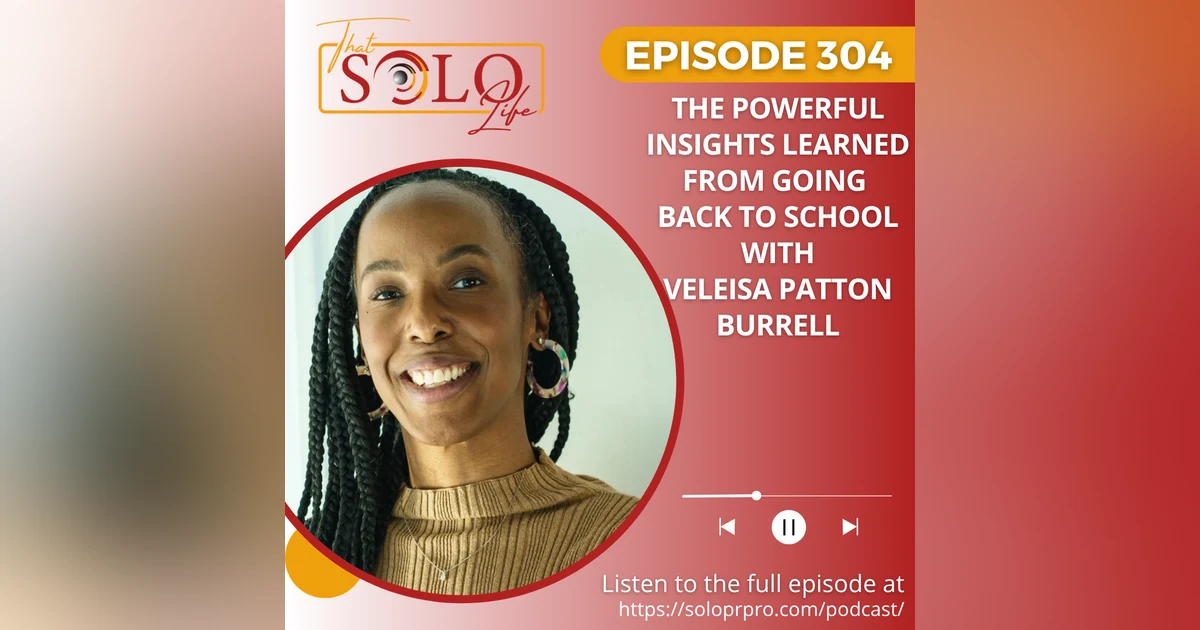


That Solo Life Episode 304: The Powerful Insights Learned From Going Back To School Episode Summary
Join hosts Karen Swim, APR and Michelle Kane as they welcome Veleisa Patton Burrell, an accomplished PR professional and educator. Together they explore the twists and turns of Veleisa's career—from solo entrepreneurship to agency life, and now as an adjunct professor guiding the next generation of communicators. This candid conversation covers career transitions, the evolving role of PR, the integration of AI in the workplace and education, and the importance of critical thinking. Prepare to be inspired by Veleisa's insights on mentorship, resilience, and finding balance in a challenging job market.
Episode Highlights- Veleisa's 20-year career in PR and communications
- The decision to shift between solo work, agency life, and teaching
- How teaching has reignited her passion for storytelling and mentorship
- The role of AI in PR and education, and how to use it as a tool rather than a crutch
- The importance of curiosity, critical thinking, and learning from failure
- Encouraging the younger generation to be authentic and build meaningful careers
- Tips on setting boundaries for a healthy work-life balance
[00:13] Introduction to the episode and Veleisa Patton Burrell
[01:37] Veleisa shares her career background and transition to solo work in 2017
[03:22] Teaching as an adjunct professor and rediscovering excitement for the field
[07:53] Inspiring the next generation through storytelling and shared values
[13:09] The impact of failure and fostering resilience in your career
[19:57] Insights on balancing work with personal boundaries and self-care
[21:17] Exploring the role of AI in education and PR, and critical thinking as a foundational skill
[28:00] Closing thoughts and where to follow Veleisa
Veleisa Patton Burrell is a trusted counselor to clients and peers alike, providing strategic guidance on integrated communications, including media relations, content development, digital communication and executive visibility. Her talents lie in detailing company values through owned storytelling consistently across mediums to earn media coverage and improve reputation with employees, partners, and clients and industry peers.
Most recently, as an executive for FleishmanHillard, a global PR agency, and Denny’s, a storied restaurant brand that is known as “America’s Diner,” Veleisa advised senior leaders on issues and crisis, developed media relations strategies and oversaw execution of thought leadership opportunities such as speaking engagements and interviews.
Side work as a mindfulness facilitator and yoga instructor keeps Veleisa’s mind and body strong and resilient. She graduated from Southern Methodist University in Dallas, Texas, with a bachelor’s degree in corporate communications and public affairs; she now teaches an undergraduate capstone course at the school as an adjunct professor. She later earned a master’s degree in communication studies from the University of Texas at Arlington. Veleisa was named to Public Relations Society of America Dallas inaugural 40 Under 40 list in 2021 and was previously a board director for the chapter.
You can connect with Veleisa on LinkedIn.
Related Episodes & Additional Resources- Ragan: Denny’s Veleisa Patton Burrell on embracing tech and the changing comms landscape
- Nature: The effect of ChatGPT on students’ learning performance, learning perception, and higher-order thinking: insights from a meta-analysis
- World Economic Forum: Why AI literacy is now a core competency in education
- Forbes: Organizations Are Saving Millions By Embracing Curiosity—Here’s The Proof
That Solo Life is a podcast for public relations, communication and marketing professionals that work as independent and small hosted by Karen Swim, APR and Michelle Kane. Karen is the founder of Words For Hire, a PR agency that specializes in B2B, Technology and Healthcare, and the President of Solo PR, a community dedicated to independent practitioners in public relations, communications and related fields. Michelle Kane is the Principal of Voice Matters, a company that offers PR, Communications Consulting, Editorial and Voiceover Services.
Talk to Us Subscribe and ShareDon’t miss an episode! Be sure to subscribe to "That Solo Life" on your podcast platform of choice. Love what you hear? Share the episode with your colleagues and friends, and leave us a review to help more listeners find the podcast. Engage with us on social media—we'd love to hear your thoughts!
Transcribing live conversations can be tricky so please be forgiving of any typos or errors that you find. Love something here and want to share? Great, please read the notes at the end. Enjoy!
Michelle Kane (00:13):
Hello, and thank you for joining us for this episode of That Solo Life, the podcast for PR pros and marketers who work for themselves, people like me, Michelle Kane and my wonderful co-host Karen Swim of Solo PR Pro. And we are so excited. We have a guest today. We always love guest podcasts. We are so happy to welcome Veleisa Burrell, a fellow PR practitioner. Hey Veleisa, how are you?
Veleisa Patton Burrell (00:38):
I'm doing well. How are you guys?
Karen Swim, APR (00:41):
We are so great and so happy to have you here with us. Oh my goodness. You guys are in for a treat. One of the smartes, baddest practitioners in the land. is gracing our stage today and we are delighted
Veleisa Patton Burrell (01:04):
Not with that intro. Yeah, no, I'm excited to be here. Karen, you and I have known each other for a number of years and I appreciate the insights that you guys bring. So now I'm like, no pressure, but also go out there and charm the world. So I'm ready. I'm ready.
Michelle Kane (01:22):
Absolutely. Yeah. So tell us a little bit about yourself. What brought you to this point in your career, what are you up to currently?
Veleisa Patton Burrell (01:31):
All the waves back and forth, right. So what brought me here? Almost 20 years in the PR comms game. I studied for this. I'm based out of Dallas, Texas and went to Southern Methodist University. So pony up for anybody that is listening and is an SMU alumni. Started off in travel and tourism on the media relations side. And across my career I just kept picking up more integrated comm skills, social media newsletters. I joke I did podcasting for the podcasting that we know, with some content creation, with an association for meeting planners. And got to a point in my career that I decided ,I know what I really like and I'm good at and I know the things that I would prefer not to do. So I launched a solo career in 2017. Started off working with entrepreneurs and other really smart people who did not know how to talk about and receive earned media for the work that they did.
(02:38):
And I did that all the way up until late 2020. So after the pandemic began, I'd already started considering that I missed coworkers. You build a really great solo community, but when you're working with folks side by side, day by day, I was like, I kind of missed that. So I actually at the big age of 35, went into agency life and I joked that became the battery on my back. I got so much more clear about the work that I wanted to do and the value that I brought to teams and to people that I manage and to clients took that back in-house. and I think that's how I've ended up with this crisscross experience from in-house to agency to executive at this point in my career. And I also just finished my first semester as an adjunct professor where I started. So that brings in a whole nother layer to sit with students and see them go into their early career and the things that have influenced them compared to the things that influenced me almost 20 years ago. So yeah, a little bit of a journey that I'm glad that to be here.
Karen Swim, APR (03:47):
I think that you're actually the perfect person to teach and mentor the next generation. And I love, I love because sometimes people think solo and they think that you have to make a choice, like a forever choice and it's not. So I love that you're showing that you really can take charge of your career by going in and out of being a solo and you're taking steps based on your interest, your experience, where you want to grow next, who you want to learn from, and choosing the environment that you want to work in a particular season. Because there may be seasons of our life where solo just really works for our life. Other seasons as you said, that you really want that connection and the team building and the things that happen in the office in in between, the meetings, in between the spaces. And so I think that that makes you so well positioned to counsel young people and it's so exciting to hear that whole journey laid out. I've known it and I've been around for so much of it, but to hear you tell the story in that unified way just really delights me.
Veleisa Patton Burrell (05:03):
Yeah, yeah. Again, it's just such a blessing to sit with the energy of early stage early career professionals and hear what they're taking in and kind of reset my thinking. And I know we're going to talk about that more, but it really did help me come back to the feeling of excitement early my career when I was like, it could be anything. And I still feel that way to a large degree. I've never been the five year plan person. I'm like, it might change. I have to write it in pencil, not pen.
Michelle Kane (05:38):
Oh, how true is that? Let's get into that. How has starting to teach as an adjunct? How has that changed you and your perspective on the work?
Veleisa Patton Burrell (05:48):
Yeah, it brought me back to what makes all of this come together. What inspired me to get into a career in communications. For me, I was always interested in the story. It was big reader. I wanted to know why things work, why people are interested in things, what's that emotional quality that comes up when you connect with something. And so that helped bring me into a career. I saw with the students a lot of the storytelling that they're receiving is online. And so they're seeing more of a visual and the people telling the story as opposed to the text telling the story. And that can be just as powerful. So coming into the classroom and getting to know them, what's your background? What are you studying, what internships have you done? Especially in a capstone class. So the class that I taught was in their time I had, I think all seniors actually.
(06:54):
So this, they know what's expected of them and not to brag on SMU students, but they're incredibly bright and incredibly driven. So they're not that step in coming in. They want be excellent. So I led that, inspire me and again, come back to, well, how can I help 'em start to think about what makes my point of view? Yes, I can be inspired by all the stories that I'm taking in, but I think what's a little bit different with students is they are influenced to a degree that I don't think that folks of my generation were like, we took it in but we didn't make it gospel. So I want and I still do, to help them think through who am I, what are my values, what are the things that matter to me? What's the impact that I want to make? And I can be inspired by the storytelling I can and bring that to my work, but ultimately I have to have a point of view.
Karen Swim, APR (07:53):
Yeah, makes sense. You said two really powerful things. One I think is that the students want to be exceptional. There is this myth around the younger generation that they strive to a level of mediocrity and that's just really not true. I think you're right. They want to be excellent, they want to make an impact. It's on us to help to pave the way for them and to support that dream and give them the tools that they need to achieve that because we put them in situations where we sometimes set them up to fail in the workplace. So I'm glad that you brought that out. And then the part about having online and looking at things in a different way, which we know there's a new study out that talks about how Gen Z doesn't view PR the same way. I think that so often where the older generation criticize them for not looking at traditional media sources and not looking at things the way that we do. But when you said it to me, what it brought to mind is this great responsibility that we have to be truth tellers
Michelle Kane (07:53):
Karen Swim, APR (09:08):
and to dispel mis- , mal -and disinformation because rather than us pushing against the progress and how a generation learns and accesses information, I think it puts a greater responsibility on us to make sure that where they're going is protected is truth, and that they are able to discover facts. So our jobs just got infinitely more difficult and complex in this environment.
Veleisa Patton Burrell (09:40):
It definitely adds a layer. One thing that I would come in and very much in the, I joke, I think I'm entering my Auntie era, I'm fine with that, but I would come in and I would say, tell me what you guys are seeing. What are you watching? And it almost always came back to influencers.
(09:57):
So they're very tied in, they're very interested. And for them, the way that media was a trusted source for those of us who were further along in their career, for them, influencers are a trusted source. I do think there is a what's required of us and helping them, instead of pushing against that and saying, no, it has to be just this select group. If you're going to consider influencers, people who do not have a journalistic background, but have a lot of opinions which you value, which is the currency, right? You value their opinion. We have to help you have a healthy skepticism about things. And I think that's what they're bringing to a lot of traditional ways that we've come up and consider that you don't question it. They bring a healthy dose of skepticism that can help us say, are these systems still serving the people that we have to reach?
(10:57):
Because their generation, my niece and nephew, gen Alpha, they are not us. And we can rail against it, we can push back against it. We can keep putting our heads in the sand and say lamenting, but they're different. So I wanted to make it less of a, here's me telling you exactly how things have to be and more share with me what it is that you guys are seeing. What is the value to you? What helps build trust for you guys to move emotions, to change opinions? Because that's the work. So we have to come back, we have a text, it was an ebook. This is me opening the page of the book. It was an ebook. We have the text and we have to come back to that. We have to come back to the research because we got, again, a lot of opinions. But the research has to stay. But you can be inspired by their skepticism and say, the math isn't mapping well, why isn't the math mapping for you? I have to understand that.
Michelle Kane (11:51):
Yeah. Oh, that's incredible. And along with that, and we see it in academia and in the corporate world, is that the absence of the freedom to fail? And how do you approach that both with your students and in your work? Because really we should be able to fail at things. That's only way we learn or maybe get to new breakthroughs.
Veleisa Patton Burrell (12:17):
Yeah. So I joke, I had a team member when I was at the agency and she was curious and asking, how did you get to where you are? And I said, I got kicked in the teeth a lot. I truly very was like, I've been fired twice. I can look back and be like, yeah, I can see where we got there. But that requires, I think a couple of things. It requires a level of honesty about who you are and what you value and what are your strengths and where you need to grow. And there were a lot of places that I still needed to grow, and I didn't know it at the time because you can't tell somebody in their twenties anything. But in hindsight, I was like, oh yeah, no, that absolutely was not going to be a place for me to grow because I wasn't ready to receive whatever the lesson was or it wasn't an environment and I didn't know how to safely navigate out of it that was going to help me grow.
(13:09):
So there just has to be a requirement to be open about who you are and open about the things that help you become the best version of you. And in order to be the best version of you, you're going to have. I was joking in preparing for this. I was like, I thought about that clip of the emperor penguins and everybody's on the edge of the cliff and everybody's like, we want to be great. We know what we need to do. But it just takes that one person to jump off and no, they're probably not going to tell you that. Yeah, I belly flopped in the water below. All you're going to see is their beautiful backstroke, but the reality is you're going to belly flo, you got to jump off the cliff, otherwise you're going to stay on the edge of it and you can pretend, you can paint a pretty picture of what you are doing and call it success,
(13:57):
But you're never going to be off the cliff. You're going to be safe on this land instead of belly flopping and be like, ouch, that hurt. That kind of hurt a little bit. But I can, very few things in life are permanent. Very few things in life are permanent. And I had my feelings hurt. I have been in a car on the drive home calling my mom, haven't pulled over because I can't see because I'm just upset. But nothing that has happened to me that has hurt my feelings or has felt like a failure or just been a true failure has ever been permanent. Life goes on, and I say this with full privilege of mental health resources. I say this with full privilege and I don't have a lot of anxiety. I say that with the privilege of I have a partner and a family that can support me, but very few things in life are so permanent that you can't say, okay, I got to sit with this. I'm going to have to sit with this for a little bit. It's going to hurt. My feelings are hurt, my pride is hurt, but I can figure a way out of it around above it.
Karen Swim, APR (15:03):
This generation's also entering a very tricky job market where we require perfection to even get a job interview, let alone a job, which I think sometimes pressures people to miscommunicate what their capabilities truly are. So there's that balance between us being open to people who don't check all the boxes but have potential to think, to learn to do, who have the ethic and within in the company culture, and then once they're on the job allowing those mistakes. How are you preparing your students for this really ugly situation that we're in these?
Veleisa Patton Burrell (15:47):
Yeah, I think that's something I'd like to talk more with this next semester about just how do they feel about the job market. We didn't talk a lot about it, although I have seen some of them on LinkedIn post about their opportunities that they're moving into, and I'm excited that they're still early career opportunities out there and they're finding 'em. I mean, there's so much power in the curiosity required to say, number one, I actually don't know the answer to that and I'd love to learn it, and I'd love, and this requires a vulnerability. I'd love for you to be the one to help me understand it. And also, I'm going to put this rudely and then I'm going to put this kindly shutting up is free, meaning sit in the space of knowledge and take notes. Just be open to what other people are sharing without needing to put yourself in there. And I get, you want to come in, you want to make an impact. I have thoughts. I have opinions because again, that's what they're influenced by is opinions. Is it rooted in fact TBD? But there is power in saying, I'm just here to be in receipt.
(17:06):
I'm here to let things be poured into me and sit with them and kind of turn them over and layer in my own understanding and ask questions and do the work and let my work be critiqued without taking it personally for agreements. Wonderful book. Don't take things personally. Top tier, honestly. Top tier.
(17:30):
And that's where you start to authentically have things that you can talk about that that you've done. I also, and this is a very boomer slash millennial statement, and I made this note, in order to do deep work, in order to get in the space of growth and taking in things, you are going to have to remove things. And probably the first thing you need to remove is social media. I go through periods. It was one of my favorite things to do. For the longest time, I did not have work email on my phone. And that was like, honestly, I made my personality a little bit this when I was at the agency and I was like, I don't have email on my phone because I want boundaries of
Michelle Kane (18:16):
My yes. Oh my goodness.
Veleisa Patton Burrell (18:18):
I'm billing in 15 minute increments when I go home. I don't want to talk to you. I want to talk to you.
Michelle Kane (18:25):
Yep, yep. That's a huge step too, because how many of us, oh, let me just check to make sure there's not, I mean, it really tethers us to the work way more than it should.
Veleisa Patton Burrell (18:38):
And again, this goes to what are your values?
Michelle Kane (18:41):
Yes,
Veleisa Patton Burrell (18:42):
You're going to feel that pressure. I get it, but what are your values? You can't build your personality around work. You cannot build your personality. I'm going to say the third time, you cannot build your personality around work because that job will let you go and you're going to be lost.
Michelle Kane (19:01):
Don't
Veleisa Patton Burrell (19:01):
Build your personality around this work. Stay curious, explore things that don't pay you. And honestly, sometimes just do things just to do things. I know. Do it for the content is a thing. Sometimes just do things and don't tell nobody there's value in that.
Michelle Kane (19:16):
Yeah, yeah. Oh my goodness. Your students are so lucky to have you. There's so bright. I truly
Veleisa Patton Burrell (19:24):
Sometimes be like something, what's going on? Something? What's happening on campus? What's going on? I love it. I love it. A cool professor, as I joke,
Michelle Kane (19:31):
Of course, the coolest,
Karen Swim, APR (19:35):
I want to address the bot in the room. Not valid in the room, but the bot in the room is the AI in the room with us. Yeah, ai. AI is everywhere, unfortunately. So talk about how has AI changed the learning experience?
Veleisa Patton Burrell (19:52):
Yeah. Yeah. So coming into the role that I moved into in 2020 with Fleischman ai, at the level that I was at, I wasn't really using it. I feel like it really started becoming a thing for me in my day to day that I was hearing about in my role with a restaurant brand and more for my junior team. And so I had a manager and then I had a coordinator, and I remember saying to my manager, I want to understand more about how our team is using ai. So again, going in with curiosity, because I don't want to know enough to tell you don't use it. I want to help me understand how you're using it. So I sat with the junior team member and he showed me, oh, you had a request for how company A is doing whatever campaign. So I used, I want to say he used, oh my goodness, what's the main one that everybody uses?
(21:00):
Show you my own opinions about how I use ai. Anyway, he used one of the more common ones, looked it up, showed me, and I was like, okay, that actually makes sense that I'm okay with how you're using it. And then going into the classroom, I was concerned in an academic environment, what are the rules? And the rules are basically you can let students use it or you can, but you as a professor, you get to make the rules. Okay. Initially I was like, I feel like this is pretty straightforward. This needs to be a strategic communication plan that comes from the research and your knowledge. The tactics are pretty straightforward. So I had again, had a conversation. I said, I want to know in quizzes and things like that, how are you guys using ai? And for them, they were using it to write a response and maybe a short answer response, put that into AI and polish it, right?
(21:57):
I was like, okay, well number one, thank you for helping me understand that because again, I want to have the conversation without you feeling like there's a consequence. I truly want to understand how you guys are using it with this class. But when I sat back and thought about it, I was like, it's a pretty straightforward, simple text. You're breaking down strategic communications plan, and we have this client, I didn't really see the need to use AI because again, these are short answer responses. So it did make me think of the pressure that they were putting on themselves to have a very buttoned up, no notes response, and I'm like, there's always going to be notes.
(22:42):
There's always going to be notes. There's always someone with a better insight or to ask an open-ended question to make you sit back and be like, well, have I explored something? Right? So I see different iterations of it and I understand the why of its use. I would caveat, and I said this to the students, this is not going to replace critical thinking. Your critical thinking has to be the foundation of everything that you do. So if you aren't comfortable or don't feel like you have enough knowledge, AI isn't going to help you because AI is not net new knowledge, not you are the foundation. You are the producer to taking, and this is where you make the bridge too far taking what you create and expecting AI to make it any better when it really maybe wasn't that rich or textured or informed to begin with. You're selling yourself short because that is a crutch, and I want you to do the work of the lifting, do the work of the reading, do the work of the interrogation, come to me, let this be a very classical educational experience of back and forth, not you to an AI tool,
(24:16):
And then you'll find that the polish is not required because you're good. You know it. And that's the confidence that comes with times, the confidence that comes with age, hopefully for most of us to know I'm good.
Michelle Kane (24:33):
Yeah, that's so true. Critical thinking is essential to all of us moving forward. Oh my goodness.
Veleisa Patton Burrell (24:41):
And it's something again that AI can't replace, so as long as critical thinking remains the foundation of good work, humans will be in the work. I will say, I think I've leaned in to AI to a degree, and I have got the right conversations with the right people who explained how they were using it. I was like, okay, that actually makes sense. Ideation, right, inspiration. It's not the end tool. Let it be the beginning tool. If you think that it is the end, you are going to end up with some booboo product, but if you want to use it for thought starters, if you want to use it to lift up your thinking, absolutely, I get that. But again, don't let it be the crutch for critical thinking or we're really going down a dark path.
Karen Swim, APR (25:29):
Yeah, that's a really good point. It's first learning to think, and then you can use it as a tool rather than a crutch. It is a tool and there's so many time saving ways that you can apply it, but before you can start down that path, you really have to know how to do the work on your own, and you have to know how to think through the work on your own, and then you can find smart applications for a, I think that that's a really good approach. Rather than saying no ai, which I've seen some educators like no ai, which is no, we want to teach them the right ways to apply that, but we want to encourage them to think and use their brains and learn to do that first rather than relying on this tool. Right? If they're just relying on it, it's going to be problematic down the road. Yeah, yeah, yeah.
Michelle Kane (26:26):
Exactly. Exactly. We need them to know how to use it because it's not going away way,
Veleisa Patton Burrell (26:32):
So
Michelle Kane (26:32):
They deal with that. Yeah.
Veleisa Patton Burrell (26:36):
We can't be so stuck in our ways
Karen Swim, APR (26:38):
And
Veleisa Patton Burrell (26:38):
Say no, because other people will figure out how to use it in the smart ways while we're so like, no, I'll put pen to paper. Sometimes you don't get me wrong. I love a good whiteboard moment. I have way too many notebooks. Same. But I still could see how if you're having a brainstorming session or if you have a new client or if you just want to get out of your own head, it could absolutely be a great partner or a great tool,
Karen Swim, APR (27:09):
But
Veleisa Patton Burrell (27:09):
You have to do smart. You have to do it smart.
Karen Swim, APR (27:11):
Well, I mean, we would not stick a brand new driver in a self-driving car and because what if it fails? You have to know accurately drive the car on your own. You have to be able to navigate it. You have to be able to monitor the self-driving and to ensure that it's not doing anything stupid, not
Veleisa Patton Burrell (27:31):
You have to know the rules in order to make the tool work for you, because truly, I remember I listened, there was some commercial for an AI tool, and they were like, it has fewer hallucinations. And I said, excuse me, I don't know how much I trust the tool that you have to reassure me doesn't have hallucinations. So that was part of my own skepticism on ai. I'm good, I'm good. I had to get those reservations. Oh my goodness. Not building trust here.
Michelle Kane (28:02):
Well, I wasn't expecting that one. Oh my goodness. Well, this has been an incredible time with you. We are so happy you've spent this time with us today. Oh my goodness. I always feel inspired and I feel so inspired after speaking with you for a bit, but where can people best find you online to follow you or keep in touch
Veleisa Patton Burrell (28:23):
Online? LinkedIn. I have been lurking in those streets. I have created such an amazing timeline of content and thinkers, and I always welcome folks to reach out and connect and we can share stories or talk about Bravo universe. I always talk about Bravo universe. That's my happy place. Love
Karen Swim, APR (28:46):
It, love it. It's working for you because not only are you super smart, really impacting lives and impacting the next generation, but you always bring a sense of calm. You definitely are not stressed. And Lord Jesus, I'm telling you, I needed you today, so thank you for that. Thank you. You're both real
Michelle Kane (29:10):
Time too.
Karen Swim, APR (29:12):
Oh,
Michelle Kane (29:13):
Back at you. My
Karen Swim, APR (29:14):
Goodness. Thank you so very much for joining us here. I cannot wait to publish this episode and treat our listeners to your insights, and I hope I know that out in our audience, there are some other people that could be teaching and following in Melissa's footprints here and help mentor the next generation. So I hope this inspires you to take that step as
Michelle Kane (29:40):
Well. Yeah, you all have something to offer, and that's a wonderful thing. That's part of what binds us together. And while everyone out there, please do follow us on solo peer pro.com. Hit us with your comments. Please share this around you. Want to share this one around. Come on now. And until next time, thanks for joining us on that solo life.
We ask that you honor the following if you want to use the transcripts for this or any episode.
You are more than welcome to share the transcript (up to 500 words) in media articles (e.g., PR News, O’Dwyers), on your personal website, in a non-commercial article or blog post (e.g., Substack), and/or on a personal social media account for non-commercial purposes, provided that you include attribution to “That Solo Life” and link back to the soloprpro/podcast URL. For the sake of clarity, media outlets with advertising models are permitted to use excerpts from the transcript per the above.
But please note that no one is authorized to copy any portion of the podcast content or use That Solo Life’s name, image or likeness for any commercial purpose or use, including without limitation inclusion in any books, e-books, book summaries or synopses, or on a commercial website or social media site (e.g., Facebook, X, Instagram, etc.) that offers or promotes your or another’s products or services.
Got questions? Email us at info@soloprpro.com.