Why AI Search Optimization Matters for PR - Episode 332
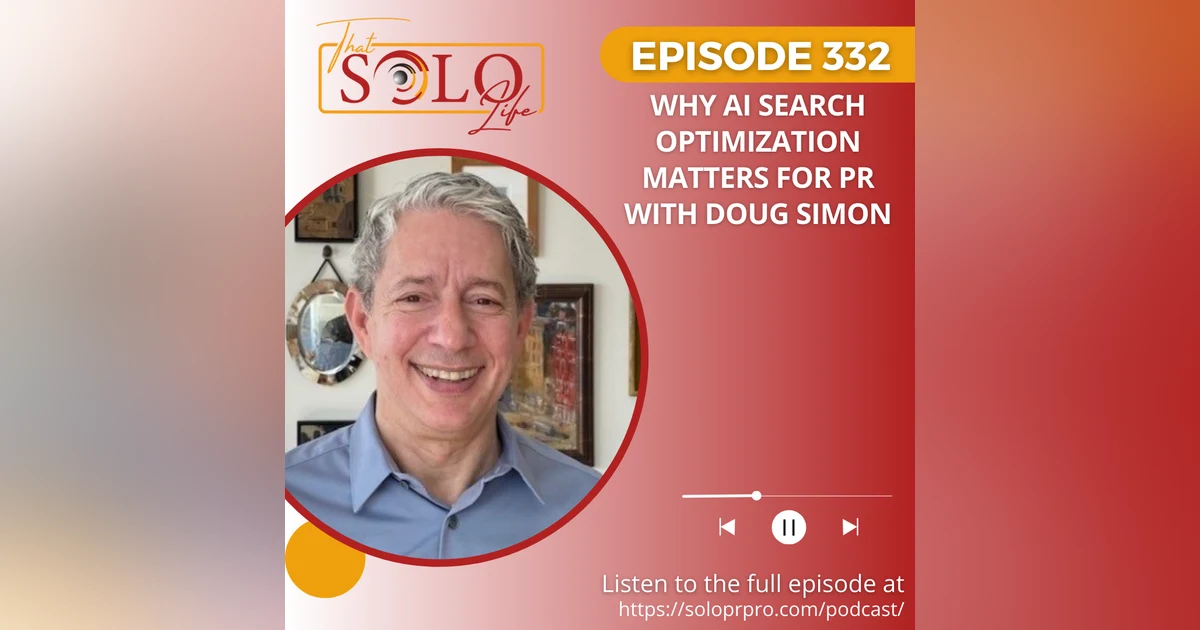


That Solo Life, Episode 332: Why AI Search Optimization Matters for PR Episode Summary
In this episode, Karen and Michelle are joined by Doug Simon, CEO of D S Simon Media, to explore the transformative impact of artificial intelligence on the public relations landscape. Doug shares invaluable insights on how AI is fundamentally changing content discoverability and why PR professionals, especially solo practitioners, must adapt to stay relevant. He discusses the shift to AI-powered search, the importance of optimizing content to answer audience questions, and how this new reality validates the long-standing PR principle of human-centric communication. Tune in to learn practical strategies for leveraging AI, insights from a recent survey of TV producers, and why your brand's own experts may be your most powerful spokespeople in the age of AI.
Episode Highlights- [04:16] The Transformative Role of AI in PR: Doug explains that leveraging AI is no longer optional but a requirement for modern PR. He discusses how AI impacts everything from content creation and research to enhancing brand discoverability.
- [06:24] AI as a Force Multiplier for Solos: Learn how solo practitioners can use AI as a powerful "intern" to extend their capabilities, from brainstorming and content drafting to design and strategy.
- [08:20] Optimizing Content for AI Search: The key to discoverability is answering the questions your audience is asking. Doug shares a case study with the Fragrance Foundation on how to identify these questions and integrate them into your PR and content strategy.
- [11:04] What TV Producers Want: Doug reveals preliminary findings from his company's survey on how TV producers are using AI. A key stat: 62% are more likely to run a story if it's optimized for AI search.
- [17:14] AI Validates Human-Centric Storytelling: The hosts and Doug discuss the irony that AI is forcing brands to communicate more humanly—ditching jargon and focusing on authentic storytelling that answers real questions.
- [19:01] The Power of Internal Spokespeople: Discover why, in the age of AI, using your organization's own experts for media campaigns can be more effective than hiring third-party influencers, leading to more earned media and stronger brand association.
- [22:27] A Final Word for Solos: Doug encourages solo practitioners to take a moment to recognize their accomplishments before diving back into the work of helping their clients succeed.
Doug Simon is the founder and CEO of the award-winning firm, D S Simon Media. A recognized innovator in broadcast public relations, his company created the industry's first AI-powered broadcast media tour. With a background that includes working at NBC Sports and becoming an "accidental entrepreneur" on July 4, 1986, Doug has been at the forefront of media communications for nearly four decades. He is a frequent speaker and expert on the intersection of AI, media, and public relations.
Related Episodes & Additional Information- Connect with Doug Simon on LinkedIn
- Email Doug: DougS@DSSimonMedia.com
- Learn more about D S Simon Media
- Episode 329: The New Alphabet of PR: From AEO to PESO
That Solo Life is a podcast created for public relations, communication, and marketing professionals who work as independent and small practitioners. Hosted by Karen Swim, APR, founder of Words For Hire and President of Solo PR, and Michelle Kane, Principal of Voice Matters, the show delivers expert insights, encouragement, and advice for solo PR pros navigating today’s dynamic professional landscape.
We hope this episode was valuable! Please subscribe, leave a review, and share it with a fellow solo pro.
Michelle Kane (00:13):
Hello, and thank you for joining us for this episode of That Solo Life, the podcast for PR pros and marketers who work for themselves. People like me, Michelle Kane of Voice Matters, my wonderful co-host, Karen Swim of Solo PR Pro. And today we are so excited to welcome a wonderful guest, Doug Simon. He is the founder and CEO of the award-winning company, D.S. Simon Media. They are a recognized innovator and broadcast public relations, and the creator of the industry's first AI-powered broadcast media tour, so you can guess what we might be talking about today. And fun fact, he also does some stand-up comedy. But first, hello, Doug. Welcome. Thank you for joining us today.
Doug Simon (00:57):
Hi, Michelle. And thanks so much for setting the bar so high for humor with that standup comedy reference. I mean,
Michelle Kane (01:05):
What's so funny about Peace, Love, and AI, right? Yeah. A lot.
Karen Swim, APR (01:11):
It's amazing. You are not the only PR or communicator that I know that also is a standup comedian. So maybe it's a natural fit
Doug Simon (01:21):
For us. It could be. There are a couple that have done it and I try and do it maybe once every five years or so is how it's worked out. That works. I only do each show once, so I don't just repeat the material, but it is fun. I'll see what I have coming up next. Maybe something this year next.
Michelle Kane (01:37):
A
Doug Simon (01:37):
Lot of stuff about how we love dogs. That seems to really go well with people.
Michelle Kane (01:42):
Oh yeah, that is certainly about our alley. My goodness, this is great. Definitely. Well, let's get to it. So yeah, tell us just a little bit about how you got to where you are today in the PR landscape and especially in the arena of AI.
Doug Simon (01:59):
Sure. Well, AI came in as a more recent thing, but it really started with a couple of opportunities. I have to work in live broadcast at NBC Sports where I was talent assistant for Bob Costas. So I really understood the needs, importance of what needs to happen during live programming, which is at the core of what we do with the media tours that we're producing. I worked at an agency, Michael Klepper Associates, and Michael had been the first one who thought it was a good idea for Bersa Marsh Stellar to have someone focused on broadcast, not just print outreach. So he had a very broadcast focused agency, but then he felt I wasn't good at new business. So he let me go and hired someone else to replace me, did his assistant, offer me my job back about a month later. So I'm an accidental entrepreneur and I figured I'd start working for someone I had to look at in the mirror every morning when I shaved.
(02:56):
And that's really my origin story.
Karen Swim, APR (03:00):
Well, that's pretty interesting. I love the term accidental entrepreneur because many years ago, most of us in this type of business, it was accidental. It was either a gap in between a job hunt. It wasn't really intentional, but we paved the way. I was an intentional entrepreneur, but I feel like people really paved the way for those of us who wanted to choose. So thank you for answering that call and deciding that you wanted to be accountable to the person that you had to wake up to every morning.
Doug Simon (03:33):
And that was true. And I positioned it that I declared my independence. So we started July 4th, 1986.
Karen Swim, APR (03:41):
Love.
Doug Simon (03:41):
And it's going to be 40 years. And again, we'll have the nationwide fireworks display. Hopefully a portion of that's celebrating us and it helps with the marketing budget.
Karen Swim, APR (03:51):
I love that. It's also one of my best friends working. Wonderful. Kudos to you. So let's talk about AI because this is a big topic in our world. How, in your opinion, is AI transforming the PR landscape? And tell us about some of the key benefits for brands leveraging AI-powered tools today.
Doug Simon (04:16):
Yeah. Well, of course it's transformative, but it's really a requirement the way things are changing so rapidly. And that's really what we've seen. And there are many different ways. Of course, for medical clients and organizations, AI is becoming a key factor in improving the quality of treatment and diagnosis. Then of course there's generative AI that's useful for anything from helping you to do a first draft, research, get information, plan a vacation. So it's everywhere that's been incorporated in the PR business. One of the big parts of it that I hope we'll talk about today, and I expect we will, is the importance of discoverability for nonprofits, for organizations, for brands as well. And the way people get discovered has changed probably faster than it ever has. And that's because of how dominant AI search has become in such a short time.
Karen Swim, APR (05:15):
Yeah. It feels like, but this is not true. AI has been around for far longer than it's been in the spotlight of everyone from parents to educators to communicators. But I'm surprised in 2026 to still hear people arguing AI versus human. And I feel like we're so far past that point. This is not an and/or it's a, how do I embrace this tool and integrate it into my workflow? What are the things that I can use it for to make me better at my job and to assist me? But I still see that. And I think some of us, we better catch up pretty quickly or we're going to get left behind. And then it really will be, it'll feel like it's AI versus human because you'll feel like it took your job, but it didn't. Somebody that was leveraging it in a different way and was more sophisticated and advanced is the person who actually won up to you.
Doug Simon (06:23):
Yeah. I mean, that's great that you say that. And I think especially for the solo practitioner, AI can be such a powerful sort of extender of capabilities. For example, if you don't have a staff, and I heard this when I was at a conference on AI in the public relations space, and one of the things that came up was treating AI as a really good intern on that, that of course you need to check what they're doing, but it gives you such a wide capability so quickly. I have a friend who started his own business, and one of the things he was doing was designing his logo and utilizing AI to come up with what are the best words and phrases that he can use to describe his offerings. So in so many ways, it can really propel the solo practitioner forward. And where it really translates to organizations and larger businesses is how do your business prospects, your customers discover you?
(07:23):
And that's changed dramatically overnight. I mean, Pew says 60% of us are using AI search to find information. And even people I speak to think they don't do that. Well, if you've done a Google search lately, the first thing you see is an AI overview. So it's become critical for organizations to find out how do you get in there? And there's really two key ways to do it. One of them is with earning media and the other with your own own content, making sure that it's discoverable.
Michelle Kane (07:57):
Yeah. Yeah. Let's dig into that. I would think before you point someone to your content, you want to make sure it's optimized. So what would you say are best practices for us to start engaging in, for us to be coaching our clients to engage in, to make sure that the content we are creating is performing well in AI search because it is a little different.
Doug Simon (08:19):
Yeah. The key is, and this hasn't really changed, it's how do you find out what your customers, what your prospects are asking?
(08:29):
What are the questions they have? And a few years ago we said, what are their pain points? What do they need to know? What's their experience? And smart people could sit in a room and brainstorm. And for us, we would have our media team, "Hey, what are the producers interested in? How can we phrase this in something that'll work? Can we make it more local?" All of those holds true, but what the AI platforms have done is create an opportunity to make that information more findable for you so you can really exactly make sure you're answering the questions that are the most common ones that are being asked that are relevant to your organization and your brand. Do you want an example of that? Yes, please.
Michelle Kane (09:14):
We do. Of course. You betcha.
Doug Simon (09:16):
Great. We recently did a media tour campaign for the Fragrance Foundation, and I can say in all the years of the company, our studio has never smelled this good, but it was about holiday gifts. So now that our tours are AI powered, we first put some information and obviously fragrance, holiday gifts to see what would come back. And it gets scrubbed across 11 of the top platforms, Gemini, Copilot, ChatGPT, Claude Perplexity and others. And when we came back with the 10 questions, one of them was, "What should I get for a teenage girl?" And our client was like, "Oh, we've got great information. In fact, if any of you watching or the two of you of teenage girls in your world, they're preferring body sprays and hairsprays as a way to get their fragrance." So when they saw that was one of the top questions, that became integrated both into the media tour with that being a question that was answered, but also in the video content that goes with it that gets shared on their social channels and online, one of the questions was simply, what do I get for a teenage girl in this area?
(10:28):
And they had the answer and now their brand is associated with search for this information across multiple platforms. And it also encourages the stations to post their content that's specific to this information because I'd mentioned we've discussed our recent producer's survey that's not quite done yet, but we have some preliminary data from that.
Karen Swim, APR (10:55):
We'd love to hear about that. This was research into TV producers around AI. So share with us some of the findings.
Doug Simon (11:04):
Sure. Well, there are four key points that related to AI. 43% of producers are using AI to generate story ideas. So that means if your organization is findable through AI, you're more likely to get broadcast coverage. So that's critical to be there. This is obvious. 90 plus percent were posting content to their website, 90 plus percent posting it to social media, 87% were posting it to YouTube. Excuse me. 67% are optimizing their content to be found. And by a 62 to 38% ratio, they're more likely to run a story if it's optimized for AI. So that's becoming a huge part of the equation. Definitely.
Karen Swim, APR (11:56):
That's really interesting. And I think those stats are something that we need to take to heart because search really has always been big in the media business for a long time, but this is a different iteration of it. This is a next level, a deeper level of it that we're seeing the muse. And it makes sense because
(12:21):
Like a lot of solos, they're dealing with fewer resources, having to cover more. They want to make sure that they get the visibility. And so we can supply that information in a way that's findable, that helps them and makes our stories more attractive. And I think that this is so important. In the past, solo practitioners have known about SEO and search, and we've known enough to integrate into our job, but I think that it's really important to master this new generation of search. Doesn't mean that we have to be experts. There are experts in this build, but we need to know and understand that and be using those strategies in everything that we write.
Doug Simon (13:09):
Yeah, definitely. I mean, both of you have been nailing it through the whole discussion, but it's so critical to be doing that. If you're going to truly help your clients, you can't just put this discoverability issue aside and you have to really be participating in doing things yourself to understand it better so you can truly help your clients. And one of the things, and this is something I learned when I was starting out in business as a solo practitioner, you need partners, you need resources so you can position yourself as a much larger organization or more capable and versatile organization to what you do. And obviously for those starting out, who are people you can depend on and rely on for feedback? Because sometimes that can be difficult for a person who's a solo practitioner. So I encourage people to engage. And the other thing that I frequently advise people to do is put something together that your customers can just say yes to, and you don't have to have a huge discussion.
(14:18):
If you can really define what your core offering is and share it and make it available, you can find, "Hey, client, you're not right for me, but I wish you well." Or, "Oh, this is spot on. We can really help you and that can help you grow tremendously by just making it easy for people to say
Karen Swim, APR (14:37):
Yes." Yeah. I mean, it's funny, I can't imagine doing my job with AI. I really can't. There's so many things that I use it for. It's just part of my daily workflow that I don't think I could do this job in 2026 in these days because it's the same job, but it's not the same job that it was 10 years ago.
Michelle Kane (15:01):
Well, and the great thing is, because what are we talking about this whole time is we're still talking about good content.
Karen Swim, APR (15:08):
Yes.
Michelle Kane (15:09):
It's how are we, as you say, packaging, how are we using the content in a different way? Because we're still proving for ... We're showing our clients in their best, most functional, here's why you need to do business with them light, but we're, I hate to use the word engineering, but we are just making sure that it's presented in a way that they can be found because that's what it all comes down to, getting found, getting trusted, and then getting down to business. So this is incredible information. And talk to us a little bit about how that storytelling and credibility, how that still weaves in. It still matters very much.
Doug Simon (15:51):
Sure. I mean, a lot of what we do and all of us do is share information and reach people that maybe if they hadn't gotten that information, wouldn't have done what you're hoping they will do, maybe support a cause or purchase a product or better their own health environment, but really sort of getting into what people are consuming to make them change behavior in some way. And obviously, hopefully that's in an ethical light that we're all doing it. So the tools we've used have changed. I gave the example early on my previous boss at his company, no one was trying to pitch broadcast television because it wasn't even thought of. Of course, the technology for how people receive information is changing so dramatically that you have to adjust with that time as is the ability to really understand how your product can benefit or address the questions that people have.
(16:53):
And the better we all are in doing that, the better the results are going to be for our clients. And it's impossible to do that now without utilizing some of these AI tools and platforms to not only ask it questions, but to really get an understanding of the population.
Karen Swim, APR (17:15):
Yeah. I love that AI is validating what we've been saying for years to clients, to not jargon, not talk at people, talk to people, use stories, be human. And it's so hilarious to me that it took artificial intelligence to have people really get that you need to be a human. Who would've thought? The computers want you to think like a human being. They want you to answer questions that people are actually searching for. It's just so funny. But I love this and I feel like this is a moment in PR that we have been waiting for and we should embrace it with everything in us. And because we have the validation to show clients, look, people don't care about your jargon. They don't care about your marketing material. They care about what they want to hear. They want you to answer their questions. They want you to give them insights.
(18:11):
They want you to talk like a human being.
Doug Simon (18:14):
Yeah. Karen, it's so great you say that because when we were introducing the AI-powered broadcast media tour and explaining it to clients when we did a report for them based on a potential project that they were considering, and one of them was like, oh, I love this. It's amazing. I've been fighting with my client because they keep wanting to do jargon. And none of the queries that people were asking had jargon in them like zero
(18:39):
Of that. So how can you be persuasive, much easier to be persuasive if you're sort of on their wavelength with what they need to know and are providing that. Another interesting point that I think is worthwhile, and this is another area of PR that's changing is for years and years I would sort of fight the battle small F on fight. So it wasn't like aggressive or anything, that people were better off utilizing their own spokespeople for media campaigns than third party experts. And this is especially for broadcast. And in our survey results, and we've doing the survey for over 20 years, it's either at or slightly above 90% of the stations say they prefer to interview someone with the organization. And in this age of AI, it's also a further way to tie your organization to the questions people are asking. And this year we did a quick assessment of the media tours we've done during January.
(19:40):
And for the clients that used their own spokesperson versus an external spokesperson, they generated 18% more earned media interviews than ones that used an outside spokesperson. Don't get me wrong, influencers certainly of their place, but there's now an opportunity to turn your own people, your own, whether they're leaders or working at different levels within the organization into influencers.
Michelle Kane (20:07):
That makes perfect sense because they are the subject matter experts after all. Yeah.
Karen Swim, APR (20:13):
And I really hope one of the things that I've spoken about lately that I hope brands really embrace is not just having spokespeople, but having your people touch, fill, and use your product or service like the audience. Because what I find so often is a company may put out a piece or they'll do a webinar and it'll be showing you about a new feature, but it's really from their perspective, not the person on the other side of that camera that's actually using it day-to-day to do work. So I hope companies take that to heart that in this new era where we are telling stories, where we're being human, where we're answering questions, that we make sure, as you said, because an influencer is going to, if it's a product, they're going to unbox it. They're going to use it. They're going to do different things with it.
(21:10):
They're going to touch it, they're going to feel it, they're going to break it, because they need to give a review.
Doug Simon (21:18):
Yeah. But just for client purposes-
Karen Swim, APR (21:19):
Internal people to step into the shoes of your audience. How are they using this service? Because sometimes they're using it in ways that you're missing, and so you're not teaching us anything. So that's why your audience goes to YouTube to find out how real people are actually using this thing. And then they talk among themselves on Reddit to say, "This works, this doesn't." And you have no idea because you haven't presented it in the way that your audience really needs.
Doug Simon (21:46):
Yeah. And just to put out a quick disclaimer, none of our client's products ever break, none of their services- Of course they don't. ... ever have problems. No. So I understand that that might be out there somewhere as
Karen Swim, APR (21:57):
A thing,
Doug Simon (21:57):
But not for the people we're
Karen Swim, APR (21:59):
Working with. I agree. My clients either. My clients are perfect. Nothing ever goes wrong.
Doug Simon (22:05):
Good. I'm glad we're on the same page on that.
Karen Swim, APR (22:07):
Yeah.
Doug Simon (22:08):
For sure. Everything's
Michelle Kane (22:08):
Great. Well, this has been so incredible, Doug. So one last question, drop some knowledge on us. What inspiration would you share if we were all sitting around a table having coffee?
Doug Simon (22:27):
Take pride in what you've been able to accomplish as a solo practitioner. A lot of us live what's next and you still need to keep that going to be able to survive in an ongoing way. But it's good to take a moment to step back and be like, great, I'm providing work. I'm helping my clients. I'm helping these other people who might be individual practitioners, earn a living and improve their quality of life. So take a moment for yourself just to give yourself the recognition of accomplishment and then get back to doing the work.
Karen Swim, APR (23:00):
Love it. I love that. Thank you. That's fantastic. I don't think any of us do that enough. In any job, we don't. We're always moving on, looking ahead and PR people are especially guilty of that. We're always running the scenarios in our head and thinking 10 steps ahead and we don't take that moment to just breathe and go, "You know what? I've done good work." And I mean, you're such a testament that you've been doing this 40 years doesn't look like it. You don't look like you've been in the bus for 40 years and you're still as excited. So this solo should give you hope that AI is not the thing that's going to make you want to pack up and retire. It's going to re-energize you and you'll want to keep it going another 20, 40 years too.
Michelle Kane (23:45):
Yeah. So how can our listeners connect with you, Doug? Sure.
Doug Simon (23:48):
There are a number of ways on LinkedIn, Doug Simon is how to reach me. Email is good, and that's Doug like my first name, S as in Simon, for my last name, Doug at Dssimon, S-I-M-O-N, media.com.
Michelle Kane (24:07):
Fabulous. Fabulous. Well, we can't thank you enough for joining us today, and we hope to have you on again in the future because this is a really important conversation that we need to keep having. And to our listeners, we usually say we hope this has been valuable to you. We know this has been valuable to you, so please do share it around. And until next time, thank you for listening to That Soul of Life.
Transcribing live conversations can be tricky so please be forgiving of any typos or errors that you find. Love something here and want to share? Great, please keep reading!
You are more than welcome to share the transcript (up to 500 words) in media articles (e.g., PR News, O’Dwyers), on your personal website, in a non-commercial article or blog post (e.g., Substack), and/or on a personal social media account for non-commercial purposes, provided that you include attribution to “That Solo Life” and link back to the soloprpro/podcast URL. For the sake of clarity, media outlets with advertising models are permitted to use excerpts from the transcript per the above.
But please note that no one is authorized to copy any portion of the podcast content or use That Solo Life’s name, image or likeness for any commercial purpose or use, including without limitation inclusion in any books, e-books, book summaries or synopses, or on a commercial website or social media site (e.g., Facebook, X, Instagram, etc.) that offers or promotes your or another’s products or services.
Got questions? Email us at info@soloprpro.com.