The Leap, the AI Edge and Authentic Leadership
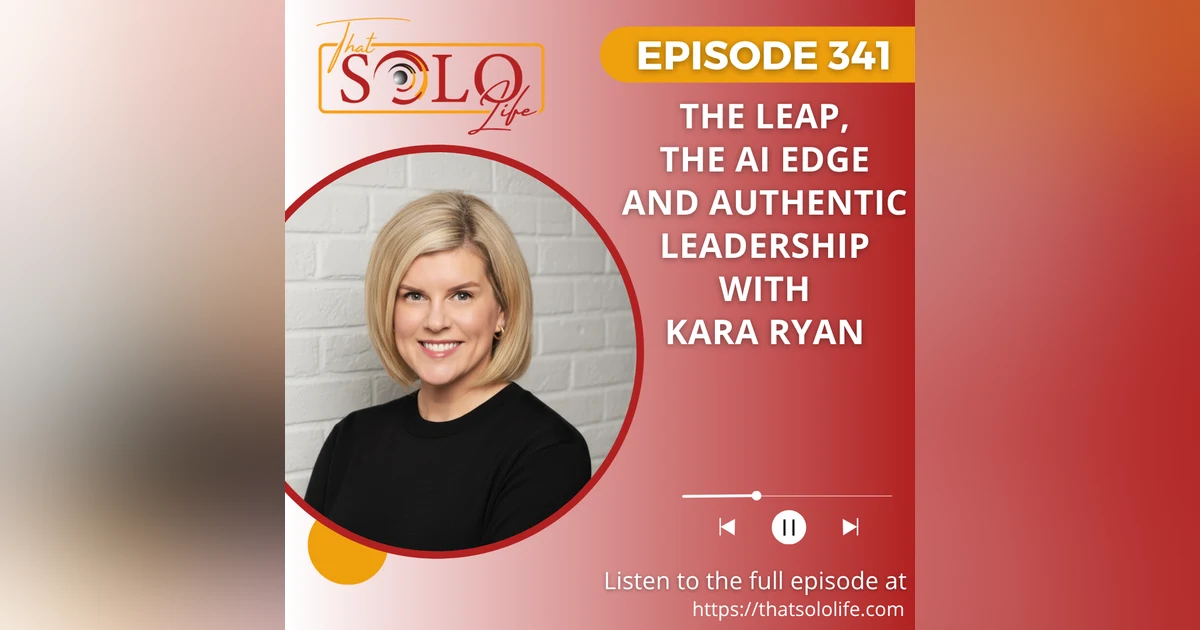


That Solo Life Episode 341: The Leap, the AI Edge and Authentic Leadership
Episode Summary
Kara Ryan spent 20 years of her career navigating corporate communications in some of the most regulated industries in the world - financial services, healthcare, and medical devices. In April of this year, she closed that chapter and opened Klyr Strategies, a solo communications advisory built upon the high-stakes moments that her clients face, such as product launches, leadership transitions, acquisitions, and IPO preparation. She joins Karen and Michelle just weeks into her solo journey, which makes this conversation something rare, equal parts seasoned practitioner wisdom and unfiltered, real-time solopreneur start-up experience. The conversation covers the financial math and mindset behind making the leap, the structural surprises that hit early, and how Kara's "advisor-led and AI-powered" approach works in practice — including why she's upfront with clients about using AI and how she keeps their data secure. She also shares her strongest professional conviction: that authenticity in leadership communication is a strategic discipline, not a personality trait, and that communicators are uniquely positioned to address it. This is a conversation for anyone who has done all the right things in corporate and still feels like something is missing.
Episode Highlights
- [02:29] The Slow Burn Decision to Go Solo: Kara always pictured working for herself — but it took 20 years, a turning-40 moment of reflection, and the realization that the job market wasn't going to rescue her to finally make the leap. She filed her LLC paperwork two years before she actually left, which says everything about how long the mental preparation can take. Her framing of "perceived security" resonated deeply with Karen and Michelle: the steady paycheck and benefits that feel like stability are increasingly anything but.
- [06:17] Why a Tough Job Market Is an Argument for Going Solo: Kara makes a counter-intuitive case: watching talented, experienced mid-to-senior communications professionals spend six, nine, or twelve months searching for their next role wasn't a reason to wait — it was a reason to move. She chose to create her own security rather than compete for a shrinking pool of roles. The calculus is different when you're in charge, but at least you're the one doing it.
- [09:11] The Real Surprises of Early Solo Life: Weeks in, the biggest surprise for Kara has been structure — in two senses. The rhythmic structure of corporate life (a desk, a schedule, a team) simply disappears, replaced by something more fluid and self-directed. And then there's business structure in the legal and financial sense: entity type, tax implications, and what it actually means to be both the employee and the employer. None of it is impossible, but none of it is as straightforward as it looks from the outside.
- [17:42] What "Advisor-Led and AI-Powered" Actually Means: Kara is intentionally transparent about using AI — it's front and center on her website and LinkedIn — because she wants clients to ask her about it. In practice, AI handles the research and monitoring work that would otherwise consume her mornings: a daily media scan, a customized briefing, a business development follow-up queue, all delivered before she sits down to work. She's not using AI to draft comms plans; she's using it to stress-test the ones she writes. The distinction matters, especially with clients in regulated industries where data security isn't optional.
- [22:25] Bring Comms to the Table Before the Decision Is Made: Kara's most consistent frustration from 20 years in corporate: communications professionals are brought in after the decision has already been made. The announcement is written. Now communicate it. But that's where the real opportunity is lost. Comms can inform the decision itself — reading the room, flagging what employees are already feeling, identifying timing conflicts in the news landscape — but only if practitioners are included early. It's not about ego. It's about outcomes.
- [25:17] Thinking About All the Audiences, Not Just the Obvious One: When a leadership transition is announced, the C-suite is often focused on one key audience — investors, say, or the board. Kara's job is to hold the full map: employees, customers, partners, media, and community. Each audience needs something different from the same moment. That multi-audience perspective is something communicators bring that AI and algorithms can't replicate, and it's one of the clearest arguments for bringing comms in before the decision, not after.
- [26:58] The Case for Communicating Less: A provocative take from someone whose business is communications: sometimes the most strategic thing you can do is recommend less of it. Kara has worked in organizations with hundreds of communications professionals and organizations with none — and the sky didn't fall in either place. What matters is the right message, from the right person, to the right audience. Blasting every channel because you have them is not a strategy. It's noise, and it trains people to tune you out.
- [38:18] Authenticity Is Kara's Signature Topic — and Her Strongest Conviction: After two decades of watching leaders transform at the podium — warm and candid in the hallway, robotic and on-script in front of an audience — Kara has landed on authenticity as her defining professional issue. Not because it's a buzzword, but because the gap between who a leader is and how they communicate creates a trust deficit that messages alone can't close. The good news: it's coachable. The harder truth: some leaders won't be coached, and sometimes the right answer is to find a different spokesperson for that moment.
About Kara Ryan
Kara Ryan is the founder and principal of Klyr Strategies (pronounced "clear"), a communications advisory serving small to mid-size companies in the medical device and healthcare space. Kara spent 20 years in corporate communications, working across financial services and highly regulated healthcare environments, with deep expertise in the high-stakes moments that define organizations: product launches, leadership transitions, acquisitions, and IPO preparation. She is based in Orange County, California — a hub for medical device manufacturers — and brings boardroom-level experience to clients who are doing big things without an in-house communications team to support them. She describes her practice as advisor-led and AI-powered, is transparent with clients about how and why she uses AI tools, and takes data security seriously as a non-negotiable.
Connect with Kara:
Website: klyrstrategies.com
LinkedIn: linkedin.com/in/kara-l-ryan
Resources & Additional Information
Klyr Strategies: klyrstrategies.com
Solo PR Pro membership community: soloprpro.com
That Solo Life podcast website: thatsololife.com
Host & Show Info
That Solo Life is a podcast created for public relations, communication, and marketing professionals who work as independent and small practitioners. Hosted by Karen Swim, APR, founder of Solo PR Pro, and Michelle Kane, Principal of Voice Matters, the show delivers expert insights, encouragement, and practical advice for solo PR pros navigating today's dynamic professional landscape.
Listen to all episodes and catch up on previous conversations at thatsololife.com.
Did this episode inspire you? If you found value in this conversation, please take a moment to leave us a review on your favorite podcast platform. Your feedback helps us reach more solo pros just like you! Don't forget to subscribe so you never miss an episode.
Michelle Kane [00:13]-[00:54]:
Hello, and thank you for joining us for today's episode of That Solo Life, the podcast for PR pros and marketers who work for themselves. People like me, Michelle Kane with Voice Matters, my wonderful co-host, Karen Swim of Solo PR Pro, and it's another guest day. Yay! Today we are joined by Kara Ryan of Klyr Strategies. Kara has spent a couple of decades in the private sector in some highly regulated areas. But she's recently struck out on her own, and we're going to talk about her journey and all the great things she's up to. So welcome, Kara. How are you? Thank you.
Kara Ryan [00:54]-[00:57]:
I'm doing wonderful. Thank you all so much for having me.
Karen Swim, APR [00:58]-[01:05]: We are delighted to welcome you and welcome to the solo PR pro universe. We love that.
Kara Ryan [01:06]-[01:19]:
Yes. Thank you. I'm quite new to it about five-ish, almost six weeks in, so haven't learned everything, but I can tell you, I've learned a lot.
Karen Swim, APR [01:19]-[01:35]:
That's so helpful. Cause I think, you know, we'll dig into this, but I think that many other people out in the audience are going to want this real-time insight from somebody that may have just stepped into what they're thinking about right now.
Kara Ryan [01:37]-[02:01]:
Yeah, absolutely. And I'm happy to provide it. It's such an interesting time to be doing this for a lot of reasons, right? Economically, the job market, you know, the AI of it all. It's just a really interesting time to be making this leap. But yeah, happy to share what I've gained so far and certainly don't claim to be an expert on any of it. But would certainly love your insights as we navigate the conversation.
Michelle Kane [02:02]-[02:28]:
Nice. Well, you said you've always envisioned yourself making your own schedule and being your own boss. And even with that, you did spend a good amount of time in the corporate world, which is great but what made you finally decide, or was it a slow burn decision? What led you to leave it behind for the solo world?
Kara Ryan [02:29]-[04:56]:
It was actually a little bit of both Michelle. A little slow burn, but also a little bit of the moment kind of struck me as a perfect time. So when I say it was a slow burn, I mean, like really slow. I as a kid, I mean, I guess I never considered working for anyone else as a kid. I always just thought I'm going to be my own boss. You know, I didn't know exactly what that would be.
I had sort of writing and journalistic tendencies as a kid. And so I kind of always thought, I'll just, you know, I'll be a writer. You know, life, life happens to all of us. So I went to school for journalism and came out of school at a time like in the early 2000s, when journalism, even now, is not the journalism of yesteryear, right? So it's really tough to get a gig there.
But it wasn't tough, or as tough, at least, to get a good gig in PR. So I ended up in a comms role right out of school for corporation, and 20 years later, I had never left. And part of that was, I think, like probably a lot of people listening to this thinking about making the jump is just the security of it. Right. So, you know, well, the perceived security of it - the same pay that's coming in every couple of weeks, the benefits, the health insurance, things like that, that do make it actually really tough to leave.
I'll admit I'm a couple of years now into my 40s and I think hitting 40 for me was really a moment of reflection career wise, also just life wise, but even when it came to my career, do I want the back half of my career to look like the front half? I kind of decided at that point which really was about a little over two years ago that I said to myself, I think I want it to look different. I really do think there's going to be a time for me soon to make the jump, do my own thing.
So I actually did file all the paperwork with my Secretary of State to get my company legal and all that about two years ago. But honestly, it took me that long to sort of work up the preparation and almost the will, the strength, if you will, to sort of finally make the leap. And it's been an interesting time to have done that, but I actually think in some ways, a lot of ways, a really great time for me personally to do it.
Karen Swim, APR [04:58]-[06:17]:
You hit on something that I think is really important. You use this phrase that I love, perceived security. Because I think that that is one of the things that holds people back from jumping into a solo career because they see corporate employment as stable, secure. History has told us, at least recent history, in prior times and, you know, prior generations that's been true: you could work at the same job until you retired, you could be there for 25 years, but that's no longer true. We're seeing displacement and layoffs and jobs being restructured very quickly. So is it secure?
I'm interested in what finally clicked for you, that you were able to overcome that mindset of the perception of security and decide to create your own thing, which is actually more secure because you can do it whenever you want to. You can do whatever you want when you're a solo. You're not bound by these boxes. So tell us a little bit about that.
Kara Ryan [06:17]-[08:32]:
Well, you actually hit on it right there, I think, well, two things really - one is, I think, just as you described, what used to be security is now really no longer, right? So across every industry, but certainly affecting those of us that have worked in comms and marketing and PR, and you know we're being squeezed a lot the roles and companies are being squeezed out, either for budget reasons or, you know, oh AI might be able to help do some of that. And we're seeing people that are on the job market really talented and experienced, you know, mid senior level people looking for jobs six, nine, 12, sometimes 18 months or more.
I'm the type of person who did a lot of different roles in my 20 year corporate career for different companies. And I kind of at the usually around the 18 month mark, started to get the itch. And by two and a half years was, you know, hoping to be in my next gig may have been the same company often was. And so I think at that point in the company I had, I was sort of at that moment where I was kind of like, okay, I'm getting the itch.
But when you look at the market out there for other roles, it's really dire. It's really tough. You know, again, even with people that are really seasoned and have great experience, it's just really hard. And so exactly what you just said, I said to myself, you know, the security that we've perceived is really not there anymore. And I could create that security for myself, a different type of security, if you will.
So, you know, it's all on me now, so there's a completely different kind of calculus, I guess, that goes along with it, but I'm in charge, right? I'm secure because I decide how I spend my days, how I choose clients, how I make my money, right?
And so I think it was a combination of the two things exactly that you just touched on was the realization that security really isn't so secure anymore necessarily in the corporate gigs. And I could create some sense of security for myself. So yeah I think it was the right time for me. And I think, you know, again, I'm very early in the mix, but I really still believe that this was a perfect time to do this for me.
Michelle Kane [08:35]-[09:11]:
It's so true. So true. I think so many of us loved the security of the direct deposit. I mean, I thought I'd always be a direct deposit girl. And here we are. And I think that was certainly my realization in my journey, was that, that that's not even secure, so don't delude yourself. But you are in this now for several weeks and counting; more than that, about six weeks. This might be kind of early to ask this question but what's already surprised you about solo life that maybe you didn't anticipate when you were thinking about how it would look?
Kara Ryan [09:11]-[11:53]:
Yeah. I mean, where do I begin? I think I would say thematically, I would say the word structure comes to mind. And when I say that, I guess I mean it in kind of a couple of different ways. One really is, again, coming from corporate, there's a lot of structure that's sort of built into that for you. Right. So whether you work in an office or from home or in a hybrid, and I've done all, there's a structure in where you're sitting day to day and what time you're sitting there and who you're interacting with that really isn't there right now as a solopreneur.
I'm working remotely from home right now, but later today, I might be in a coffee shop. I'm on phone calls with people that I've never met before, that I'm doing outreach to. That's just different, right? There's a different structure to my days. So I think when I jumped in and when I made the leap, I thought, oh, I'll keep my standard of being at my desk nine-ish to five-ish. And I think the hours I'm working are roughly the same - I really probably should look very closely at that - but the blocks of time aren't.
So I'm not here consistently nine to five. I might be here from nine to noon and then take a break, go do something else around the house, go run errands. And then knowing me, I'm a night owl, so I'll have an idea or something will strike me at 8pm and I'll find myself at midnight still still cranking that out.
I think the structure has been different for me. And I sort of anticipated like, you know, oh, it'll be the same. And it hasn't. And then when I say structure in a sort of second way, it's truly like how you structure your business could have implications. And I thought I did really pretty robust research into sort of the legal ways to structure a business and I landed fine. I'm fine. I've done research to make sure I'm fine. I've talked to people, lawyers to make sure I'm fine. But I'm learning now, if I had structured something slightly differently or added on a different type of structure, an S-Corp, for example, you're looking at different tax implications for yourself, right? And at six weeks in, I don't yet have a full glimpse at what my income is going to look like so do I pull those triggers or don't I?
So when I say structure, I really mean it in a couple of ways. But I think both of those things have been a bit surprising. I just thought, oh, I'm going to work for myself. Taxes will be pretty straightforward. And nothing is. Nothing is as straightforward as you want it to be. But yeah, I would say the structure of it all, I think, has really been surprising to me early on. And I'm sure there's a lot more surprises to come, but that's kind of what I've sussed out so far.
Karen Swim, APR [11:55]-[13:18]:
I think that's a pretty common reaction too. And it's because you don't think of yourself as the worker, right, because you, you're coming out of being an employee. So you're an employee. So you think about all of the things that that means, you know, you get a paycheck, you have health insurance and you know about benefits, but then you have to think about the structure that provided all of those things to you.
Like, oh, I need to figure out my computer problems or have some kind of a plan. And, oh, I am the employer who also is paying employment taxes. Like, oh, what does that house really look like? Because you don't really know, right, until you're in it, how much is going to go to that. Like, you have no idea.
So it's definitely not like being an employee and having it taken out so nice and neat and you look at your net. It's like, no, you're responsible for the employer side of the house now. And you're responsible for those, you know, health benefits and, you know, your retirement.
And so, yeah, that part can be very new. But I think, you know, you've done the right things by getting the right counsel, by going into it eyes open, and you're prepared because you're, you know, looking at it and understanding it right from the beginning.
Kara Ryan [13:19]-[13:24]:
Yeah, yeah, absolutely. As close to the beginning as we could. Right, exactly. And you know what?
Michelle Kane [13:24]-[13:27]:
Five years from now, you'll look back and you'll go, oh, look how far I've come.
Kara Ryan [13:28]-[13:50]:
I really hope so. But nothing that's been surprising has been scary so far. I think it's kind of like a realization moment rather than a scary, oh, I should have done something completely different moment. So that's been comforting. Nothing's been upended, you know, or completely turned my business upside down. But yeah, there's some surprises for sure.
Karen Swim, APR [13:51]-[15:38]:
I love that it gets more surprising, but in an exciting way. I think, you know, you talked about this a little bit, but I think I was that person too. I was, you know, two and a half years and I was off to the next thing. I love that as a solo, you can add or take away things that make sense for you. You know, you can do it on every client engagement if you felt like it. And over time, you, you know, as you build a time and add people, you can delegate the things that don't light you up and keep just enough hours for the things that you are truly passionate about. And I think what a joy to be able to do that.
So you really can change your job as often as you want to. And we've had solos become journalists who became comms consultants. We have people who have gone on to teach, who have started AI companies, who have become yoga teachers. I mean, there's just a wide variety of pivots that people have made. And I love that flexibility and ability to adjust your hours in every season of your life. If you have small kids, you may want to work less. If you have an empty nest, you may want to work more or not. It could be the opposite. When seasons are busy, you may want to, you know, work a little less in the summer and you can structure your client engagement so that you have that downtime.
So yeah, you're going to love it. Those are the good surprises that'll come your way, how great it all feels and how it's not as hard as we think it is when we're in corporate America. It seems scary. It really isn't.
Kara Ryan [15:39]-[16:35]:
Yeah. And I think to your point around, you know, how you structure your time and slower seasons and busier seasons is for me also, like I love to travel and my family happens to live, you know, 1500 miles away from me, my parents, my sister. So I like to visit them, you know, ideally three or four times a year. And it used to mean taking three or four days off of work to be able to really spend my time there. Or I'm sitting in my parents' house glued to the computer because I want my team's light to be green and everybody knows I'm online.
I think that's the realization for me, too, as I can now do those trips. And sure, I will be working partially there, but there's no one sort of keeping tabs on me being, you know, in my seat at certain times. It just feels like a little more freedom. That's something that's for me who loves spending time with my family and doesn't get to do it as much as I'd like is going to be a huge benefit for me.
Karen Swim, APR [16:36]-[16:56]:
I love that. We have some solos who have said that they really don't take formal vacations because they just travel a lot and do whatever they want and they have their laptops so work can get done, but they don't, you know, they feel like they're always on vacation. And I, you know, that's beautiful when we're able to do that.
Michelle Kane [16:56]-[17:42]:
It is. Yeah, good for them. And the beauty of operating the way that we do is you find, you know, the larger the organization, the slower it takes to change direction of the ship, whereas we can pivot in a nanosecond.
So let's talk about your approach to your business. You described your approach as advisor-led and AI, oh my gosh, hello, AI-powered. Advisor-led and AI-powered. Goodness gracious. Tell us what that means in practice as you work with your clients and why you decided to just say like, hey, AI's here and I'm using it.
Kara Ryan [17:42]-[21:48]:
Yeah. It's very intentional that I lead with that. It's very upfront on my website, sort of in my LinkedIn. The content that I create, I acknowledge advisor-led, AI-powered, and I really mean it in several ways, actually. And I think some people maybe are reluctant to showcase that they're using AI in their business or in their work. We know a lot of people are and they're sort of not acknowledging it. And that's okay. I want to be upfront about it because I want clients to know how I'm using it. So I want them to ask me, Hey, you say advisor led AI powered. What are you doing with AI? How's that going to help me?
And, you know, for me, it's a couple of things; it's really getting me smarter, faster, you know, knowing more information about a client before I even meet with them, right. really deep research on where they are as a person, but where their company is, where they've been, where they're going. So I get like a daily media scan every morning at 7am, an email gets sent to me with kind of the goings on in a very super customized niche that I've asked AI to focus on. And that same daily briefing that comes to me tells me, here's what your day looks like today. Here's where your business development stands in terms of you need to reach out today and follow up with, you know, what's happened since your last follow up with that client.
So a lot of it for me is like letting AI do work honestly while I'm sleeping. That would take me, you know, an hour or two, maybe more when I got up that morning. So things that just are delivered to me that make me smarter and faster that really don't have anything to do necessarily with creation of work, but actually make me smarter so that when I do create the work, It's well-informed, well-intentioned, and I'm not spending a ton of time researching necessarily.
So I'm looking at AI to manage a lot of the thinking behind what goes into me doing, if that makes sense. So I still plan to do a lot of the client work. I'm not going to ask any AI tools to help me. I'm not going to ask them to, say, craft a comms plan for this client. That won't happen. But what I will ask them for is, I've crafted this comms plan. I have these messages. Act as a hostile investor and tell me how a hostile investor might react to this message set, right? That's something that would cost a lot of money and research to do without these tools. But it's not AI crafting things for me. It's AI making me smarter on what I've crafted. So that's kind of one way that I'm using it.
And I guess the other one is really, you know, when I say advisor led and AI powered, I say advisor led because I want it to be clear, especially with the types of clients that I'm working with, you know, a lot of them, med tech, health care, regulated industries that are, you know, looking at the FDA or even the SEC that are looking at them. I want to make sure the information I'm using to help craft comms plans for them is secure and safe. It's not being used to train these AI tools.
So I'm investing in the paid versions that get me up to a level where I know the data is secure with me, not being used to train the models. And that way I can confidently tell clients, hey, I am working with AI to help craft. I'm using data that you've provided me, but rest assured, it's secure. It's safe. It's not being used so that your competitor can go into… chat GPT and find out what your launch plan is. That will not happen because of the investments and the care that I'm taking to make sure that data is secure. You know, it's really important to me that, especially with these big moments that I'm kind of focusing on for them. So whether they're looking at a product launch or a leadership transition, you know, things that need to be kept under wraps until they're ready to be revealed are not just out there for anyone to find.
Karen Swim, APR [21:51]-[22:23]:
I love that. And you talked about the big moment. So you've worked in highly regulated environments. And I'm guessing that you are now carrying forward that experience into your solo PR pro career. So as you look back at some of these very high stake communication situations that you've been in, what are some of the things or one thing that you wish more companies understood before those situations happen?
Kara Ryan [22:25]-[24:43]:
Oh, man, the list is there. I guess the one thing I would say I wish most companies understood, and this applies to tiny companies, medium size, every size company, is I think a lot of leaders go, okay, we've made a big decision, we've decided A, to acquire something, sell something, make a change to our leadership team, we've decided to launch a product, now let's communicate it. And that's when people like me, you know, historically get brought in often, right? And I think it's not ill-intentioned, but it's too late, right?
People like us in PR and communications can do a lot more good if we're brought to the table when the discussion around the decision is actually happening rather than the decisions made now communicate it. Because at that point, we've missed opportunities to sort of gauge the vibe in the room, if you will. What are people saying? What is the leadership team saying about this decision? Are they all really behind it? And if not, what are their hesitations so that we can craft, you know, communications that marry up to that and address some of those concerns.
When we're brought in late, you know, we may be handed a decision that a competitor just communicated news two weeks ago that really is going to make this look bad. Or, you know, employees are really having a hard time right now and you're about to communicate that you're, I don't know, making investments in something that they don't think is really important.
So I think the earlier that comms is brought to the table, and I know I'm singing to the choir here if there's communications folks listening that have worked in a corporation, but the earlier we can be brought in, the better. And it's not just a, oh, I need a seat at the table from an ego perspective. It truly is that we can actually help form and inform that decision so that it lands in the way a team wants it to, rather than in the middle of, you know, chaos or something that is a news landscape or media landscape that's just really not a good time for them to make that type of announcement. So I would say the one thing is comms at the table as early as possible.
Michelle Kane [24:44]-[25:16]:
So true. So true. I used to say I don't need to know everything. Like you said, it's not ego driven. You know, oftentimes I could care less personally, but I need to know so we can troubleshoot, prepare, or point things out that might have been in their blind spots that could really save them a lot of agony later. So that's, yeah, if only our corporations and organizations could embrace that. We're not needy.
Kara Ryan [25:17]-[26:27]:
We're just trying to save you some heartache. To build on that a little bit, Michelle, is we're thinking about audiences besides maybe just the one audience that that team has in mind. Depending on the type of moment we're talking about, if it's, you know, a leadership transition, and there's a new, you know, C-suite member coming in they may be thinking, oh, how's the investment community going to take this? I'll be thinking about that too but I'll also be thinking about how are those people that you walk around the halls with every day going to be feeling about this? And, you know, we know they can be just as important in terms of being ambassadors or you know, potentially not for your organization.
So it's really about, you know, considering all the different kinds of audiences and what they need to take away from it rather than I think sometimes leaders are making decisions based on, you know, one kind of key audience in mind. Not that they're intentionally ignoring the others, it's just not a focus. And I think we as communicators are thinking about all the different publics, internal, external, everyone that can potentially, you know, get a reaction from this news. And I think that's a perspective that we kind of uniquely bring from communications.
Karen Swim, APR [26:29]-[26:57]:
Yeah, I love that. You've said before, because we had a chance to talk before the podcast, and you said that sometimes communicating less is actually better. So talk about what you think is right size communication. What does that look like? And how do you help clients to find where that line lives?
Kara Ryan [26:58]-[29:00]:
Yeah, it's a bit of an odd take for someone who's looking to do communications advisory work with clients to say, hey, maybe you need to do less communicating. And it's not like a hard and fast rule. But having worked in organizations that have really large communication teams, I mean I'm talking, I've worked for organizations that globally have a couple hundred people working in communications and I've worked in organizations that have no comms. Right. And what I've learned is even at the organizations with no comms, the sky didn't fall. You know, so there was stuff, you know, information still gets communicated, maybe just not in the way that we as communication professionals would think is ideal. But I think what that's taught me is as long as you've got the right message delivered really clearly from the right person or people, and it goes to the right person or people, that's all you need. It may not require a full all-hands meeting and a newsletter article and a Teams channel or a Slack message campaign, you know, plus an email from the CEO. It may not need all that, right? And there's, internally, few people are actually going to see all those things.
And then when you talk about externally, same thing. If you're really trying to get something across to just one audience, just one community, focus on how they'll receive it rather than oh, we need to, you know, we need to blast this out, we need to make the massive news of this. Focus on that audience or that person or that team that needs to receive it, what they need to hear and go that direction. I think in teams where there are a lot of people, you know, we make a case, well, we should do all these different channels because we have them and we have people to manage them. But I think it's also important to think about how it's received. And it's so rare that someone's going to be receiving it in all those channels. And as long as they're receiving it in the right one at the right time, you've done your job. I completely agree.
Karen Swim, APR [29:01]-[30:40]:
And that is contrary to what we see overall in today's world. It feels like everybody thinks that more is the best, and it really isn't. I think what happens is that things really get lost in that quantity, that volume. You know, you lose those quality things that will stick, the things that people will remember. You just don't remember anymore because it's not resonating because there's just so much being thrown at you. So it feels like a fire hose of information and you take in a tidbit here or there and that's it.
And I agree on corporate channels because you get stuff in email, you get it in Slack, routines, you get it everywhere. And it's just like, you kind of tune out. It just feels like more information, not information that's really for me, that's going to make a difference to me, that's something that I care about.
I love that you are calling that out. And I think that's tough. I don't think it's tough for PR pros who understand that to really grasp that concept. I think the tough part is really a process of getting your clients to live by that rule. That's the tougher part because they always think that everything has to be; they're thinking about algorithms, which also are not favoring volume these days, but they're thinking about blasting everything, everybody, and they want to do 10,000 things at one time. And I'm going to need you to do this one thing. Yeah.
Kara Ryan [30:43]-[31:22]:
And you're so right. I think the algorithm, you know, analogy works across the board is certainly externally, we know algorithms are driving how people are hearing and receiving our information. And I think that does kind of lend itself into oh, well, we've got to hit them from every angle because the algorithm may hide it. And I think that's led to us not thinking about what lands - where does it need to land specifically - what will make people really believe it, act on it, lean into it, so that nothing gets lost. And it is, it is harder now, with sort of the algorithms kind of dictating how things get to people or don't.
Michelle Kane [31:23]-[31:29]:
Yes, yes. I don't know anymore. I feel like the algorithms are just madness.
Kara Ryan [31:31]-[31:37]:
And changing by the second, right? So you learn it and then you go, oh, so true.
Michelle Kane [31:37]-[31:42]:
Yeah. And you're like, So all the more reason. Yeah.
Kara Ryan [31:42]-[32:25]:
Yeah. That's what I was going to say, that's why I think it's almost like, you know, I wouldn't say ignore algorithms, but definitely like communicate what you believe needs to be communicated, what that person or audience needs to hear and receive when they need to hear it, receive it in the way that you know or believe that they'll receive it best.
And because the algorithms are changing day by day, you may or may not hit every time. But if you hit them from every audience or every I'm sorry, every channel all the time, they're just going to tune you out going forward. They're not going to know what's important because you're hitting them so much. So, yeah, I think I think we almost, again, don't ignore the algorithms, but don't let them dictate your communications.
Karen Swim, APR [32:26]-[33:48]:
Right. You know we could have a whole conversation about that and we might do that at another time, but as you were talking about that, I remember this was just like a really dumb example, but it was meaningful. Someone was talking about when you're watching streaming shows and you stop watching the show and you come back. You want to continue watching but sometimes you have to click through so many things to just get that thing you're watching because the algorithm thinks that it knows you and it's serving up stuff on your homepage, but that's not what you came there for. You came there to watch that show that you were watching four weeks ago, and you just want to be able to click that button and not go through that whole thing.
And to me, what that says is that this ties into this larger argument about why we need human judgment. You think you know what people want but you kind of don't. And something like that shows me that, yeah, technology can figure out a lot of things but sometimes it does make things harder. And sometimes it buries the right information - it buries the thing that's most important to you. If you've ever gone to a social media site and tried to find that article that you had started reading, but then you had to go take a client call, you're like, I was interested in that, I want to see that, and it's like where is it?
Kara Ryan [33:50]-[34:03]:
Yeah. It happens to me all the time. I'll be scrolling through Instagram or something and you see a post and you want to show it to somebody and you show it to them and the screen refreshes and then you go, oh my God, I'm never going to find that again. Yeah.
Michelle Kane [34:03]-[34:04]:
The worst.
Karen Swim, APR [34:04]-[34:58]:
It's like don't look away. It's going to disappear. Which I think is horrible, that's the way that the algorithm works. But it's not human. And we have to keep drumming that message home that technology has its place, but it's not a human being. And no to all the companies out there who are firing seasoned workers for quote, unquote, AI natives, I have to caution you that the one thing that you're losing that you're not thinking about is that institutional knowledge, but you're missing out on experience that can strategically use those AI tools and pick up what it's missing. You know, I love Claude, but he's not a human being. Right? He's not everything.
Kara Ryan [34:58]-[36:13]:
And he wasn't in the room that one time when something went awry and you were and you know how to solve it. Right? I mean we're talking about Claude like he is a person, but yeah, it's true. I think that goes back to sort of my advisor led AI powered mindset, right? It’s that there is a level of judgment that you have to have. These tools hallucinate sometimes, and even when they're not hallucinating, they're giving you true information. It may just feel a little off the wall or kind of crazy to use in your work. I mean, I've gotten into research sometimes where it might mix up a company name, things like that. There is such an important human layer in all of this that, you know, Karen, I completely agree with you when you're trading out, you know, an employee with institutional knowledge and judgment for, oh, you know, I can do that. You're really not. Like your AI can do a lot, but it's not a human. It doesn't have the same judgment that person does. And I would love to see companies leaning more into training those employees to use AI in their roles and become even better, smarter, faster, rather than saying, oh, absolutely. I would love that I think some are doing.
Karen Swim, APR [36:14]-[37:33]:
And they have this mindset because I'm reading about people that saw ahead of the trend and started studying on their own and learning things and they got fired anyway because companies felt like, oh, it's going to take them too long to ramp up. But when you have been an expert in an industry, learning a new tool is something that you've been doing for years. And we've worked our way through a lot of tools. So just because you're 45 doesn't mean that you're too stupid to learn something new. Quite the contrary, it means that you probably will master it in a much different, quicker way than somebody who's not gone through so many rounds of learning and pivoting. And what you said, they've been in rooms.
You know, you could have a perfectly good scenario laid out by AI, but AI doesn't know about that time that this thing happened that was so major, and it taught you a lesson about something to look for. That you're not gonna find in chat GPT becuase that's human experience. That would be good except I know to look for this thing that happened that I have worked into every comms plan since then because it is a possibility. You don't know that.
Michelle Kane [37:35]-[37:42]:
AI is not going to protect you from yourself at the end of the day. That's what we need humans for.
Kara Ryan [37:42]-[37:43]:
Exactly. Yep.
Michelle Kane [37:47]-[38:18]:
Oh my goodness. Well, while we're talking about things like high-stakes comms, you've gone through a lot of different situations in corporate that you've navigated. You've navigated layoffs, leadership transitions like we were just talking about, crisis moments and preparation for that. What's one thing, and we know being at the table certainly is important, but is there another thing you wish more organizations understood before these things happen as opposed to after?
Kara Ryan [38:18]-[41:37]:
Yeah, definitely bringing comms in early, like we talked about earlier, is really important. I think also for me, something that I've, and again this comes from having been in those rooms, it's not something that an AI tool can necessarily clock is, you know, the leaders that are sort of championing or being the spokespeople during big moments of change. I think it's really important that this is a bit of a buzzword, but I really believe that their authenticity comes through.
And this may feel a little contrarian, but I feel like sometimes that's even more important than maybe the message. And here's why I say that, because I think you can train, you can equip leaders with the best talking points and messages ever. They can be perfect. But if that leader is inauthentic, meaning how they show up with those messages is different than how they showed up, you know, over coffee in the break room yesterday when you spoke to them about the same topic. Trust is lost, right? Maybe not a ton of trust and you may not even perceive it, but if you're in front of an audience with talking points and you sound like a completely different person, and I'm not just talking about tone, right?
I know that you need to have a different tone if an investor called than you do in a break room. I get that. I'm saying if you're kind of just flipping a switch and becoming almost a robot or you're saying things that the person in the coffee room wouldn't have said, people are going to wonder who, which of these personalities is real? Who am I really getting? And can I believe what they're saying, either to me in the coffee room or to this, you know, on this investor call, which is real? I feel really strongly that authenticity and coming across as you know, the same person, again, you can vary your tone per audience, but it shouldn't feel like a completely different person is delivering messages across different audiences.
Over my career I have worked with a lot of leaders. Some are brilliant at this, right? And then some really struggle. They get in front of an audience or at a global town hall even and just really struggle to bring themselves to the table. And it just creates a perception among whoever's listening to them that they know, this person's got a few different ways of being and I'm not sure which one is real. And that's, to me, that's really important. Again, sometimes overshadows even what they're saying.
So really important to train on messages, but also on being authentic. And I guess, you know, part of that too is if the leader can't be authentic, a lot of this is super coachable, right? It's very coachable. But sometimes it's not. Sometimes the leader is either, I don't want to be coached, I think I'm perfect. And in that case, you know, maybe it's a suggestion that certain messages are delivered by other leaders. I think that's a little bit more of an extreme kind of scenario. But it's not about you're bad at this, you're doing this terribly. It's really about how we want this to land, and here's what we think needs to happen to make it land that way. So, yeah, I think authenticity and messaging are at least of equal importance.
Michelle Kane [41:38]-[42:05]:
Yeah, definitely. And it gives that consistency that the business world loves, of course. We like consistency. We don't like surprises. So if anything can rattle that, it's not going to be good for you. But oh, my goodness this has been such a great conversation. We are so glad that you joined us today. Now, where can our listeners find you online to connect with you?
Kara Ryan [42:06]-[42:20]:
You can find me on LinkedIn, Kara Ryan, and then Clear Strategies. My website is klyrstrategies.com. That's K-L-Y-R strategies.com. But yeah, those are both great ways to get in touch.
Michelle Kane [42:22]-[42:38]:
Wonderful, wonderful. Well, to our listeners, we hope you've gotten a lot out of this. And of course you did. And if you've yet to make the jump to becoming a solo, we hope this inspired you to check it out and maybe make that move. Until next time, thanks for listening to That Solo Life.