How Two Indie PR Pros Delivered 170,000 Attendees and Daily Media Coverage for the World Cup
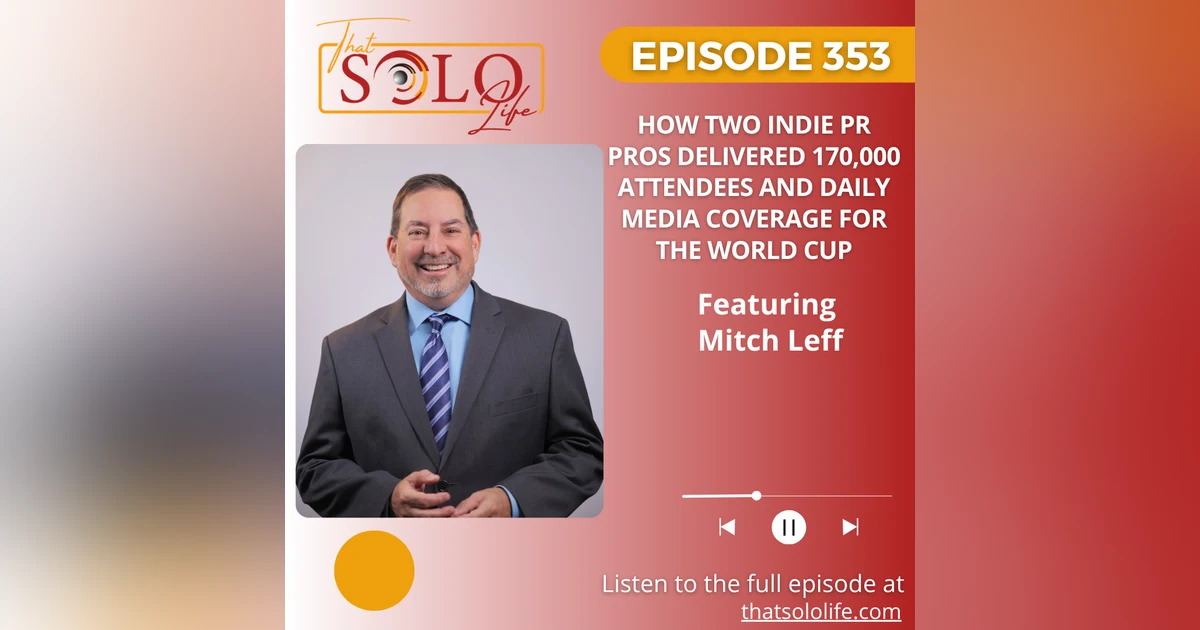

Mitch Leff and his colleague Kim Speece were engaged to work on a 34-day World Cup Campaign for Decatur. Eighteen months later, the two Solo PR Pros had delivered 170,000 attendees, daily media coverage for every single day of the World Cup, international press from Japan’s Asahi Shimbun, features in Southern Living and Garden & Gun, and the best sales month in 29 years for one of Decatur’s most beloved bars.


Episode Summary
Most PR wins are hard to see in real time. The brand building, the reputation work, the slow accumulation of coverage that eventually shifts how a client is perceived. Those results are often invisible until long after the campaign ends. Mitch Leff's World Cup campaign for the city of Decatur, Georgia was the opposite. The goal was clear: get people to the square. The measure of success was visible from day one. And by the time the Indigo Girls closed out the 34-day Watch Fest on the last night of the tournament, Mitch and his partner Kim Speece had delivered 170,000 attendees, daily media coverage for every single day of the World Cup, international press from Japan's Asahi Shimbun, features in Southern Living and Garden & Gun, and the best sales month in 29 years for one of Decatur's most beloved bars. Even more amazing, they did as two independent practitioners. There was no junior staff, no agency overhead, just decades of experience, meticulous timing, and a daily 8:30 pm video blast to TV stations so that the morning shows always had something to run. In this episode, Mitch joins Karen and Michelle to walk through how the campaign came together, how they set expectations without a baseline, how they managed story angles that didn't pan out, and what it means for the case that independent practitioners can do what large agencies do and do it with excellence.
Episode Highlights
- [01:48] Saying Yes Without a Budget, Scope, or Timeline: Mitch's colleague Jen Johns called in the fall of 2024 with an idea for 34 days of World Cup programming in Decatur's newly renovated town square. No budget confirmed, no scope locked, no clear timeline beyond 'the World Cup is happening.' Mitch said yes anyway, drawn by the scale of what it could be and the relationship with Jen, who he'd worked with through years of sports-adjacent clients. His first proposal didn't even have a budget number in it. The plan and the funding came together in the months that followed.
- [04:00] Working Backwards from the Event: How to Build a 14-Month PR Timeline: Mitch and his colleague, Kim Speece sat down in spring 2025 and mapped the entire campaign backwards from the final night of the World Cup. Every announcement got its own milestone: the overall program launch, three separate band announcements for the headline acts, a cluster announcement for the smaller supporting performances, and a commissioned economic impact study from a professor at Emory's Goizueta Business School scoped specifically for Decatur. Each milestone had a deadline, and every deadline was worked backwards from the one that followed it.
- [06:10] When a Story Angle Doesn't Pan Out — and When Something Better Shows Up: Mitch had planned for the volunteer story as a strong visual element: hundreds of community volunteers being trained and deployed, a natural human-interest thread. It didn't work as well as expected as the training sessions were smaller and less visually compelling than he'd imagined. At the same time, an unplanned opportunity arrived on a Sunday morning: a founder of REM posted that he'd be sitting in with Drivin N Cryin at the Watch Fest the following evening. Mitch had an updated media advisory out that Sunday afternoon. The lesson he draws: you plan the story angles you know, you stay close enough to what's actually happening to catch the ones you didn't.
- [08:39] Turning a Crisis Risk Into a Proactive Story: Heat was on every event organizer's mind during the 2026 summer. When Atlanta media began running stories about fans passing out at Centennial Olympic Park, Mitch had a different story ready: everything Decatur had done to prepare. Misting stations. Shade coverage. Water stations. Paramedics and fire department staff on site, including the fire chief. He pitched the preparedness angle, booked the interviews, and turned a potential crisis narrative into a positive feature about a city that had planned ahead.
- [13:56] Setting Expectations and Baselines When You're Starting from Zero: The newly renovated Decatur Square had never hosted an event of this size. The fire department estimated a capacity of around 5,500 people. That became the planning number. For media expectations, Mitch told the client they should expect three of Atlanta's four TV stations at the launch press conference, plus the Atlanta Journal-Constitution and local radio. They got all four stations, an advance story in the AJC, significant radio coverage, and international press. Once it became clear that Decatur had a more organized and sustained program than any other city in the region, Mitch revised his projections upward, telling the client they'd get more coverage than originally planned, because the program itself had earned it.
- [16:00] Building Media Relationships Six Months Before You Need Them: One of Mitch's core principles for event PR: never let a reporter first hear about the event when the event is happening. Every journalist who might want to cover the Watch Fest knew about it six months in advance. The outreach spanned local, statewide, regional, national, sports, and travel media. The Chamber of Commerce, the Convention and Visitors Bureau, the Mayor's office, and elected officials were all on every distribution list, because they were fielding calls from other media and amplifying the reach. By the time the World Cup started, the reporters already knew. Mitch's job in the final weeks was to give them content, not context.
- [18:00] The Daily Blast That Made Morning Shows Easy to Say Yes To: Two weeks before the World Cup, Mitch and Kim began sending a weekly 10-day look-ahead to media. Once the tournament started, they added a daily blast: a brief note about what happened that day and what was happening the next day, with video of that evening's concert shot and delivered to TV stations by 8:3 0pm. Not a press release. Not even a full media advisory. Just here is what happened, here is what is coming, here is usable video for your 11 pm show and your morning block. Morning producers came in at 2 am and found the clip at the top of their inbox. Channel 69, the CBS affiliate, ran a drone shot of the Decatur Square on most mornings of the World Cup. That daily cadence is what made Decatur reliable, and reliable is what keeps reporters coming back.
- [20:16] Owning the Last Weekend When No One Else Was Doing Anything: As the World Cup wound down, Mitch checked the schedule and noticed that the downtown Fan Fest ended July 15th and nothing else was happening in Atlanta on the 18th and 19th. He told the client: we can own that weekend. The city of Atlanta ultimately announced a Ludacris concert in Piedmont Park for one of those nights, but the concert ended at 6 pm. The Indigo Girls at Decatur didn't start until 8 pm. Mitch made sure reporters knew that Decatur would be the closing act. Decatur is how the World Cup ends. By the time the Indigo Girls took the stage, the narrative was exactly what he'd pitched it to be.
- [22:07] Two Independents, No Agency Overhead, One Full Campaign: Michelle raises what the episode is really about: two independent practitioners, no junior staff, no agency infrastructure, and they delivered a campaign that the client said far exceeded their expectations. Mitch explained that knowing when to send a release at 11:30 pm instead of 3 am because you understand how morning producers work, knowing which story angles have visual legs and which don't, and having relationships with reporters built before you need them was the key to success. The budget didn't require a third person, and the experience of two senior people meant the judgment was there from day one. They split the days, set up a workspace on the square for managing other clients, and absorbed the overrun in June and July because that's what the work required.
- [29:34] What Mitch Is Most Proud of, and What the Numbers Don't Capture: Karen asks the question that goes beyond the data. Mitch's answer circles back to the relationship: a city manager and mayor who were responsive every single day, a client who consistently said the results were beyond what they'd imagined, and a square that was packed night after night with people who'd never been to Decatur before and will come back. The Brickstore Pub's best day in 29 years. A reporter flying in from Tokyo's Asahi Shimbun specifically to cover how smaller cities benefit from World Cup hosting. A morning when Mitch could watch the CBS affiliate run a drone shot of a full Decatur square at 5 am and know that the video he'd sent the night before was the reason it was on the air. And the last 20 minutes of the Indigo Girls set, when Mitch and Kim let themselves feel what they'd built and then started wondering what was next.
Mitch Leff is the founder and principal of Leff Associates, an Atlanta-based independent PR firm with more than four decades of experience in public relations, media strategy, crisis communications, and event PR. His work spans sports, government, nonprofit, and corporate communications — including the 1996 Atlanta Olympics — and he is widely recognized as one of Georgia's most connected and experienced independent practitioners. Mitch also leads the Georgia Independent Professionals Group, a community of solo and independent PR and communications professionals across the state. He is an active presence on LinkedIn, Instagram, and Facebook, and is a frequent resource and connector for the Georgia independent PR community.
Website: leffassociates.com/our-team
LinkedIn: linkedin.com/in/leffassociates
Email: mitch@leffassociates.com
Resources & Additional Information- Decatur Watch Fest 26: decaturwatchfest26.com
- Leff Associates: leffassociates.com
- Georgia Independent Professionals Group: Connect via Mitch Leff on LinkedIn
- Solo PR Pro membership community: soloprpro.com
- That Solo Life podcast website: thatsololife.com
That Solo Life is a podcast created for public relations, communication, and marketing professionals who work as independent and small practitioners. Hosted by Karen Swim, APR, President of Solo PR Pro, and Michelle Kane, Principal of Voice Matters, the show delivers expert insights, encouragement, and practical advice for solo PR pros navigating today's dynamic professional landscape.
Listen to all episodes and catch up on previous conversations at thatsololife.com.
Did this episode inspire you? If you found value in this conversation, please take a moment to leave us a review on your favorite podcast platform. Your feedback helps us reach more solo pros just like you! Don't forget to subscribe so you never miss an episode.
Michelle Kane (00:08):
Hello everyone, and welcome to That Solo Life, the podcast for PR pros and communicators who work for themselves, like myself, Michelle Kane of Voice Matters, my wonderful co-host, Karen Swim of Solo PR Pro. And we're so excited we have a guest this week. Joining us is Mitch Leff of Leff and Associates. Hey, Mitch, thanks for joining us today.
Mitch Leff (00:33):
Yeah, thanks for having me. Appreciate it.
Karen Swim, APR (00:36):
Hey, Mitch. Wonderful. We're so glad you're here. Yeah,
Mitch Leff (00:40):
Good to be here. Good to be here.
Michelle Kane (00:42):
Definitely. So we're going to jump right into it because you have a lot of great stuff to talk about, and we're so excited that you're here with us. It's super timely because I don't know who of us is out there going through World Cup withdrawal. I have to confess that before it hit our shores, I was like, "Oh, whatever." I knew it was going to be exciting for Philly because we were one of the hotspots, but I've really come away thinking maybe I need to learn about soccer because this community is fabulous. So with that, you've worked on some enormous campaigns over the last four decades of your fantastic career, including the 1996 Olympics. So when a friend called you back in the fall of 2024 and asked you to chime in on the World Cup hosting plans in Decatur, she had no scope, no budget, no timeline.
(01:42):
So when she presented you with this potential project, what made you say, "Yeah."
Mitch Leff (01:48):
Well, it's interesting. Yeah, it's interesting. So Jen Johns is an old friend of mine who's been in the world of sports for decades, and she and I had worked together when she was at Mercedes-Benz and a couple other clients in between, somewhat sports related. And she kind of had an idea of the scope a little bit. It was kind of coming together. And in terms of the timeline, we knew when the World Cup was going to be, and she knew generally that she wanted to do 34 days of programming through the World Cup. But yes, we didn't have an idea as to what the budget was going to be, and it was all kind of coming together. I think she'd been working on it for a couple of months at the point that she called me. And why did I say yes? That's a good question.
(02:44):
I think I was really intrigued by it. I was just intrigued by what we thought it could be doing
(02:54):
34 days of match watch parties and concerts around the World Cup. But we hadn't really gotten into the details yet. We didn't know who the bands were going to be yet. I think she had some ideas about who she wanted the bands to be, but that initial conversation, I don't even think we talked about that. And in fact, I think my first proposal, I don't think I had a budget in there yet. I think it was just kind of a general, what will be the tactical plan for doing this? And then we came back a couple months later and put a budget against it and worked that out with the city.
Karen Swim, APR (03:36):
Okay. So you and your business partner, Kim, you mapped out basically 14 months of PR strategy in the spring of 2025. Walk us through what that planning process actually looks like when you're starting with scratch, starting from scratch with a client who doesn't have a baseline.
Mitch Leff (04:00):
Yeah. So Kim Speece and I worked together for God, more than 10 years, and she's kind of my partner on just about everything. And she and I sat down and we said, "Okay, let's work backwards from, here's the timeline." And this is kind of a typical thing I do with this kind of event is you put together a timeline and you work backwards from, "Here's when the actual event happens, and then here are all the milestones leading up to it." And we knew generally when they were going to announce it, although I think it may have gotten pushed a month or so. I can't remember the exact
(04:38):
Timing. And then we started putting things in between. I was like, "Okay, we're going to announce the first band or the first big band. We're going to announce the overall..." Well, I think we announced the overall program, what the whole thing concept was. And then later we announced the band. We had three announcements with the three big bands that we were going to do. And then we had a couple of announcements in there that were all the smaller bands that were interspersed in between. And then we started trying to think of, okay, what are all the other pieces? We had a volunteer piece. We worked with another client at the Gizueda Business School at Emory to do an economic impact study, specifically focused on Decatur, because we know that economic impact and numbers like that are really of interest to journalists as they're covering events like this.
(05:32):
And we said, okay, we want this to be done by March of 26. So back, back, back, when do we need to engage the professor? When do we need to have it done? When does he need to have it done? So all of those pieces. And then as we went, there were other pieces that we said, okay, we're going to add in a piece about this partner or we're going to add in a piece about this particular element of the program that didn't necessarily know that we were going to have three or four months ago.
Michelle Kane (06:10):
Yeah. And it's an enormous task, but certainly one you've tackled before. So she was right to go to you. And along the way, I think we've all experienced this. You have your story angles mapped out and sometimes they just don't pan out. So even though I'm sure you had some story angles mapped out that you were excited about, how did you know when to hold onto a story angle and when to pivot to something that just materialized?
Mitch Leff (06:44):
Yeah, one of the ones that it was a great element of the program, but didn't turn out to be the best media story angle was the volunteer piece. We had several hundred volunteers and they were awesome and they did great, but I had this thought in my head initially that, okay, we're going to have some events and some visual milestones where we can show, okay, here's the volunteers being trained and here's the volunteers meeting. And it didn't quite work out that way. It was a little more smaller volunteer training sessions and it wasn't as visually exciting as we thought it would be.
(07:27):
I think there were some bands that we thought would be more interesting to highlight, and sometimes it depends on the availability of the talent and their interest in doing interviews. One of the more interesting things that happened was we had a band called Drivin N Cryin that was performing on a Monday early on in the month. And Sunday morning I woke up checking my social media feeds and one of the founders of REM had posted, "Hey, I'm going to be sitting in with Drivin N Cryin at Decatur Watch Fest tomorrow." And we're like, "Okay, that's great. That adds a little bit of an element of all of those REM fans." Heightens it.’ Oh, Peter Buck's going to be there. Now even more people are going to be there. It's just another draw. So we quickly, I think Sunday afternoon, we did an updated media advisory for that and got that out and got a little more play on that on traditional media and on social media.
(08:39):
One of the things that we planned for tactically, but not necessarily from a PR perspective was the heat issue. Logistically, Decatur had planned for,
(08:52):
It's going to be a hot summer, what do we do? They had missing stations, they had cover tents, they had water stations, they had paramedics and staff on site to help. But there was a week or two when it became really, really hot in Atlanta and media started doing a lot more stories about, "Hey, we've got fans passing out in Centennial Olympic Park because of the heat." And we had a good story to tell about how the city had prepared for it. So we did a pitch on that and reached out and did a number of interviews talking about that. And we had these big giant misting machines that the fire department in Decatur had provided, lots of shade. We had fire chief on site most of the time. So we were able to do some really good stories about here's how prepared the city is for that.
(09:43):
And the nice thing was the city was very prepared and we had a couple of instances of people having heat issues, but not really too much because there were so many things that we had done to prepare for that.
Karen Swim, APR (09:55):
It has definitely been the summer of the heat dome. And I don't think anybody was prepared for that because how could you actually prepare for how hot it's been?
Mitch Leff (10:07):
It's funny, I was reading something earlier this week about how when Atlanta was pitching the Olympics, the Atlanta Olympic Committee told the International Olympic Committee that the average temperature in Atlanta in the summer was 79 degrees. And the IOC didn't catch on until after they had awarded the city to Atlanta. I was like, "Wait a minute." And Billy Payne's like, "But it's the average of the morning temperature and the highest temperature." So it's a little bit of shenanigans there. And it was hot for a week or so here in Atlanta this summer, but it wasn't as hot as I think some summers have been here. So there was that.
Karen Swim, APR (10:51):
So that's a little climate mathy. Oh, that's good. A little creative climate math.
Michelle Kane (10:56):
Yeah.
Mitch Leff (10:56):
Yeah. Yes. But you look at that, and we had some crisis communications prep that went into this. We kind of mapped out, here are things that could happen that were weather, safety, financial, all the typical things that we do for a client when we do crisis prep and talk through a lot of things. So we had a document with some Q&A that we had prepared, but fortunately we didn't have to deal with that too much. We wrote the crime issue. Crime was not an issue and we really didn't have any serious incidents in Decatur during the festival. And we had really good crowds. We'll talk about that in a minute, but we'll get into the crowds a little bit. But we asked, what's interesting was that Decatur had just renovated the square and they had an old gazebo that they had taken down and they'd built this beautiful new stage, which is going to be incredible for years to come for the city.
(12:02):
And I said, "Well, what's the capacity of the new square with this setup and this configuration and whatnot?" And they weren't exactly sure because they'd never done an event of this size on the square. So usually in a situation like the fire department gives you an estimate. So they said it's about 500, 5,500 people. So that was the number we went with when we were selling tickets because we weren't selling tickets. The tickets were free for all the concerts, but there were three concerts, Big Boy, The War and Treaty, and Indigo Girls that were admissioned by, you had to get a free ticket and there was fence and there was a little more security just for crowd control. But all the other events, Watch Fest, all the other smaller concerts were, there were no fences, no tickets required, just come on. And they had some systems that measured attendance, and the average daily attendance ended up being about 5,500 per day on the square.
(13:06):
And about, I think there was max some days of about 11,000 people in and out of the square on a given day. I think the city generally hoped that they had good crowds for this, but I don't think they had a number. I think the city manager said that the number was about twice what they expected. So they had kind of a general, okay, we might get 70,000 people.
(13:34):
But about four or five weeks into it, they attracted 140,000 people coming through the square. And then at the end, it was about 170,000, which we think is a conservative number, but that's the actual data that we had.
Karen Swim, APR (13:56):
Let's talk about that a little bit because going into this, you didn't have any success metrics because it hadn't been done before, and you couldn't even compare it to an event that had been at this place because this place was newly renovated and nothing had happened. So how did you set expectations, establish a baseline, and then report resolved in a way that was meaningful to the client?
Mitch Leff (14:26):
There were a couple of pieces that we knew were positive for Decatur. A, they were ahead of the game. Most other cities, even the city of Atlanta, at some points, they were ahead of the game. Although the city of Atlanta did a great job and their planning was incredible too. But we were talking, gosh, late in 2025 about what we were doing, and most of the cities had no idea. So we were really ahead of it. So I knew that we were going to have a better event than most other cities just because of the planning and the scope.
(15:02):
And the client was asking us, "What kind of media should we expect for this?" And I told them, I said, "For the initial briefing, the initial press conference where they announced it, I said we'll have," I think at the time we had four TV stations. We've since added another one here in Atlanta. So I said, "We should have three out of the four TV stations. We should have AJC, Decatur-ish, some radio." We ended up having all four of the stations, an advanced story in the AJC, lots of other radio coverage and some international coverage as well from some international reporters that happened to be interested in World Cup at that point. And we were tracking, we was critical mention to track, so we were tracking the media. And it was clear early on as the program came together that we had a great program here.
(16:00):
It was going to be 34 days out of the. Well, World Cup was 39 days with five days of rest days in between. So basically 34 days of activities. And as we saw how other cities were progressing, it became clear that Decatur had a much bigger, better, more organized plan than anybody else. And at that point we told the clients that,
Michelle Kane (16:24):
"You're going
Mitch Leff (16:25):
To get a lot more coverage than maybe we even expected just because you've got such a great program here." And
(16:36):
Part of our goal was really to make sure that we built the relationships and we educated all of our media way in advance. I knew that once the event hit, it was going to be crazy and have a lot of media coming in. And that's not the time to first be telling reporters, "Hey, we're doing this event." We wanted every reporter who wanted to cover the event to know about it six months ahead of time. So we did. We were targeting local media, statewide media, regional media, national media, sports media, and travel media. So that was kind of the -
Michelle Kane (17:15):
That's incredible.
Mitch Leff (17:16):
It was a broad focus. And then as it progressed, we would hear from other media who were interested in coming. We made sure that Chamber of Commerce, Convention Bureau, Mayor's office, elected officials, we had a list of organizations that we made sure were on the distribution list for all of everything that went out because they were sharing that with other media who were calling them. So they were an extra partner as we put this together. And then as we got
Michelle Kane (17:56):
Into it - Well, and that -
Mitch Leff (17:56):
Sorry, go
Michelle Kane (17:57):
Ahead. Sorry.
Mitch Leff (17:58):
Yeah.
Michelle Kane (17:59):
No, go ahead. No, go ahead. Go
Mitch Leff (18:00):
For it. As we got into it, we decided, well, a couple weeks before the World Cup, we decided we were going to do a weekly release that was a, "Here's what's happening
Michelle Kane (18:15):
For
Mitch Leff (18:15):
The next week in Decatur." So reporters would have a week at a glance. And then putting that together, we said, "Well, let's make it 10 days." So it was a 10-day look ahead, and it overlapped a little bit. So it's like 10 days and then each overlapped a little bit. And then as we got into it, we decided, okay, we've got that. We're going to keep doing that, but we're also going to do a daily blast to key reporters and say, "Here's what happened today, and here's what's happening tomorrow." And so what we would do is we'd have a concert at six o'clock or seven o'clock, and we would shoot video of the concert and get the video out by eight o'clock, 8:30 that night to all the TV stations. It wasn't a press release, it wasn't even a media advisory. It was a, "Here's what's happening tomorrow in Decatur, and here's a video from tonight that you can use on your 11 o'clock show tonight and on your morning shows the next morning." Because the morning shows were hungry for content about this.
(19:21):
And there were a lot of days when -
Michelle Kane (19:22):
Totally.
Mitch Leff (19:23):
There were a lot of days when the Watch Fest or the Fan Fest downtown wasn't happening. So on those days, Decatur was the only place or the only place it was really promoting itself.
(19:38):
And we followed the schedule. We checked the schedule and we realized that the Downtown Fan Fest ended on July 15th, the last game, the last match at Mercedes-Benz Citium, which meant no one else had any big activities on the. Well, there were no matches on the 16th or 17th, but nothing else was happening on the 18th or 19th really. So Decatur, I told my client, I said, "We can own that weekend because no one else is really doing anything." Then it turned out that the city did a concert in Piedmont Park with Ludicrous. So they had a big event that night too.
(20:16):
But as I would tell reporters, some of the reporters were reporting, "Oh, the city's ending the World Cup with the Ludacris concert." I said, "No, no, no, no." I said, "That concert ends at 6:00. We have the Indigo Girls don't start till 8:00. So we go till 9:30. So Decatur is ending. Decatur is the cap, the cherry. Decatur is wrapping up the World Cup." So there's a little bit of that. I wanted to make sure that when a reporter said, "You can go to the stadium and watch this, but if you can't get a ticket, we want you to go to Decatur." And I think one of the high points of our work was when we realized that every time an anchor or reporter said, "Here's where you go watch it," it was, "Go to Fan Fest and go to Decatur." That's
Michelle Kane (21:10):
Fantastic.
Mitch Leff (21:10):
There were some other places tossed in there too. We also do work for the City of Smyrna and they were doing watch parties too. So they would mention Smyrna and Decatur and Fan Fest as the places to go. Once we got to that point where that was the cadence, and they knew that Decatur was doing something every day. And that's one of the things that made it easier too, is the fact that we did something every single day there was a match. Other cities and other events that were only a day or two here or a weekend here, I don't think it was as easy for reporters to keep track of, are they doing something every day? They knew Decatur was going to be doing something every day. And they knew that every day there we could get an email from Kim and/or Mitch that said, "Here's what happened in Decatur today.
(22:04):
Here's what's happening in Decatur tomorrow."
Michelle Kane (22:07):
Yeah. Well, let's talk about that because if this doesn't flex the power of a solo PR pro, I don't know what does. Because as we said, you and your colleague, Kim Speece, you're two independent PR practitioners. Yeah, exactly. I don't know, how did that feel going into that? Or how did you. Because I know I always say, "Hey, I put together the team that's required." And I've always said in the past that meant the ad agency I might've been working at at the time, I'd run upstairs to the art department, whereas now I Zoom them or something. So how did that come together to present a strong team?
Mitch Leff (22:57):
Yeah. Well, part of it is you look at the budget and you say, "How big a team can they afford?" We were originally thinking about having a third person. And then as we got into it, we realized that the two of us could handle it for the most part. And Kim's incredible. She and I have worked together for more than 10 years. She's a great media relationships, great writer. I mean, she's a former TV producer, so she knows how media works. That helps. So between the two of us, we knew how to time it. So it wasn't just a, "Hey, we're going to send out a press release at nine o'clock in the morning." It was, "We're going to send out a press release or advisory at 11:30 at night because we know that
(23:45):
The morning producers come in at 2:00 and if we send it out at 11:30, it'll be at the top of their emails. Whereas if we send it out at three o'clock, six hours earlier, it would get buried. So it's that experience and understanding that really, I think, elevated us and allowed us to really reach people and be a lot more successful. We worked hard at it. We had a budget for this. We probably overworked the budget a little bit in June, July, but that was to be expected. At that point, you have to do what needs to be done to get the work done. But it was a good budget and we were happy to be involved with it, so that wasn't an issue. And Kim and I, we'd split up the days sometimes. Sometimes I'd be down in Decatur, sometimes she'd be down there.
(24:42):
We had a workspace set up so we could work on other clients if we were down there just in case.
(24:50):
And I told the client, I said, "Here's what's going to happen. The first couple of months, reporters will call and say, Hey, can I come down there and talk to somebody? But when it gets into it, they're just going to show up. And they're probably not going to call or are they going to call when they're on their way or when they're there and say, "Hey, I'm on the Square. Can I do an interview?" And I said, "And the morning shows are just going to show up." And sure enough, once the World Cup started, I'd be watching, "Hey, it's 5:00 AM and we're live from Decatur Square. No one's here, nothing's happening, it's dark, but here's what happened yesterday." And they could use the B-roll that I gave them the night before that showed a big crowd there, which is why we do that. Channel 69, the CBS affiliate had a drone, and every morning for most of the World Cup, they'd have a drone shot of, "Here's the drone shot of Decatur Square." And a lot of events or a lot of things that we do for clients, the results are not always immediately tangible.
(26:00):
You're doing brand building, you're doing employee awareness, you're doing things that might have results as part of a larger mix. But this we knew the goal and the result was going to be if we had crowds there. That was going to be The sign of success. And we started with the Big Boy concert the first night, and the tickets sold out in a couple hours, but we knew when you give away free tickets, there's always a percentage of people who don't show up anyway. So we had some logistical planning to deal with, okay, if there's more room, we'll let more people in. But as we say, you can have the greatest event, but if no one knows about it, then no one's going to show up. And
(26:53):
That first night, the square was packed. There probably were three, four, 5,000 people on the square for that concert. And we thought, okay, this is great, but what's going to happen tomorrow? Because Big Boy is a big draw. And then night after night, day after day, we had crowds in the hundreds and thousands coming out for watch parties, for the smaller concerts, bands that no one had ever heard of, bands you might have heard of that were local. And it was consistent and it built. When the US was playing, the square was packed to the gails. And one of the goals that the city had was to have a good economic impact on the bars and restaurants and retail around the square in downtown Decatur. And they hit that. That's awesome. The restaurant, I mean, I've been surveying the restaurants, "How did it go for you?" And a lot of them were saying, "This is the best month we've ever had." The Brickstore Pub indicator told the city manager one day that that day was the best day they'd ever had in 29 years at that location.
Karen Swim, APR (28:08):
Wow. Yeah. I mean,
Mitch Leff (28:11):
That's the thing. Yeah.
Michelle Kane (28:15):
You want that economic impact for sure.
Mitch Leff (28:18):
So there was that. But the long-term goal was to get people down to Decatur who'd never been there or haven't been there in a long time. And certainly no one had seen the new square yet with the new stage. So we wanted to get people down there so they could see it. Obviously with the goal that, oh wow, this is great. I should come down here again after the World Cup, come down here for dinner, come down here for a concert. Being there on the square almost every day, the people who could walk there, they were coming every day. I mean, I ran into a friend of mine, a guy I know who is walking distance. He wandered over one day walking his dog. Didn't realize that, oh, there's a concert. And I said, "Well, there's a concert every night." So he would walk his dog over.
(29:03):
Where you been? Yeah. Yeah. Well, you can tell people these things, but - No, true. And as with anything, you have to tell them 10 times. And then they're like, "Oh yeah, okay, I did hear this was happening." But it was a rare thing to hear someone say, "Oh, I didn't know you were doing that indicator." I mean, honestly, if you didn't know we were doing this indicator this summer, then you really were not consuming any sort of news or information at all.
Karen Swim, APR (29:34):
Yeah. Well, Mitch, I mean, wow, this sounds fantastic and I know that it was amazing to work on. And I know that it's not the last of the many amazing things that you will work on, and it wasn't the first. So as we wrap up, tell our listeners quickly, what's the thing that That you're most proud of that maybe had nothing to do with the numbers at all?
Mitch Leff (30:10):
It had nothing to do with the numbers at all. Well, I mean -
Karen Swim, APR (30:14):
Unless it was the numbers. We're okay with numbers. We love numbers over here.
Mitch Leff (30:18):
Yeah. I mean, what I really obviously appreciated as the PR person was hearing the client say, "We never expected we'd have this much media." And then seeing that result that the square was so full every day, so many people. And then the client knowing that a good portion of that was because of the work that we had done to promote it. And it was a great relationship. The city of Decatur was incredible to work with. City manager, the mayor were incredibly responsive. I can't think of a day when I didn't have either the city manager, the mayor,
Karen Swim, APR (31:05):
Or the
Mitch Leff (31:05):
Director of tourism doing an interview. We had media coverage every single day of the World Cup. There wasn't a day when there wasn't some sort of story somewhere about the World Cup. And we had a reporter fly in from Japan. He's with a newspaper called Asahi Shimbun, which is a huge
Michelle Kane (31:26):
Newspaper
Mitch Leff (31:27):
In Japan. And he flew in from Tokyo, came from the airport to Decatur, spent the day in Decatur. I don't even know if he went downtown because he wanted to do a story about how smaller cities were reaping the economic impact of the World Cup. And he talked to people, he talked to the city manager and just had a great time. Now, I can't quite read the whole story. I need to get a translation, but the first half that I can read on Google Translate looks really good. But they were excited because most cities never get into a big Japanese paper like that, and that's a
Karen Swim, APR (32:06):
Goal
Mitch Leff (32:07):
Of the tourism effort. They were in Southern Living, they were in Garden Gun, those kinds of things. And some of it was big mentions, some of it were small mentions. But
Karen Swim, APR (32:19):
Part
Mitch Leff (32:19):
Of the goal was we wanted to be part of the conversation. So if someone says, "Here are the things to do in Atlanta, if you're here for World Cup," we wanted Decatur to be one of those things. We didn't want to be left out of the mix. And there were very few things where we were left out. I mean, some of them were bigger. You always want a bigger feature than others, but I said, "It's good at least to be mentioned in a story."
Karen Swim, APR (32:47):
If
Mitch Leff (32:47):
Someone says, "Hey, there's three places to go. You go to Fan Fest downtown, you go to Decatur, you go to the stadium." That I though was a huge success. And I will say, Kim and I, we got a little bit cheery at the end, that last 20 minutes with the Go Girls concert where we knew it was like, "Okay, this is going to be over in 20 minutes, and then we're done."
Karen Swim, APR (33:13):
What are we
Mitch Leff (33:14):
Going to do tomorrow?
Karen Swim, APR (33:15):
Exactly. Sleep. You go to take a break, get some sleep, not be on call throughout the night, and then onto the next because that's how solos do it. Well, Mitch, oh my gosh, thank you so much for coming and talking to us. Mitch is one of our friends and a partner, and we'll have all of his information in the show notes so that you could connect with him if you're in Georgia. Mitch also runs the Georgia Independent Professionals Group, which is a vibrant, thriving big group of fantastic Georgia solos. Many of them are also Solo PR Pro members. So we have a lot of connections and a lot of community and deep roots and friends with many of the same people. But we were so honored that you chose us to come and tell the story, especially as a podcaster yourself and all the success.
(34:12):
And I mean, this is so inspirational that it doesn't take a village. It just takes a couple of really savvy, smart, expert solos to pull off something that wows your client. I mean, I would probably tape some of the things they said and play them every day as my theme music because I can a client tell you that this is way more than I expect. It doesn't always happen.
Mitch Leff (34:46):
WSB Radio put up a graphic on one of their stories one day, and the big graphic had a picture of the city manager and it said, Decatur Watch Fest exceeds expectations.
Karen Swim, APR (34:58):
And you screenshot that, right?
Mitch Leff (35:00):
I screenshot that. I have a couple of things I'm going to have. I have a pile of magazines and things, some cover stories.
Karen Swim, APR (35:10):
Make collages, pass them out at dinner parties out of them, posters. I mean, I have a whole Etsy shop going like I did that.
Mitch Leff (35:23):
I have a whole post-event video idea. I have to go through the hundreds of clips and figure out how to put a reel together, right?
Karen Swim, APR (35:32):
Love that.
Mitch Leff (35:35):
But you're right. I mean, it is a testament to what independent practitioners can do. So a client doesn't need to hire an agency and pay them $25,000 a month. They can hire independent that doesn't have the overhead, doesn't have the, not the junior staff aren't important, but has senior people who are working on the accounts, who have
Karen Swim, APR (35:56):
Decades
Mitch Leff (35:56):
Of experience,
Karen Swim, APR (35:57):
Who
Mitch Leff (35:58):
Can get the job done in a way that is strategic and smart and economical.
Karen Swim, APR (36:05):
Love it. That is a perfect ending.
Michelle Kane (36:08):
That's it right there. Yeah. So Mitch, how can people connect with you? LinkedIn, website?
Mitch Leff (36:15):
LinkedIn, Facebook, Instagram.
Karen Swim, APR (36:20):
I'm
Mitch Leff (36:20):
On TikTok. The website is leffassociates.com. I think the Instagram is MitchleffPR. Facebook, I have a Mitch Leff Facebook page and a Leff Associates Facebook page; either of those. Mitch@leftassociates.com is the email. Yeah, I am not hard to find it. And whenever someone tells me I couldn't find your number, I'm like, "Well, you didn't even look." It's on everything. My phone number, my email is on all of my platforms. I'm an open book in terms of getting in touch with me.
Michelle Kane (36:57):
Yep. Fantastic, Mitch. Well, thank you so much. And to our listeners, we know you found value in this, so please do share it around. Hit us up at thatsololife.com. And until next time, thanks for listening to That Solo Life.