What Happens When Social Media Shuts You Out
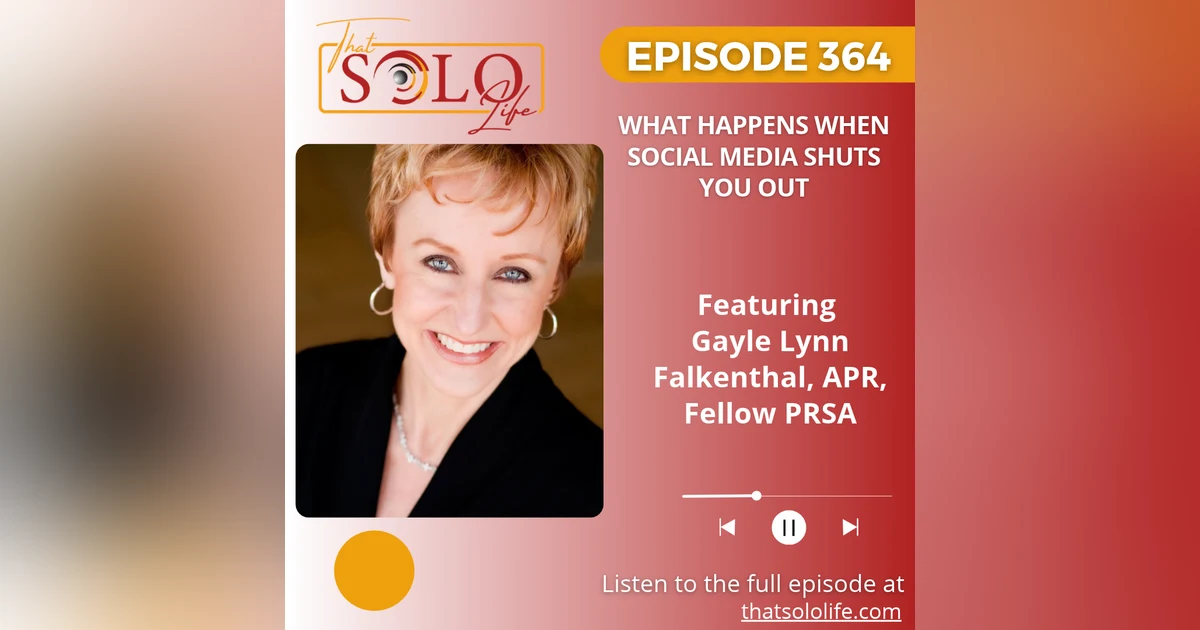

One public relations professional spills all on what happens when big tech cuts off your access to a social media property and the key takeaways for all pros when it comes to client work.


Episode Summary
Gayle Falkenthal was ringside in Arlington, Texas with 70,000 people at AT&T Stadium, Netflix cameras everywhere, Jake Paul and Mike Tyson about to fight and halfway through the event, her Facebook account disappeared. No warning. No explanation. Just gone.
What followed was a 16-month battle to get it back: Meta's automated AI moderation system, dead-end customer support calls, a crowdsourced Reddit strategy, and ultimately a small claims court filing that ended with a call from Meta's attorneys the night before the hearing. The account was restored within 90 days.
In this episode, Gayle Falkenthal, APR, Fellow PRSA, owner of Falcon Valley Group and the only female Hall of Fame voting member of the Boxing Writers Association of America, joins Karen Swim, APR, and Michelle Kane to unpack what happened and more importantly, what every solo practitioner and their clients should take from it. The conversation covers platform over-reliance, AI moderation risks, the non-negotiable case for owned media, what Gayle observes about real-time content strategy from her ringside perch at major live events, and how she has built a specialized solo practice around doing exactly the work she is best at.
Timestamp Highlights[00:00] Meet Gayle Falkenthal. Karen and Michelle introduce Gayle — APR, Fellow PRSA, owner of Falcon Valley Group, 15-year award-winning television broadcaster, former director of public affairs for the San Diego County DA's Office, former comms officer for the American Red Cross, and the only female Hall of Fame voting member of the Boxing Writers Association of America.
[00:03:12] The night Facebook went dark. Gayle sets the scene: ringside at the Jake Paul vs. Mike Tyson fight at AT&T Stadium, posting licensed Netflix photos and behind-the-scenes content, when her account is suddenly taken down. She initially assumes a technical glitch. It takes six months to learn the cause: an AI moderation bot flagged an apparent copyright violation.
[00:05:46] The 16-month fight to get it back. Unable to work client accounts, losing access to sports fan communities that drove significant traffic, Gayle refuses to let it go. She discovers through Reddit that AI-driven account takedowns have affected hundreds of thousands of users. The path forward for Gayle was small claims court. After a botched service attempt delays the first hearing, Meta's attorneys call the night before the second trial and offer a settlement. The account is restored within 90 days.
[00:09:43] The real takeaway: platforms you don't own can disappear on you. Gayle draws the wider lesson for herself, her clients, and her college students. AI moderation is imperfect, unpredictable, and not appealing. If a platform is the primary channel for a client's community, sales, or communications, they are one AI flag away from a crisis. Vine disappeared overnight. TikTok nearly did.
[00:15:09] The one channel that has never failed. After everything, Gayle names it plainly: a robust email list and a quality newsletter. Whatever else changes, owned channels are the ones that remain in your control. The Facebook ban was the push she needed to accelerate her YouTube channel and Substack presence.
[00:16:02] Ringside as a PR laboratory. Gayle explains how her boxing journalism work gives her a rare view into the other side of the PR equation, watching what major event communications operations do well, what smaller promoter PR teams get wrong, and translating those lessons into her solo practice. From Netflix's full production rollout to the one-person PR bands scrambling for smaller promoters, she's observing what actually works.
[00:26:30] Good enough beats perfect in real-time content. The lesson Gayle carries from watching major event social teams: speed matters more than polish when content is time-sensitive. Rough edges read as authentic. Practice the basics until they're automatic, then bring more intentionality to planned client work. She shot ribbon-cutting video for a client on a Friday and had everything ready by Monday morning.
[00:30:37] What clients think they're hiring, and what they're actually getting. Gayle is explicit about her positioning: she is a strategist, positioner, message builder, and brand builder working in public affairs, nonprofits, and issue-driven communications. She is not a social media manager, not a news release factory, not a generalist who takes anyone who signs a contract. Knowing what you do best, and turning away what you don't, is what makes a solo practice sustainable.
Resources & Additional Information- Falcon Valley Group: falconvalleygroup.com — Gayle's strategic communications consulting practice
- YouTube: Gayle Falkenthal on Boxing — Gayle's boxing journalism channel featuring interviews and event coverage
- Gayle on Substack: Gayle Falkenthal on Boxing
- Connect with Gayle on LinkedIn: Gayle Falkenthal, APR
- Solo PR Pro: Membership and Resources
- That Solo Life: All Episodes
That Solo Life is a podcast created for public relations, communication, and marketing professionals who work as independent and small practitioners. Hosted by Karen Swim, APR, President of Solo PR Pro, and Michelle Kane, Principal of Voice Matters, the show delivers expert insights, encouragement, and practical advice for solo PR pros navigating today's dynamic professional landscape.
Listen to all episodes and catch up on previous conversations at thatsololife.com.
Did this episode inspire you? If you found value in this conversation, please take a moment to leave us a review. Your feedback helps us reach more solo pros just like you! Don't forget to subscribe so you never miss an episode.
0:12 MICHELLE KANE: Hello, and thank you for joining us for this episode of That Solo Life, the podcast for communicators who are not just stringing gigs together. Nuh We're building businesses right here. I am here with my wonderful co-host, Karen Swim. And today we are so excited to have this guest. And we are. Yes. I'm so excited to welcome Gayle Falkenthal,APR fellow PRSA and the owner of Falcon Valley Group, which is a strategic communications consulting practice based in beautiful San Diego, California. Gayle was also a, an award winning broadcaster and producer with 15 years in television, which is like 50 years in people years.
0:56 Right. She has also served as director of public affairs for the San Diego County District Attorney's Office, was vice president of marketing and comms for the San Diego Convention Center Corporation and comms officer for the American Red cross. So can I just say you're a badass? Today, she focuses on public affairs, nonprofit comms, digital media strategy. Here's a fun fact. She is also the only female Hall of Fame voting member of the Boxing Writers Association of America, which is a distinction that speaks both to her journalism roots and her commitment to earning a seat at every table that matters.
1:42 So oh my gosh, Gayle, we are so glad that you're joining us here. You're also a fellow solo PR pro member. So you're a fellow savvy smarty. You know. Your background is incredible and it really shows us what a career in this arena, if I may make the pun, can be. So we really can't wait to dig in. Yeah. What do you say, Karen? KAREN SWIM, APR: Yeah, I mean, I feel Gayle,just imagine that we've just thrown roses at your feet because totally deserve your flowers. And I'm so excited. And I love having solo PR pro members like you on this broadcast, because I love showcasing to the world that independent practitioners are truly, we are truly the best of the best of the best of this profession.
2:39 And you have such a commitment to excellence everywhere that you step in touch. And so I also hope that there are younger PR professionals out there that are listening to this and understanding what is possible, because you are showing them the way. And and I'm so grateful. GAYLE FALKENTAL, APR, FELLOW PRSA: Thank you so much for having me. To hear the theme song play that I listen to every week and think, wait a minute, that's for me. KAREN SWIM, APR: Yes, it's for you. MICHELLE KANE: Yeah. GAYLE FALKENTAL, APR, FELLOW PRSA: Amazing. KAREN SWIM, APR: So, dear audience, imagine that you are holding a rally and you've used Facebook as your engagement tool to reach your audience.
3:27 And on the day that you have about 300 rallies planned across the country, your Facebook page suddenly goes dark. Well that happened. More importantly, they were up and running pretty quickly. Our own dear Gayle was banned from Facebook for a very long 16 months. Gayle, tell us about the Facebook ban and what happened. GAYLE FALKENTAL, APR, FELLOW PRSA: What a crazy story. So it dovetails both my lives together because in November of 2025, I was ringside in my other role as a boxing sports writer at AT&T Stadium in Texas, watching Jake Paul and Mike Tyson go at it.
4:26 Okay, that's a story for another day. But halfway through the event, as I am posting and you know, this included photos that were available and licensed to us by Netflix, who was the producer and the behind the scenes information which people find interesting. Other observations that they don't see on camera. Suddenly, I realize I've gotten a notice that my account has been taken down. Okay. Things happen, you know. Power outages, technical difficulties. I get it. As I later through the evening, went on to post and then published my stories, there are, as you know, one of the strengths of Facebook is the group's example shown here.
5:16 There are a lot of specialty sports fan groups, boxing groups. That is where I get the lion's share of traffic. Believe it or not, for a lot of what I publish. At least I certainly did then. And to suddenly have that tool disappear, I thought, you know, this is kind of a big event and kind of a big deal. This is going to be great. I moved on you do you need to do. I returned home and in the week that followed I thought, what's going on? Let's cut to the chase. I discovered that Facebook had taken my account down because it. It took me six months to find this out, by the way, that there was apparently an accusation of copyright violation.
6:01 Now, I thought backwards to the timing of all this and realized, oh, the can. The bot thought it couldn't possibly be true that a woman was sitting ringside feet away from Mike Tyson. Okay, I get that. Then the journey begins and I was determined to get that account back. I'm just that way. Meanwhile, it was affecting my ability through my business to work with my clients accounts. I couldn't see what was going on. I mean, I couldn't get on at all. I couldn't post for them. I, you know, it was really ball and chain around my ankles.
6:44 Fortunately, Meta still had me had access to my Instagram account, which if there'd been a problem on Facebook. It should have been evident on Instagram as well. But no, that one was still there. So I went back and forth with Meta customer support. I actually got very helpful people up to the point where they said, well, they couldn't actually tell me exactly why my account was disabled and try this, try that. No. Yeah. It's gone. It's completely gone. And I turned to where all smart people turn for crowdsourced information. Reddit. It's very illuminating to see how many pages subreddits are devoted to "fill in the blank"disabled me.
7:32 Facebook disabled me. Instagram disabled me. Meta disabled me. Twitter disabled me. Let's go down the list. That indicates a sobering problem that we need to be worried about in general is that these are not platforms we control and we should not be over reliant on them, right? The lion's share of people read it. Were crying over losing family photos and memories and things that were very important to them personally. Not necessarily business accounts or influencers, but they were there as well. And those people were the ones. Thank God for them down the road ahead of me to say, here's how you go after Meta.
8:18 And being in California is a little easier, but this is possible to do in all 50 states and quite a few foreign countries, I might add, is you sue Meta in small claims court. I thought, honey, bring it on. I'm not afraid of a courtroom. I spent eight years with a district attorney. I'm not afraid of a courtroom. And the the saga carried on down to a court appearance where Meta's attorneys didn't show, and I was about to get a ruling in my favor until the judge decided that the service document wasn't quite executed perfectly. So we did it all over again three months later.
9:01 And finally, on the eve of the trial in small claims court, I received a call from a meta attorney offering to settle. And the account they promised me had disappeared 16 months ago was back in 90s. Now, the timing of this was. It was a perfect storm. First of all, I was somewhere very unusual. Me, me and 70,000 of my best friends were present. That was it. But it was also the week Meta first started using its AI monitoring tools.
9:43 They've since added new iterations of that, but all of the social media accounts are doing this, and inevitably you may be the one tripped up in some odd AI take down. And so if you put all your eggs in one basket with any of these accounts and it gets taken down. Yeah. It's a mistake. Doesn't matter whether it was justified or not justified. You and your clients are out on, you know, you're out of business, right? MICHELLE KANE: And right. GAYLE FALKENTAL, APR, FELLOW PRSA: All you're relying on to reach your audience, you're in big trouble.
10:25 So I'm here to tell you, make sure that isn't you. MICHELLE KANE: Right. Right. GAYLE FALKENTAL, APR, FELLOW PRSA: That your Instagram account isn't the only way you're selling your products. Make sure your Facebook account isn't the only way that your group is getting together and scheduling events and communicating. You better have backup and you better have backup that you own. Unfortunately, Facebook for me was frankly, for me personally was secondary. It did hamper my sports writing for a little while. MICHELLE KANE: There are. GAYLE FALKENTAL, APR, FELLOW PRSA: There are workarounds, but. And it prompted me to get more busy and more visible on my YouTube channel. Oh, more aggressive about Substack.
11:07 So it was a blessing in disguise. It forced me to do a little diversification, which was very healthy. MICHELLE KANE: Yeah for sure. But my goodness, 16 months. GAYLE FALKENTAL, APR, FELLOW PRSA: 16 months in multiple calls and meetings, refusing to lay down and die. Good. The time it took to get me scheduled in small claims in California. So I would say, had I gotten to court a little quicker. And the process server actually done his job. We had a conversation about that. I might have only been a year. MICHELLE KANE: Only, only. GAYLE FALKENTAL, APR, FELLOW PRSA: Only here can. MICHELLE KANE: You. I just just the disruption to your business.
11:50 Right. It's like that's that's not a little thing, you know. GAYLE FALKENTAL, APR, FELLOW PRSA: To explain to my clients, okay, here's what happened. And my clients, by the way, are all very well aware of what I do on the weekends and are mostly sort of agog about it, but they, they were terrific. Yeah. No one lovely thing about being in sole practice, especially if you've done it for a while. Yeah. You know, eventually you find the clients you've deserved all along, the good ones. MICHELLE KANE: That's so oh, that's so true. GAYLE FALKENTAL, APR, FELLOW PRSA: And they're a blessing. And they all said, gosh, isn't that awful? We get it.
12:31 But they have in house one of my one client that's very, very active on Facebook because they have an older adult audience. We're able to handle it just fine. And now I'm back with them and our roles were such that I was mainly providing them visual assets, the photos and the video they were posting. So we were we were just fine. And my dogs weighing in on this, he was very. MICHELLE KANE: That's okay. He's he's, he's protecting his mom. He's like, yeah, it was bad. KAREN SWIM, APR: Because PR pros we yeah, we advise our clients to go where the audience is. And so while advise them not to rely and lean on that one platform, I mean, obviously it's always good to have email addresses and do email newsletters.
13:22 But that's still a big part of the communication strategy is to go where people are going and where they get their information. And if that's cut off. That's huge. Because what happened to you could happen to a client as well. GAYLE FALKENTAL, APR, FELLOW PRSA: And it's happening. I encourage everybody watching and listening to this podcast. Get on Reddit and just do a search for Facebook disabled me and start looking through the page at the stories. Note how many members there are. This has happened to tens of thousands of people, hundreds of thousands. If you add all of them together.
14:03 Yeah. And this is being done by AI tools that we don't always know what they're doing. We don't always understand the process. You have someone that's caught up in having an account disabled, being accused of child pornography. The tool sees them and all their children in bathing suits at the beach. MICHELLE KANE: Oh, for goodness sake. GAYLE FALKENTAL, APR, FELLOW PRSA: So we need to be very aware that these are useful tools, but they cannot be the tools we rely on. And unfortunately as in my role as I teach college students undergrads as well.
14:44 More and more, they want to build campaigns around nothing but influencers. And if influencers are using those platforms and something happens, what happens to your campaign? Let's dial back to when our government in the United States was talking about banning TikTok. MICHELLE KANE: Yeah. GAYLE FALKENTAL, APR, FELLOW PRSA: And that was the only place certain people lived to do their business and communicate. MICHELLE KANE: Yeah. GAYLE FALKENTAL, APR, FELLOW PRSA: What happens when that goes away? And we all think, oh, that's never going to happen. Well, remember something called Vine, which was sort of the Neanderthal version of TikTok, if you want to look at it that way. It disappeared overnight.
15:25 Yeah. And TikTok came within a whisker of disappearing overnight. Yeah. So that's the cautionary tale. Not my boo hoo. I was offline for a while, but if you are overly reliant on these tools, yes. Reassess your mix. Reassess. Yeah. You have a have a backup plan. At the very least, keep some other avenue of communication alive. And I'm just here to say, after all these years, the one thing that has never, ever failed me is a robust email list and good quality newsletter. MICHELLE KANE: Yep. Absolutely. Yeah.
16:06 You know, I, I think In addition to all that, let's get back to the event that triggered this because it sounds pretty wild. It was. GAYLE FALKENTAL, APR, FELLOW PRSA: Pretty wild. MICHELLE KANE: And, and, but, you know, because we're, we're nerds at least I am the behind the scenes stuff is fascinating to me. So, you know, you're there at this Netflix produced live event and I tell us about what it was like watching just how this played out. As far as, you know, you had Netflix's PR department, you had ESPN's media operations. All the Cogs are all working in this live, you know, event as well. Talk to us a little bit about the logistics, about how, you know, photos can hit the net instantly.
16:56 What was the vibe? GAYLE FALKENTAL, APR, FELLOW PRSA: So I got into this serendipitously, a little more than probably 16, 17 years ago. I had originally back in my youth wanted to be a sportscaster sportswriter, but at that point, the openings for women were few and none. And you were usually either the eye candy on the sidelines or there were sports that had women covering them. It was generally tennis, gymnastics, and figure skating. MICHELLE KANE: Yeah. GAYLE FALKENTAL, APR, FELLOW PRSA: Not that there's anything wrong with that. I follow all three of those, too. But I grew up in a boxing household. I was a boxing fan. I always thought this was great.
17:39 I got my chance. And what I realize now over this time is not only do I consider it fun and does it give me something to write about that I enjoy and do interviews and produce video. But as a public relations professional, it gives me a look at from the other side of the equation. I'm the person you're dealing with during the week and I play that person on the weekend. I'm the boxing journalist on the weekend, so I see who's doing a good job. What tools are they using? What's the most efficient and effective when you were dealing with me?
18:20 And sometimes these things are so small. Yeah. But I've dealt with very small promotional operations. I have dealt with many solo practitioners who are hired, sometimes by the athletes themselves, sometimes by the managers or Agents sometimes buy the promoters and sometimes buy the broadcasters or. Today, increasingly streaming operations. So I go back to the HBO Showtime USA network. MICHELLE KANE: Wow. GAYLE FALKENTAL, APR, FELLOW PRSA: All the way up to today, we're streaming is the deal. There's only two organizations that are on either broadcast or linear television.
19:01 The lion's share has gone to streaming, and we're talking all the way from the big events. Like you see on Netflix. We're going to have another one coming up at the end of the year out of London Prime Video. But the majority are streamed currently one of the operations that most people know about, and this is also outside my area. I don't cover mixed martial arts, but most people are familiar with the UFC and its new boxing arm. They've all moved to Paramount Plus. They've left ESPN a year ago. Most of the boxing promoters around the world are on a platform called Dazn DAZN Americans are going to start to get to know more about it.
19:45 It was originally based in Great Britain. It's got an American arm, and it used to show a lot of things like snooker and darts and, you know, Gaelic football. But increasingly, increasingly it's. And it still does, by the way. But it's increasingly the home of combat sports, particularly boxing. And it has also picked up, for example, individual NHL teams on the West Coast. It streams all of the Los Angeles Kings games. It's picking up the NFL. It shows Premier League, Champions League, World Cup level soccer around the world. That's that's the deal. So you work with them.
20:25 You work with the promoters and you work with their PR teams. MICHELLE KANE: Yeah. GAYLE FALKENTAL, APR, FELLOW PRSA: Some of the PR teams from the smaller places just sort of like our, you know, in our niche professions, you know, the smaller folks are smaller teams. They're one woman, one man bands. They're scrambling. If I need something, I better not ask at the last minute. I better be user friendly on my end to help them help me. Now, when you're at AT&T Stadium and Netflix, Netflix is paying for everything and they want as many eyeballs as possible on this crazy event. They pull out all the stops because they are investing big money for a big payoff.
21:13 MICHELLE KANE: Yeah. GAYLE FALKENTAL, APR, FELLOW PRSA: And it was things that I'd never seen before. We had a the working hotel was some distance away. We were we were in Irving, Texas and had to be taken out to Arlington. No problem. Netflix. All orders up for of the biggest enormous luxury buses I've ever seen in my life to take us all out there with catering on board. Okay. I could get used to that. MICHELLE KANE: That works. GAYLE FALKENTAL, APR, FELLOW PRSA: Versus hustling myself up to the concession concession stand between fights for a bottle of water. Right. I will tell you, the media accommodations at AT&T Stadium are chef's kiss perfect up to somebody.
22:06 Well, they had a barista there for us. I mean. MICHELLE KANE: That's nice. GAYLE FALKENTAL, APR, FELLOW PRSA: It's pretty great. But getting down to the practical things there are events all week allowing us to get time with the athletes, the promoters, you know, the other people that are important to talk to can be trainers. It can be their future and past opponents because the athletes all tend to just, You know, come like moths to a flame to these events. And they know a lot of us need video. Need one on ones, need interviews. They know we need visual assets. And all the good ones deliver through cloud folders in a timely manner.
22:48 Yeah. Including on fight night. Those are real time photos. So if you're ever watching, you'll see those people right around the lip of the boxing canvas. Right? Increasingly boxing photographers are women, by the way, which I find fascinating. The good ones. And that photographer will shoot photos for a three minute round and an editor appears over their shoulder. They hand. They trade a card, a fresh card for that one they just used for three minutes. The editor hustles over to their screen looks at what they've got, post a dozen 15 of the best photos, and within seconds I've got real time photos.
23:32 MICHELLE KANE: Amazing. GAYLE FALKENTAL, APR, FELLOW PRSA: You're all using video shows up. That's also how you're seeing photos and video increasingly by their social media teams. And there used to be one sort of scruffy looking 20 year old, and he was the social media team. Not anymore. That is its own full production with multiple people on multiple channels in real time. Because talking about going where the audience goes. Younger audiences don't often sit and watch a sporting event from start to finish.
24:13 They are checking their social, their TikTok, their Instagram reels, their sports are still very much in real time on X Twitter. And they're seeing the social media teams produced clips. In real time. Yeah. So they of course are trying to draw you to go subscribe to that streaming service. Because if this if you loved this 30s, wouldn't you love more of it over here for the monthly subscription? MICHELLE KANE: Oh yeah. GAYLE FALKENTAL, APR, FELLOW PRSA: And all the bonus content they've got to produce. MICHELLE KANE: Yeah. GAYLE FALKENTAL, APR, FELLOW PRSA: Entice you to pay that subscription. I just had a colleague this week comment to me who is a former military public affairs officer, retired also in combat sports.
25:02 MICHELLE KANE: Wow. GAYLE FALKENTAL, APR, FELLOW PRSA: Comment that one of the promoters this week has done a phenomenal job of program content. It's on their YouTube channel. It's it's excerpted on their other socials. And it is also being carried by the streaming service as a preview, hoping it will make sure everyone tunes in this week. So these are big operations. Now if you're a Netflix, you have a cast of thousands. MICHELLE KANE: Right right. GAYLE FALKENTAL, APR, FELLOW PRSA: Experience. Public relations professionals at the helm who've been there, done that. They are so good at their jobs. And I'm I'm watching you. I want to see what are you doing that works?
25:42 MICHELLE KANE: Right. GAYLE FALKENTAL, APR, FELLOW PRSA: What? What works for me. MICHELLE KANE: Right. GAYLE FALKENTAL, APR, FELLOW PRSA: Yeah. I adopt, so while I'm there enjoying myself, doing my work and having a good time slaving over a hot keyboard, watching, you know, big, meaty men punch each other. I'm observing what tools can I take home? And it is so invaluable to me. MICHELLE KANE: Yeah. GAYLE FALKENTAL, APR, FELLOW PRSA: Observing that. But we can all do that when we're working with media on site. Yeah. With their teams, for sure. How's this working? What tools can I adopt? And I'm here to tell you, friends, I am not a technical genius or a tech tech wizard in any way.
26:26 But in the simplest forms. All of us can do this. KAREN SWIM, APR: Yeah, yeah. And I want to lean into that for our solo pros, because you have this amazing lens on these operations that are happening, not only happening under what we would consider like abnormal, you know, circumstances because it's live and it's huge. And so the speed at which they're working is, you know, almost like crisis communications in real time. GAYLE FALKENTAL, APR, FELLOW PRSA: So it absolutely is. And it's a sport where crises happen. It's yeah, you know, it's a dangerous sport and we're all very aware of that. Yeah, we do have crises when.
27:08 KAREN SWIM, APR: For our audience of like, what are the biggest lessons you've taken away from, you know, having this lens on how these operations work? GAYLE FALKENTAL, APR, FELLOW PRSA: So as impressive as Netflix's production values are, I mean, the lighting, the graphics. Yeah. They've got 15 members of the broadcast team. Do we really need all those people? I'm not sure. But hey, it's a pay day for all of them. It's great. They are swift. Their materials are clean and they're usable. But on the other hand, it's better to have it out there quickly and to be good enough than for us to dither over.
27:53 Is it perfect? Do I need to go take classes and learn how to do something? For Pete's sake, go out and do it. Practice. Practice on your pets. Practice on your friends. Go practice at the beach or the park. MICHELLE KANE: We're yeah. GAYLE FALKENTAL, APR, FELLOW PRSA: We're go go to a sporting event and pretend from your seat in the stands that you're doing this. Yeah, everybody's got a phone. I mean. MICHELLE KANE: Yeah. GAYLE FALKENTAL, APR, FELLOW PRSA: Those tools in honestly, that's the tool I use. I don't have a full production camera. Some of my colleagues do, but most of us, this is good enough. And when doing these things in real time matters, the production quality matters a little less, frankly. Just get it out there.
28:38 I will also say, increasingly in an AI age, things that are just the tiniest bit rough around the edges. MICHELLE KANE: Yeah. GAYLE FALKENTAL, APR, FELLOW PRSA: Are appealing to the audience. They can tell it's real. They can tell if I am getting jostled in a scrum or the framing isn't just quite right, or if there's just crazy music going on off here and some other guys are back there because the guy I want to talk to is right here, and we can hear him and you know, we're good. Can I get that thing posted in the next ten minutes or right after the event? And once you've done that and you're not thinking about the basics anymore, then when you are doing this for your clients, you can be a little more thoughtful.
29:22 I shot video for a client on Friday. It was a ribbon cutting. That's pretty basic stuff, but I wanted to make sure that I did interviews on site that I framed them with the background, you know, of what we were talking about that I caught the moments. MICHELLE KANE: Yes. GAYLE FALKENTAL, APR, FELLOW PRSA: And, you know, if the backlighting wasn't 100% perfect, so what? MICHELLE KANE: Right. GAYLE FALKENTAL, APR, FELLOW PRSA: It's there. It's real. That's exactly what it looked like on that morning. And I did it on a Friday afternoon. And the client had everything ready to go from me by Monday morning. MICHELLE KANE: It's phenomenal. Wow.
30:02 Yeah. We can do it. GAYLE FALKENTAL, APR, FELLOW PRSA: Do it. MICHELLE KANE: Let's talk about, you know, because we've your career, because we have sometimes we've we've been ending, you know, our episodes on asking our fellow PR pros, like, how are you framing what you do Now. So like, if a client comes to you and says, hey, I want to hire you to do some comms for me, when they do that, what do they think they're hiring you for? But what do you know that they're actually getting? GAYLE FALKENTAL, APR, FELLOW PRSA: So I worked as a journalist for a long time, and most of my clients or people come to me know that although as it's getting more in the background I have to introduce that.
30:50 I was a radio talk show producer for a long time. MICHELLE KANE: That's awesome. GAYLE FALKENTAL, APR, FELLOW PRSA: So you are doing nothing but talking to people all day long. MICHELLE KANE: Yeah. GAYLE FALKENTAL, APR, FELLOW PRSA: That helps. Some of my former broadcast colleagues are now the people I talk to and the next generations behind them in the newsroom. So that's useful. Most people know I have those ties, but the work I'm doing, I'm very clear what I'm good at. I. I'm a public affairs non-profit, issue driven operator. I am not a person working in hospitality, in consumer products.
31:36 You know, nothing in the retail space. I mean, none of the people I work with, with one lone exception for several years really sell anything. They, they're working in public policy. They're trying to affect change because that's where I feel my tools are most valuable and most valuable to me as a member of my community. What I see happening in my community. So when someone comes to me outside those niches, I explain to them what I do. And often they realize, oh, right, right from the get go. It's not a good fit. I find the discussion about being a generalist versus being a specialist. So interesting because we know there are people who are fervent defenders of both sides. I will say in my case, yes, early in my career, would I have pretty much taken anybody who would have signed a contract? Yes.
32:36 Was that a bad idea? Yes it was, yes it was. Because when I'm working in an area that I'm less familiar with, or I'm working on a task that I don't particularly love to do, I don't do as good a job. I because of the nature of some of my clients, I, from time to time have to get involved in event planning. Think of $2 million fundraising gala. And if any of my clients are listening, just shut it off right now. Those come up one in particular every year And the first time I get the notice of, well, here's our kick off meeting.
33:23 I think kill me, kill me. Now, if I didn't love the client. They're my favorite client. If I didn't love them that much, I. I'd be gone. I'd be a goner. You're doing yourself a disservice when you force yourself. Through. Through. You force your square peg through that round hole. MICHELLE KANE: Yeah. GAYLE FALKENTAL, APR, FELLOW PRSA: It never works. It never works. Yeah. You somehow find an affinity for it or you get better at it. And I'm not saying don't try new things. MICHELLE KANE: Right. GAYLE FALKENTAL, APR, FELLOW PRSA: You know, but when you get to the point of knowing that you're going to take this leap to become a sole practitioner, and you're it, and you don't have staff and you don't have another senior person you can hand things off to or share with. You pretty much know what you're about.
34:18 MICHELLE KANE: True. GAYLE FALKENTAL, APR, FELLOW PRSA: Trust it. Trust that. MICHELLE KANE: I love. GAYLE FALKENTAL, APR, FELLOW PRSA: That. Do the things you're good at. Do less of the things you're not good at. And so when I talk to people, I make it very clear I'm not going to be the person. Despite having the skills to put up the content, churning your social media. I'm just not. You have a lot of people who could do that for you. I will guide them. Having watched television being edited on the fly for years and years, how to do it or what it should look like. But where I'm at at this point is I make sure people know I have a strategic communication practice. I'm the strategist, I'm the positioner, I'm the message builder.
35:03 I'm the brand builder. MICHELLE KANE: Right. GAYLE FALKENTAL, APR, FELLOW PRSA: Then you can help me with many hands to go out and execute. Yep. I'll watch that execution and we'll measure it. Is it working? Great? We do more. Is it not working or is it not being translated in the way I think we should? Let's have a discussion about that. Let's put the plan together, you know, and we'll we'll drive down that road together so they know that I'm not there to work on their influencer digital mix or populate their social media. And I'm not there to churn out a news release a day or cold call, you know, media who have no interest in us.
35:49 That's I'd rather spend time on the five that matter than the 500 that don't care. KAREN SWIM, APR: Yeah. MICHELLE KANE: That is this is a perfect note to end our time together on. That is wonderful. One more question, Gail. Where can people find you online if they want to connect? GAYLE FALKENTAL, APR, FELLOW PRSA: So if you Google Gail Falcone. I promise you, I'm the only one. There are no others. I'm it. I'm easy to find. My website, though, is Falcon Valley Group, Falcon like the Verde Valley group.com, and all the contact info you need is there. And may I recommend you subscribe to my YouTube channel, Gael Falcon on Boxing.
36:30 MICHELLE KANE: You betcha. GAYLE FALKENTAL, APR, FELLOW PRSA: Where I do interviews and I. One thing I love to do is interviews. Every athlete, particularly in combat sports, has a story. No one in box. No one gets into boxing from an affluent background. They are from amazing circumstances. They are achievers. They come from around the world. Sometimes they don't all speak great English or any English. And it's my job to translate their stories to people, which is another tool that all of us at solo PR Pro should know how to do. MICHELLE KANE: Yeah, right. KAREN SWIM, APR: Love it. This is great. This has been such a great conversation.
37:12 I'm so glad that you shared everything with us. Yes. Listeners, when you hear this episode, I expect you to share it and say hi to Gayle over on LinkedIn or, you know, go to her website if you're looking for strategic communications help. GAYLE FALKENTAL, APR, FELLOW PRSA: And I'm on Substack as well, mostly as a fun tool, but Substack. Oh, everybody. MICHELLE KANE: Yeah. KAREN SWIM, APR: Yeah. We will share all of the links in our show notes as always. So yeah, thank you Gayle. MICHELLE KANE: Yes. Thank you. Thank you. GAYLE FALKENTAL, APR, FELLOW PRSA: I truly when the invitation came in, I couldn't have been more honored.
37:52 This podcast has gotten me through a lot of tough weeks. MICHELLE KANE: Oh. GAYLE FALKENTAL, APR, FELLOW PRSA: I'm glad to be part of it now. MICHELLE KANE: Oh my goodness. Gayle that that makes that that just made our day. Well everyone please do share this around because Gayle is 1 in 1,000,000. And until next time thanks for listening to That Solo Life.